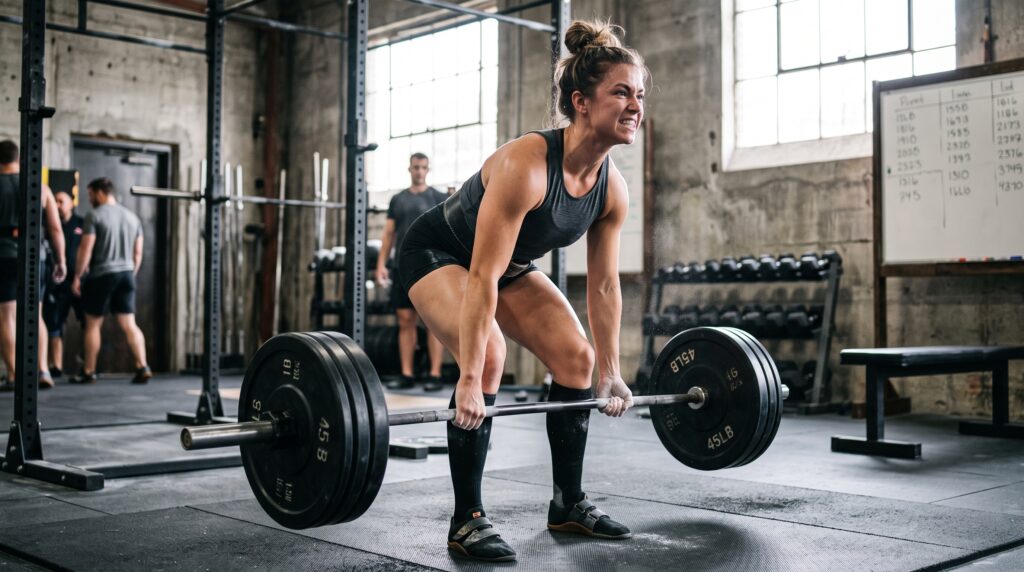
Pulling a bar off of the ground is a really fundamental process. It's what weightlifting is all about. It's the reaction between the loaded barbell, you and gravity. Gravity pulls in one direction: it pulls straight down. You're interacting with the floor with your feet. This means that the reaction between the weighted barbell and you is a function of your feet basically.
What Mark Rippetoe has determined over several thousand hours of thinking about this is that the barbell needs to be over the middle of your foot anytime it's moving as a result of you pushing on the bar. That's whether you're squatting, deadlifting, power cleaning or whatever. That's a little more complicated if we're bench pressing. But today we're just going to talk about the deadlift and squats and things like that where you're standing on the ground and you're interacting with the barbell loaded, either in your hands or on your back. We're going to discuss the importance of aligning and moving the barbell-lifter system vertically over midfoot.
It's a very simple relationship. It's a vertical line right over the middle of your foot. And if your form deviates from that, then you're not pulling efficiently. If you're going to pull efficiently, the barbell has to track vertically over the middle of your foot. The middle of your foot ends up being about an inch in front of your vertical shin. If you stand with your shins vertical behind the bar, when you reach down to pull the bar off the ground, your shin is going to incline a little bit to the point where the barbell in contact with your shin is about an inch in front of the vertical position. If it's there, it'll be right over the middle of your foot. This is fundamental. If you've got the bar way out in front of you, what's going to have to happen if you try to pull it from there is, the bar is going to have to roll back a little bit before you can even get it off the ground, and then it will go up in a curved bar path off the floor. This is inefficient. You're using up juice that should be more efficiently transmitted into the bar if the thing is right over the middle of your foot. So, this is what you keep in mind. This is the basic structure of a pull. Whether it's a deadlift, a clean or a snatch, it's the basic structure of a pull if the pull is going to be efficient.
The deadlift is not a complicated movement. All of the features of this pull are dictated by physics, by your physical relationship to a loaded barbell. The bar needs to travel at a vertical line right over the middle of the foot. And you ought to be able to figure out why that should be. There's less total force has to be applied to the system if everything is in balance over the middle of the foot. At the top, you shrug the shoulders back. Lift the chest up to create a firm spine from the back of your head all the way down to your pelvis. The low back stays in rigid extension for the whole pull. When the weight gets real heavy, this becomes a problem. That's why we use the deadlift as a low back strengthening exercise because it requires a stronger set of spinal erectors to hold the weight in that position. And then, once everything is in balance, you push down with your feet. Don't think about pulling the bar up. Think about pushing down with your feet. A more efficient pull will take place if you think about it like that.
That's really all there is to the deadlift. It doesn't need to be complicated. So this is all explained in the blue book. Read it and then read this post again and see what you can do to improve your deadlift by making it a more efficient pull.
* If you're not familiar with the 5 steps to follow in the Starting Strength methodology for performing a deadlift, click here. You'll find the information in the section for this lift in that article.
"The deadlift also serves as a way to train the mind to do things that are hard."
Mark Rippetoe
Bibliographic references:
- Starting Strength. (2026). The Mechanically Correct Pull [Video file]. YouTube. https://youtu.be/3vwIFQ5OAuY?si=JQ-Kixp8T1MQBGkL
- Rippetoe M. (2011). Starting Strength: Basic Barbell Training, 3rd Edition. The Aasgaard Company.
Discover more from Atleta Explosivo
Did you enjoy this content? Subscribe and receive the lastest posts about physical preparation and training in your email.