Kinesiology

Weight training, Biomechanics, Kinesiology

HOW TO PROPERLY BREATH WITH A LIFTING BELT

Today I’m going to explain about something a little more basic, but very important. I´m going to take you through basic anatomy and mechanics of a proper breath with a belt. When we aren’t thinking about it, we normally take breaths properly. If you’re like going to dive underwater or something, you’re going to get a big belly breath. You’re going to expand your diaphragm and get as much air in you as possible. But anytime you tell someone to take a big breath, they normally do it incorrectly. They take a big chest breath. They kind of suck their belly in and take a big shallow breath and they get their chest real big. That’s not what we want to do when we are doing a Valsalva maneuver to lift heavy weights.

Track and field, Exercise physiology, Kinesiology, Physical preparation

HOW TO RECOVER AFTER SPRINTING WORKOUTS AND STAY INJURY FREE

Learn cool down drills that will improve sprinting technique, speed up recovery and help prevent injuries. A good post workout routine that includes specific cool down drills is a critical component of sprint training. Unfortunately, it’s also one of the most overlooked areas when it comes to speed training and most track and field events in general.

Track and field, Biomechanics, Kinesiology

COMMON ERRORS SPRINTERS MAKE AND HOW TO AVOID THEM

Learn some of the most common errors athletes make with sprinting technique and how to avoid them. In this post I ´ll share with you coach the errors coach Karim Abdel Wahab has seen athletes make throughout his time working with elite sprinters as well as football players preparing for the NFL draft combine.
Starting with the the most common mistake, which is staying too low out of the blocks or at the beginning of the sprint, you’ll learn why staying low dramatically reduces the ability to produce force down to the ground and results in slower speed. Coach Karim provides an effective cue to help solve this issue.
Another common error is breaking at the waist. This breakdown in technique also inhibits speed and will result in slower times and can potentially lead to injuries. Learn how to spot a “fake lean” and some tips on optimal sprinting biomechanics.
Finally, there area two Athlete Insight sections in which Olympians Jeremy Dodson and Janay DeLoach discuss about the biggest myths and worst advice they heard in high school and why you should avoid them if you want to reach your potential.

Track and field, Biomechanics, Kinesiology

HOW TO SPRINT FASTER WITH PROPER GROUND CONTACT AND FORCE APPLICATION

Learn how to sprint faster with proper ground contact and force application. One of the biggest misconceptions out there is how the foot strikes the ground (it’s not on the toe and not on the heel). This post covers where the foot strikes the ground and why that is important for force application and speed development. In order to take advantage of the “stretch reflex” and really utilize the muscles of the lower leg, it’s important to ingrain into the nervous system how to properly land with each stride. This post teaches the fundamentals of correct ground contact throughout the entire sprint. Athlete Insight sections cover force production and how striking down and back is different than “stomping” your way down the track.

Track and field, Biomechanics, Kinesiology, Physical preparation

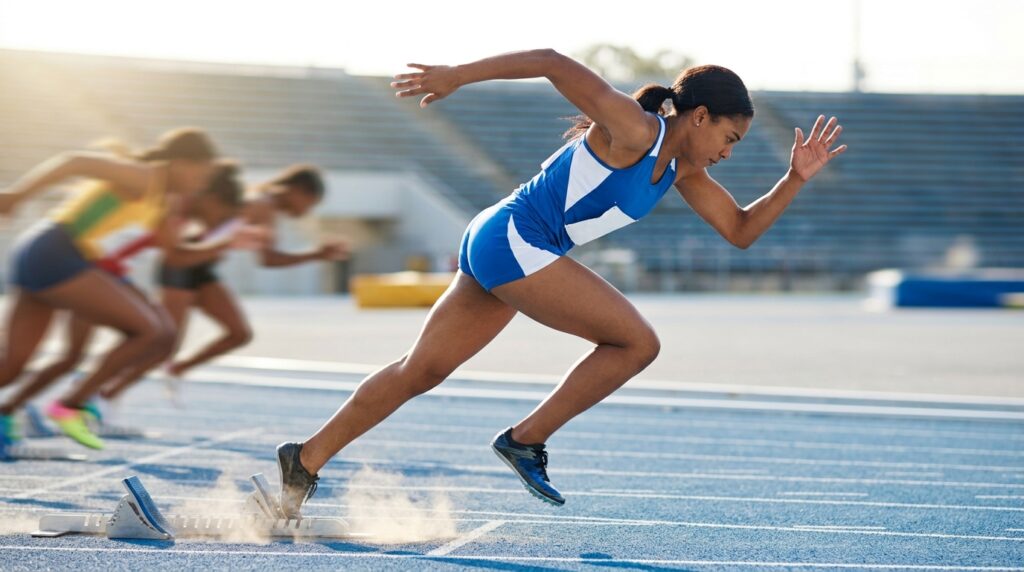
HOW TO DO FASTER STARTS AND IMPROVE YOUR REACTION TIME

Learn how to sprint faster by improving your start. This post contains some of the key technical aspects of acceleration out of the blocks including posture, force application, and arm movement during the first phase of sprint. I´ll share with you several drills that improve reaction time that coach Karim Abdel Wahab uses prior to having athletes get into the blocks. Finally, you´ll find out Olympian Jeremy Dodson´s opinion about how video games help to improve reaction time, his mindset at the line and first 3 steps out of the blocks. He also shares some tips that have helped him perform at a peak level.

Track and field, Biomechanics, Kinesiology

SPRINT FASTER WITH A PROPER FOOT STRIKE

Learn how to sprint faster by maximizing ground contact and developing a proper foot strike. A common mistake many sprinters make is striking the ground on their toes resulting in massive ankle amortization and increased ground contact times. The goal of these drills is to get the athlete to develop a flat foot strike by overemphasizing landing flat on the heel. The result will be a flat foot strike during sprinting (landing on the forefoot or where the track spikes are).

Track and field, Biomechanics, Kinesiology

HOW TO MAXIMIZE YOUR BLOCK STARTS

Run faster with proper sprinting technique. In order to maximize speed at the start of the race, you need to learn how to properly perform block starts. When done correctly, blocks starts are the best platform to apply maximum force in order to overcome inertia. This post looks at how to properly work your way down from a 3 point start to achieving the hard post and triple extension out of the blocks.

Weight training, Biomechanics, Kinesiology

WHAT GRIP WIDTH SHOULD YOU USE IN THE BENCH PRESS?

The width of your grip on the bench press is a relatively important variable in the training effect you obtain from the exercise. A wide grip on a bench press is typically what is used in powerlifting meets because the wider grip in the bench press reduces the range of motion that the bar has to travel. It is thought that a shorter range of motion would enable you to bench more weight. And if you get used to doing it with a wide grip, that’s probably true. Most bench press records are set with a wide grip. In fact, the inside score mark on a bar is the widest permittable grip for the bench press. In other words, your index fingers have to be making contact with some part of that inside ring, and that’s the widest permittable grip.

Scroll to Top