In this post I provide you the Latif Thomas' step-by-step approach for teaching all the skills of acceleration and top speed running, including all of his best coaching cues and strategies.
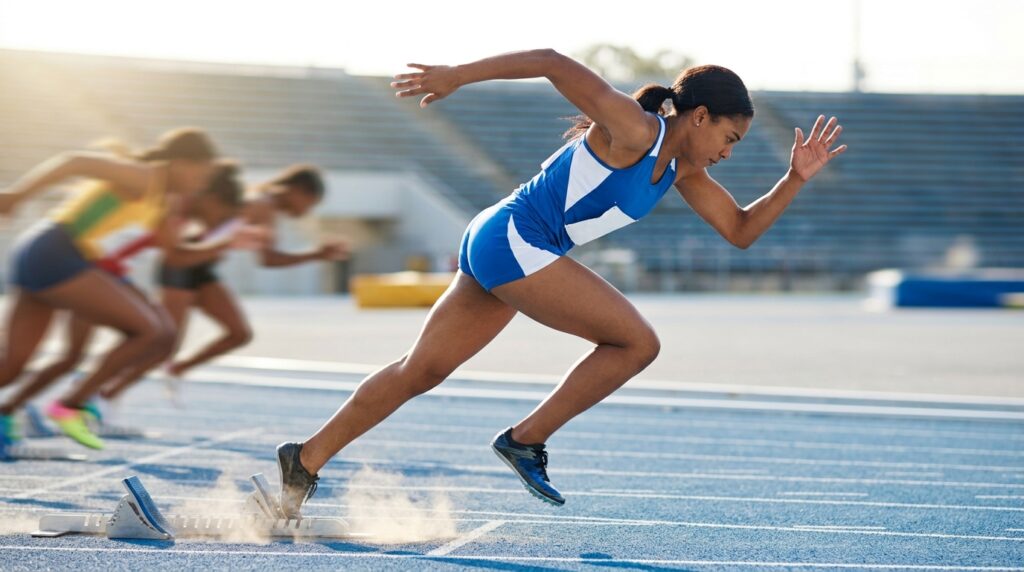
Technical feedback is crucial to the development of the sprinter. Without it, individuals don't know what to focus on during practice. As the athlete begins to rock forward, there are three specific things we need to see our sprinters do before their back leg or their quick side leg ever touches the ground.
- The first thing we want to see the athlete do is swing and drive the lead arm up. It's going to be the arm of the front leg.
- The second thing we want to see athletes do is get triple extension on the drive leg or the front leg, at the ankle, knee, and hip as the athlete toes off. The athlete is fully extended, so there's no bend in the knee, and there's no little bend at the waist.
- The third thing is that the athlete comes out at a 45° angle to the ground. So, if we were to draw a line from the back of their heel through their hip and the back of their head, that would be at a 45º angle. They should have a pretty good straight line through that angle.
3 things to see:
- Drive the lead (front leg side) arm up to the head.
- Achieve triple extension on the drive/ support leg before toe off.
- Drive out at a 45º angle to the ground.
It's critical that we have these three things in place for a number of reasons:
- Driving the lead arm up allows the athlete to get triple extension off their drive leg. If the athlete only flicks that front leg arm up, the back leg is going to hit the ground right away. They're not going to get good push off the ground or out of the blocks. The first step is going to come down quickly and they're not going to set themselves up for a good drive phase. So, it's critical that athlete drive that lead arm up, which helps athletes get that triple extension. So, the first thing that coach Latif Thomas begin queuing athletes when they just come out of an acceleration position is get that lead arm up. Getting the lead arm up allows the triple extension off the front leg. As that leg extends, that allows the free leg or the swing leg to get good clearance from the ground or from the blocks, and allows your sprinter to get a good big first step out of the blocks and maximize all the gains we've been trying to do in the weight room.
- We need to get triple extension in the power leg before the swing leg hits the ground. We've been spending all the time doing plyos and Olympic lifts in the weight room trying to get extension. We need to take advantage of that now as far as our practical application is concerned. So, these are the things we need to focus on right away. This is a lot easier said than done for a lot of your athletes.
- We have to cue our athletes to come out at the 45º angle because that sets your sprinters up for the optimal drive phase or optimal acceleration position. If the athlete comes out lower than 45º in that straight line from the ankle through the head, then they're going to fall forward. They're not going to be able to handle that. They're not strong enough. If they come out at an angle that's higher than 45º, they're just going to pop straight up from the athletic position. They're going to pop straight up out of the blocks. They're going to grind through the gears too quickly and reach a false top speed too early. So 45° as they come out is the optimal angle coming out of the blocks or out of your acceleration position.
If you want to set yourself up for the best possible start or acceleration, whether it's out of the blocks, in a workout, in a relay or whatever the case may be, this is the position athletes need to be in before the rear leg hits the ground.
Cueing your athlete to "drive the lead arm" helps them achieve triple extension on the support leg, setting up a better acceleration pattern.
Triple extension maximizes strength and power output, thus aiding in block clearance, relay zone exit..., allowing for a better acceleration pattern.
Driving out at a 45º angle ensures athletes don't fall forward during their start or pop straight up.
If we can get the athlete in that position as they begin their acceleration work, we can transition to the next phase of acceleration development. So, as they roll forward out of this position, we really have to cue the athlete once they get that lead arm up to drive the arms aggressively down and back behind them because the arms and legs work in concert with each other. The more aggressive the athlete is with the arms, the more force they're going to be able to apply to the ground. And so, simultaneously with the arms, the athlete also has to drive the feet hard down into the ground. You want to cue your athletes to pump their legs like pistons. We're not really stepping over, driving down so much in the acceleration portion. That's more of a top speed queue, but we want our feet to be more like pistons. We want to drive our feet down and back toward our hips. As the foot comes out in front of the hips and we come out, the feet come down and back, pushing the ground away behind ours. The foot is not landing out in front of our hips or coming straight down, but rather that foot is coming back. That's how we get force, overcome inertia, and get our body accelerating down the track.
Cue athletes to aggresively "drive the hands and elbows down and back" (not just back) to aid in acceleration.
Cue athletes to drive the legs down and back like pistons. Feet should land beneath or slightly behind the hips while accelerating. This action puts athletes in the best mechanical position to overcome inertia, apply maximal force to the ground and increase velocity.
The next thing we want to talk about with our athletes is to make sure that they toe off with the feet behind the hips. That comes back to driving the feet down and back as opposed to straight down during acceleration. What you want to cue your athletes to do is leave the foot on the ground behind them. Why? During acceleration, ground contact time (the amount of time the feet spend on the ground) should go from long to short, meaning they should spend more time on the ground earlier during acceleration and spend subsequently less time on the ground as the athlete picks up in velocity. Athletes often times do what Latif Thomas calls "spin their wheels": they're trying to get their turnover going quickly, trying to increase their stride frequency, and if anything, increase their stride length by taking bigger strides. What we want to do is have athletes drive the foot down into the ground and let the foot stay in the ground as long as possible in order to take advantage of the things that we're doing in the weight room in terms of plyos, squats and deadlifts, Olympic lifts...
Cue athletes to "leave your foot on the ground behind you". This ensures maximal force application and prevents a premature increase in stride frequency.
So, it's extremely important that your athletes drive the feet down into the ground and not focus on increasing stride frequency or turnover, or increasing stride length by taking bigger strides. Because remember, stride length (the amount of distance the hips travel in a stride) and stride frequency (the number of steps you take in a given period of time) are byproducts of force application. They are not things we train in and of themselves. We don't coach faster turnover. We don't coach longer strides. We coach force application which in turn creates faster turnover and creates naturally longer strides. So that's something that's very important that we keep in mind. That is a byproduct of force application, not training qualities that we focus on in and out themselves.
Improved stride length and frequency are byproducts of force application. They don't need to be individually addressed.
Bibliographic references:
- CompleteTrack. (2016). Acceleration Development [Video file]. YouTube. https://youtu.be/sdqItTUd7tc?si=0LSFB9xgrvZlRy9J
Discover more from Atleta Explosivo
Did you enjoy this content? Subscribe and receive the lastest posts about physical preparation and training in your email.