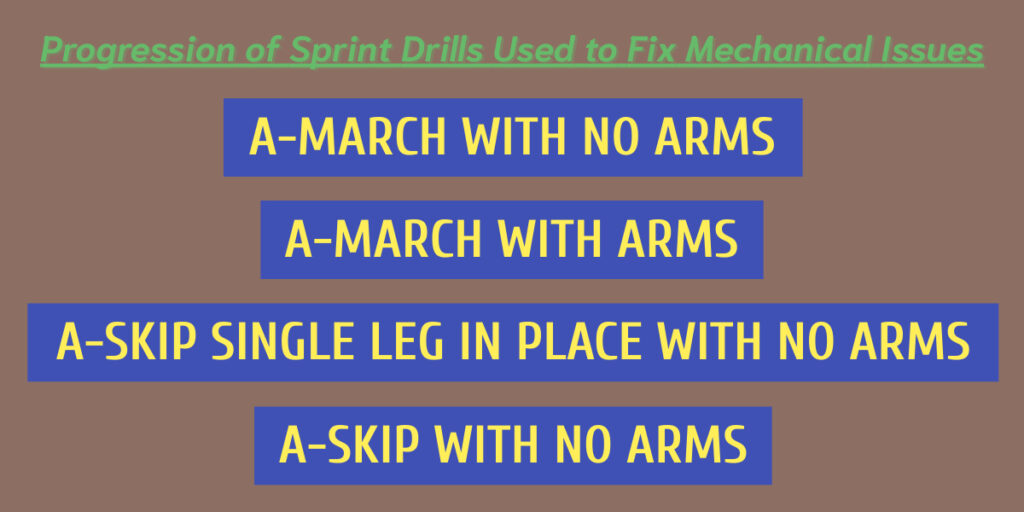
Track and field coach Latif Thomas likes to simplify teaching sprint drills to his athletes. In this post, we're going to discuss how he addresses the proper way to both teach and perform drills such as the "A-March", the "A-Skip" and the "Fast Leg". Remember that drills don't teach or fix full speed technique. They just reinforce proper ranges of motion.
A-MARCH WITH NO ARMS
The A-march with no arms is the first speed drill that coach Latif Thomas teaches. He wants to make sure that their athletes are not using the arms at first because it's going to involve too much of coordinative demand. So here all we're teaching and queuing athletes to start off by doing chin up, chest up, knee up, toe up, heel up, and focus on recovering the heel, stepping over the knee, and driving the foot backdown into the ground such that it lands underneath the hips.
What you're going to see from your athletes as they try to perform this drill, even with no arms, is that they will bring the leg straight up like a traditional high knee where the ankle is directly beneath the knee, as opposed to behind the knee and the ankle is out past the center of mass. This is going to cause them to reach and slap.
Another thing that you'll see athletes do is do a straight hamstring curl where that all that takes place be the heel and the foot is behind the body as opposed to recovering up underneath the hips. This of course is going to cause athletes to have too much backside mechanics. So, we want to slow it down nice and easy, so that athletes get used to the idea of recovering the heel.
Cue athletes to pretend like there's an egg where their hamstring and their butt meet and they want to crack the egg with the heel. Clear the support leg knee with their active leg ankle and heel. Step over, drive down, and get the foot back down underneath the hips with first foot strike being on the ball of the foot, not the heel. This is how Latif Thomas teaches the A-march. We've got to get athletes to be able to do it before they can begin to progress to the next level. Because if they cannot get this down, they cannot do any of the drills that come later, even though those drills are of course more fun than A-March with no arms.
A-MARCH WITH ARMS
Once you've decided athletes have met a sufficient level of proficiency with the A-March with no arms, then you can add the arms in. You're going to be very surprised at how poor your athletes are at doing this by just adding arm action into the mix. Coach Latif Thomas uses this as an opportunity to tell them how much improvement they can make once they can get it down because this is an introductory level drill and they're having a tough time doing it. So again, with our arms we want to cue the same things we queued in any arm action drill. Again clearing the hips in the back, cheek height in the front, making sure we don't doggy paddle the arms, palms stay in, but again the same degree of range of motion as we saw in the previous drill. Add this next element.
As athletes get proficient in terms of smoothness and repetition and symmetry, then you can have them focus on driving the feet down faster into the ground and it becomes a higher intensity march as opposed to just going smoothly because we want to teach our athletes to fire the glutes and be explosive. And so again, simple to complex. Start off nice and easy. Get the range of motion down, get the movement down, add the arm action in there, and then pick up the intensity before you move on to the running and skipping drills, that are the next level of the progression.
A-SKIP SINGLE LEG IN PLACE
Your athletes aren't going to be able to A-Skip correctly. This is just a fact. So, you have to break it down, like most things, into small pieces that they can manage. So, what we're doing here, and the way Latif Thomas starts is by having athletes simply do the A-Skip in place with no arms. This way we can simplify things and slow it down in ways they can understand. So coach Latif Thomas generally starts by having athletes on one leg at a time start the A-Skip process hopping upon the support leg, for example, the right foot hop up-hop down. So the cue is very simple: you're going to hop up on the right leg, bring the foot up and then hop again, so both feet land at the same time.
By isolating one leg at a time in place, hands on the hips, you will allow athletes to coordinate the movement a lot better, as opposed to trying to have them do too much where their brains just melt and they can't pull it off. So, start having your athletes do the A-Skip in place that you can have them all in one spot. You can do a large group at a time and begin to address the mechanical issues of recovering the heel up underneath the butt, stepping over the knee, the support leg knee with the active leg heel and bringing the foot back down to the ground, landing underneath the hips. Latif Thomas has found over the course of years that by breaking it down like this, starting with this particular drill is the easiest way, and athletes will very quickly see how much room for improvement they actually have.
Once your sprinters have gotten down the range of motion and the pattern and the rhythm for the A-Skip single leg with no arms in place, simply have them alternate legs because we want to have them do an equal number of repetitions with each leg. And then, we can simply go from alternating legs in place with no arms to having them do alternating with no arms moving forward, not covering a lot of ground, trying to get as many repetitions in a short period of time as possible.
A-SKIP WITH NO ARMS
Once your sprinters have the A-Skip down where they're in place, the next thing we're going to do is add a little bit of forward momentum. Again, we're still going no arms, but we're going to add that little bit of for momentum where athletes have to move forward. Again, you'll be surprised at how difficult it is for your sprinters to pull this movement off, even that little bit of extra, but it's a great transition into the more technical elements, certainly when we start to get to adding the arms and because your athletes are going to still have difficulties. The added coordinative demand can cause problems and we want to get these things down, and you want to make sure that you're queuing them. Of course, you have to be able to see these issues as the athletes do them. And so, we want to reign that in. But, of course, as you'll see, if you try to have your athletes use their arms, that adds so much more coordination. You wouldn't even believe how quickly kids will unravel. Coach Latif Thomas really likes to focus on keeping the range of motion with the legs going, really getting that down before we add that next element of arms into the mix. So, this is the next progression by adding a little bit of forward momentum to the drill.
Bibliographic references:
- CompleteTrack. (2016). Top 3 Sprint Drills Used to Fix Mechanical Issues [Video file]. YouTube. https://youtu.be/uqGytI20ggc?si=kQ62epmoDSZlJcdY
Discover more from Atleta Explosivo
Did you enjoy this content? Subscribe and receive the lastest posts about physical preparation and training in your email.