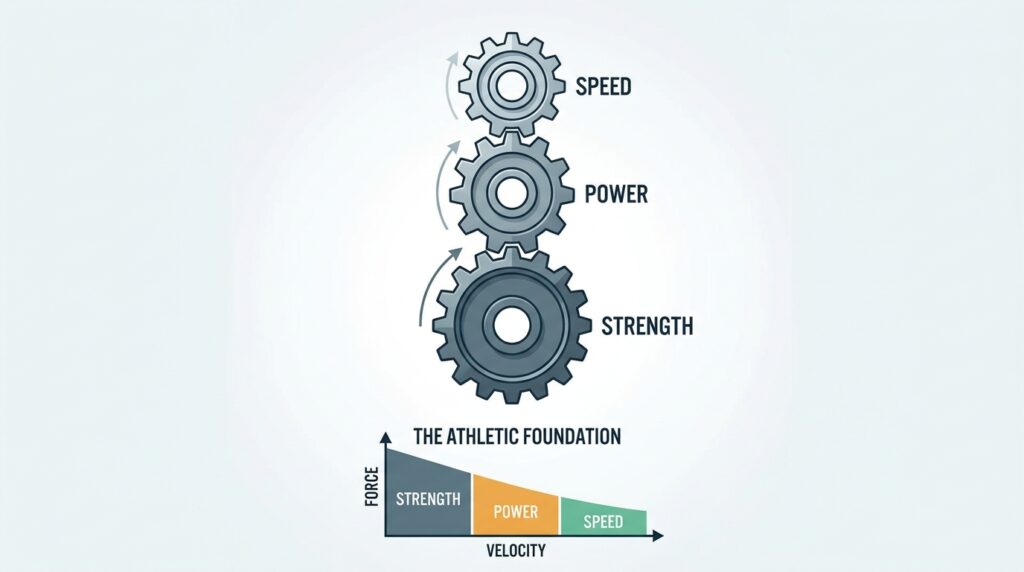
Key Goals of The General Preparation Phase
When track and field coach Boo Schexnayder talks about general prep and he asks people what's on their mind for general prep, the first thing that pops into people's mind is always "this is the time to get fit". He says absolutely not. He thinks that that is a very simplistic and a very generic approach to things. Keep in mind, you don't need an 8-hour webinar just to make athletes tired. Anybody can make people tired. It's not hard. So what we really need to do in good general prep phases is to have targeted responses. Decide exactly what it is we're trying to accomplish, and understand that even general prep is going to be specific to some point and to some extent in the way that we do things in a good training program. So let's take a look at what should be included in general prep.
First of all, let's analyze the term "intensity". Intensity, in short, refers to the difficulty of training. Difficulty of training, of course, can take many different forms. Difficulty of training, in most of our situations, can refer to the intensity level of the tension that we apply to muscle tissues and connective tissues. This is the case in sprinting, jumping and weight lifting. Intensity levels can also apply to the degree of distress that we apply to the energy systems in certain situations. But in any case, intensity levels are key. And ultimately, our ability to manage and reach intensity levels is going to dictate whether we succeed or whether we fail. It's probably the single most important and the single most vocal thing in our training.
Absolute Strength Development - Long Term Concerns
There can come a time when this type of work can be counterproductive. When coach Boo Schexnayder is dealing with athletes, their training age and their level of development has a lot to do with how he handles the absolute strength piece. For example, if you're young and undeveloped, and you come into his program, you're going to squat a little bit in the general prep, and you're going to squat real heavy in the specific prep in order to get strong. But things change for you once you have become strong.
When Boo Schexnayder was working with really high level jump athletes, most of them weigh like 180 lb or so. They can all deep squat about 400 lb. He noticed everything got better and better as they got stronger until they hit about to 400 pounds. Then, after that, it didn't seem like it helped anymore. So coach Boo Schexnayder had a dilemma on his hands. Should they try to increase the squat to 450 lb? And then, he started thinking: "Well. What's really important here is that I maintain balance. I have to keep the slow forms of strength balanced with the explosive forms of strength and with the jump forms of strength." So he's thinking if he increases this heavy, slow type of strength more, then he has to increase explosive strength and jump strength significantly as well to keep balance in this organism. You're already scratching the genetic ceiling there. So he thought it wasn't best. So the point he's getting at is that he feels that for every event, every sport, and every body type, there comes a time when you become strong enough as far as absolute strength is concerned. And to continue to progress absolute strength development beyond that point typically causes more harm than good. So basically, the way he trains his athletes has a lot to do with their training age. Most of the things presented here can be kind of generalized to lower training age people. And as we progress forward, some options and things that are a little different for higher training ages will be given.
So in short:
- If you're of a low training age and you're not strong enough yet, in your general preparation, you're going to do that absolute strength prep stuff that we mentioned. And then, when you get into specific prep, you're going to do the heavy absolute strength development and the absolute strength complementary stuff.
- If you're of a high training age, in general prep, you're not going to do much, if any, squatting at all. Then, in specific prep, you'll have to do just enough absolute strength development stuff until you're back where you were.
So young athletes might squat four months, while advanced athletes might squat four times or possibly even less. So that being said, it's very important to put that in the correct context as far as how we actually handle that squat component, how we handle the absolute strength or the maximal strength component. Coach Boo Schexnayder thinks that often we generalize things. The thing that really bothers him is that there's a lot of stuff out there about how terrible squats are and all these types of stuff. It's kind of some misinterpretations of stiffness and so forth. So we have a whole generation of athletes who come up and now we're not squatting them when they're real young. As a result of that, there are certain levels of endocrine development that they'll never achieve and, because of that, they're going to have a lower performance ceiling for the remainder of their athletic lives.
Intensity Concerns
Getting back to our idea of polarization of training, it's all about living at the extremes. Nothing ruins an athlete more than when you train them in season in middle zones. So staying out of the middle zones of training is what we're trying to do.
When we look at our neural training, we always want to ask ourselves the question #1: "Is it intense enough to help?" Keeping in mind that the competitions or games you're having are of extremely high intensity. So if they're a very high intensity, something that's not very intense is not going to help, it's not going to progress things, it's not going to help you to improve and it's not going to maintain. It's going to represent a reduction in training loads. Therefore, it's going to represent a potential reduction in fitness level. So it has to be intense enough to help.
The second question you ask is: "Is it easy to recover from?" The things that you do in the neural world that we consider home base (like acceleration development, light Olympics...), because of the lactate, actually have a restoration component. Those things are ridiculously easy to recover from, and they're a way of maintaining neuron stimulation.
So what we have here is we have things that are really intense and we have things that are on the lower intensity. We're on training at really high intensities or training at the low home base types of stuff. We're staying away from the middle ground. For example:
- If we're going to maybe look at our Olympic lifting program, this makes sense that we would Olympic lift at 90-95-100% at this particular time of the year. Of course, we're not going to do it if our athletes are beat up or subject to stressors, but at certain times, this would be a nice strategy and something we want to do.
- On the other hand, lifting at 60-65%, that's kind of your endocrine support restoration, and you can recover from that stuff really easy.
- But if you Olympic lift at 85%, that's the middle zone. It's not intense enough to carry over into the competitions and help you, but lifting at 85%, certainly not easy. So that makes it difficult to recover from.
So suddenly we have in our program, something that's not intense enough to help, but also difficult to recover from. And as a result of that, that's what we call "training baggage". That stuff that we're doing to make people tired and all it's doing is creating baggage, creating problems with absolutely no benefit whatsoever.
Speed and Power Periodization Summary
To wrap things up, this is a chart that illustrate what Boo Schexnayder personally likes to do with speed and power training throughout the course of a season or a year. Let's kind of review basically the choices for the different times of the year here with each key neural training component.
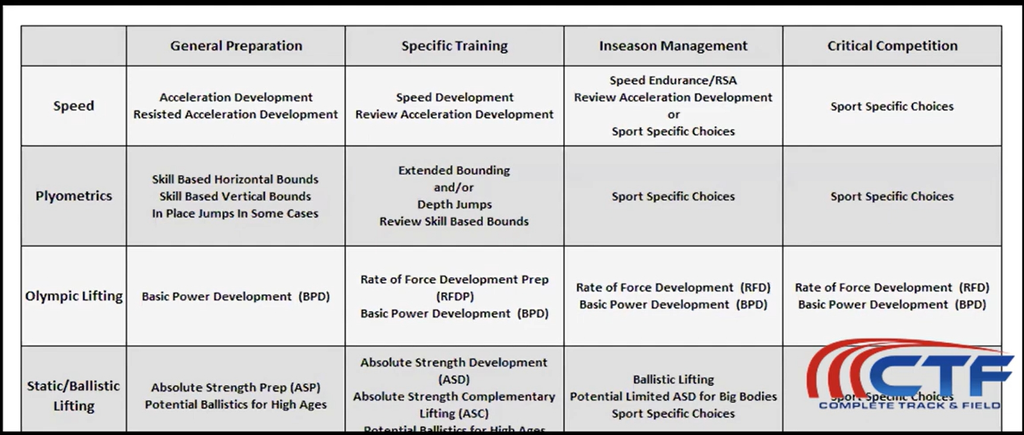
These are the four phases and the four different topics at the different times of the year. Regarding speed:
- In general preparation, basically all we're going to do is acceleration development, either resisted or on the flat. The reason why is potentiation or neural drive. What we're doing is we're trying to drive rate coding increases. The reason why acceleration development is because acceleration development is very safe because of the distances that are being sprinted there.
- Once we move a little deeper into the year and we get into our specific training phases, then we start to address speed development. Maximal velocity is hit in some type of construct. If you're a track and field athlete, you're doing really true sprint-float-sprint kind of stuff. If you're like a big person, then you're doing shorter sprints where you just touch max velocity. So it's done in an individualized way. That would represent the high-end of our polarized approach, while reviewing acceleration development would represent the low-end of our polarized approach.
- In-season management, this is where either speed endurance or repeated sprint ability (RSA) become what we do. They become the high-end of our polarized approach. Continuing to review acceleration development is the low-end of our polarized approach. But all sports don't necessarily need to do this stuff. It might be embedded in the sport or there might not be a need to do it at all. Throwers don't need to have speed endurance. Basketball centers don't need to do speed endurance. So what we do is we make sports specific choices. You, as a coach, have a unique understanding of the workings of your sport and your best qualifier to make those choices.
In the plyometric world, in general prep, there are three bases to hit: skill-based horizontal, skill-based vertical, and if you're a volume person, if you're in a big jumping sport, then we might use in-place jumps as a volumetric booster there. Then we move into more intense forms of jumping: extended bounds and depth jumps. Again, the sport demands will dictate whether you'll do extended bounds or depth jumps or possibly some combination of both. The depth jumping and the bounds represent the high-end of our polarized approach. The same stuff that we did in general prep, these horizontal and vertical skill-based bounds are the low-end of our polarized approach. And then, once we get in-season, in both phases we make sports specific choices.
In our Olympic lifting program, every session we do is a basic power development session. So, every session is in that 60-65% type of zone. In specific training and the next phases we add rate of force development too (90-100% type of zone).
Bibliographic references:
- CompleteTrack. (2020). How to Train for Speed, Power, & Strength with Boo Schexnayder [Video file]. YouTube. https://youtu.be/oqxGeXbSoKM
Discover more from Atleta Explosivo
Did you enjoy this content? Subscribe and receive the lastest posts about physical preparation and training in your email.