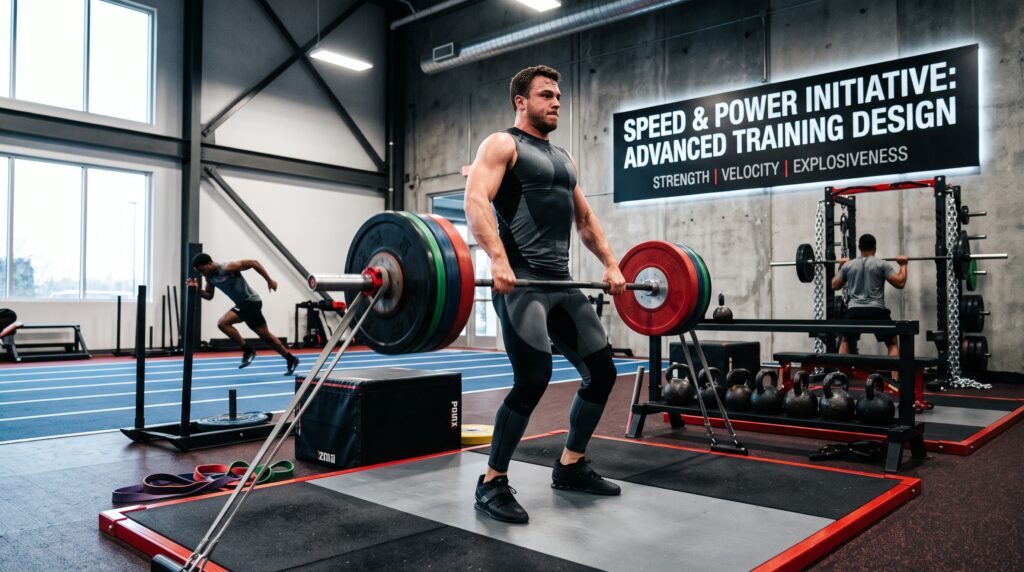
This is how world class sports performance coach Boo Schexnayder completely details the process of planning and writing weight training workouts for speed and power.
We can classify all weight training exercises into the following categories. This is important because each category of exercises serves a very different purpose in the program. Also, when we study the various weight training protocols available to us, they'll be classified in the same way.
- Purposeful training
- Each type of exercise plays a unique role in the program
Categories of weight training exercises:
- Olympic lifts
- Static lifts
- Ballistic lifts
- Regional lifts
Olympic Lifts
Olympic lifts are the competitive lifts, specifically the snatch, and clean and jerk. Also included in this group are exercises that are derivatives of partial movements or teaching progressions for these lifts. These might include work from various depths, pulls or dumbbell versions of traditional barbell Olympic lifts.
Olympic lifts help develop absolute strength, power, reactive strength and coordination. They're complex lifts, training many types of strength in the presence of a technically specific and demanding movement. This produces a very complex training stimulus and results in far better strength and skill acquisition. The high levels of power output and large amounts of muscle tissue recruited in these lifts may result in significant metabolic changes in addition to localized responses and adaptations.
The need for athletes to maintain high intensity and power output throughout each set implies the use of a low repetition and multiple set approach to training. Lower repetition numbers and significant rest intervals between the sets allow the athlete's power output to remain high throughout each set and throughout the entire session. Another huge advantage of Olympic lifts is that, aside from immediate short-term fatigue, they present no significant long or short-term negative training effects.
Olympic lifts:
- Develop multiple forms of strength and skill
- Absolute strength
- Power
- Reactive strength
- Use low numbers of repetitions and high numbers of sets
- No negative effects
Static Lifts
Static lifts are traditional weight lifting exercises that involve gross movements and major muscle groups. Relatively high loads are employed, necessitating low speeds of movement. Large ranges of motion are employed in most cases. You can't be fancy and heavy at the same time, so the high loads require simple movements. These exercises are typically but not exclusively bilateral, and most static lifts can be classified as squatting or pressing movements.
Static lifts are the primary tool for absolute strength development and enhance postural qualities and anchoring ability when technique and loading are appropriate. Large amounts of muscle tissue involved in static lifts may result in significant metabolic changes and adaptations in addition to localized responses. Hypertrophy (increase in muscle size) may be a desired or undesired result of high levels of static lift usage.
The intensity of these lifts implies the use of a low repetition and multiple set approach to training. Lower repetition numbers and significant rest intervals between the sets allow the athlete's power output to remain high throughout each set and throughout the entire session.
These static lifts do present some negative short-term effects, including decreased mobility, decreased elasticity, and discoordination. This means overuse of these lifts might make these short-term negatives semi-permanent. Unwanted hypertrophy might also result from extended use of these lifts as well.
While the use of these lifts presents tremendous advantages, these negatives mean that they should be programmed carefully and might be inappropriate in certain situations or at certain times of the year. When we look at long-term programming shortly, an important feature of our planning will be using these exercises because of their obvious benefits while limiting exposure to these lifts to prevent excessive accumulation of these negative side effects.
Static lifts:
- Develop absolute strength
- Use low numbers of repetitions and high numbers of sets
- Produce some short term negative effects:
- Decreased mobility
- Decreased elasticity
- Discoordination
Ballistic Lifts
Ballistic lifts are fast, repetitive, bouncy weighted exercises that involve gross movements and major muscle groups. These exercises display a high degree of involvement of reactive and elastic qualities. Most ballistic lifts take the form of loaded jumps or speed presses. These lifts enhance power, elastic strength and absolute strength, and greatly resemble the demands of competition in many speed and power sports and events. The intensity of these lifts combined with the need to express high power output during these lifts implies the use of a multiple-asset approach to training.
Because the exercises are performed fast, repetition schemes might be higher than in other forms of work without significant power output decreases. In short, because the exercises are fast, sometimes the sets just don't take very long. Aside from the immediate fatigue, ballistic lifts produce no negative effects. However, the ballistic nature of this work combined with the loads used, the impact, and the spinal loading involved does present some risk. Athletes should develop adequate levels of strength before undertaking this type of work.
Ballistic lifts:
- Develop multiple forms of strength specific to most speed/power sports
- Use high numbers of sets and low or high numbers of repetitions
- No negative effects, but do require preparation before introducing them
Regional Lifts
Regional lifts are exercises that employ smaller muscle groups addressing a particular region of the body. Because loads are usually lighter, these exercises may be simple or complex. In our discussion of static lifts, we discussed the fact that the movements have to be simple because of the high degrees of loading. In this case, because the loads are lighter, we can be more complicated in our movement patterns.
Regional lifting regimens often include sport-specific movements. A variety of regional lifts are usually bunched together into a session to address a variety of body parts and employ a variety of flexion, extension and rotational movements.
These lifts are typically used for two purposes:
- While these exercises are not the best strength builders, they do serve to supplement strength development.
- Secondly, and possibly more importantly, they are used to produce metabolic effects in the body.
Some exercises that aren't really weight lifting but have a mild gymnastic component can fit here as well. These metabolic goals are met better with high repetition formats. Most sessions will use many different exercises employing diversity of movement to get a complex training stimulus. For this reason, we normally see only one or two sets of each exercise, but we see high numbers of sets when we take into account the entire session. Besides immediate short-term fatigue, these lifts present no significant long or short-term negative effects except for the potential for some unwanted hypertrophy if mismanaged.
Sometimes the differences between static and regional lifts aren't clear. Some exercises, like dumbbell presses or gross single leg work, can fit into either category depending upon how they're used. Don't let these gray areas bother you. Sticking to the protocols and parameters will ensure you're using them correctly.
Regional lifts:
- Help develop strength, but are most valuable for metabolic purposes
- Use high numbers of repetitions and low numbers of sets (per exercise)
- Sessions usually contain many exercises
- No negative effects
Compatible Training Constructs
When training an athlete, we are continually trying to foster adaptations, and the key to achieving high levels of adaptation is sending very clear biochemical messages to the body's adaptive processes. The clarity of these messages is determined by, more than anything else, the way the different types of training are combined into sessions.
When training units that send similar messages are combined into a session, the program becomes more effective. For this reason, we should always plan training in a compatible fashion, meaning that we continually group training with similar messages into the same sessions. This means that the weight training session should address a compatible purpose with other elements of training done that day.
Compatible training constructs:
- Grouping training units with similar biomechanical messages into the same workout
- Separating training units with different biomechanical messages into different workouts
Bibliographic references:
- CompleteTrack. (2020). Advanced Weight Training Design for Speed & Power Sports [Video file]. YouTube. https://youtu.be/3vmaKpFqC7M
Discover more from Atleta Explosivo
Did you enjoy this content? Subscribe and receive the lastest posts about physical preparation and training in your email.