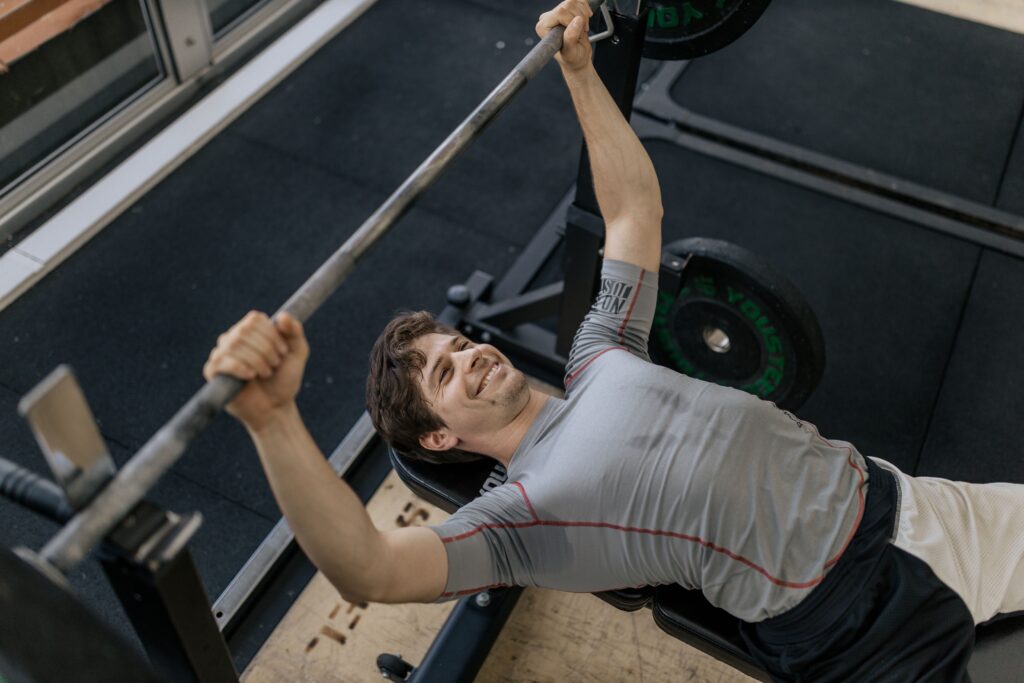
The bench press is everybody's favorite exercise in the gym. When you first start lifting weights, the first thing you do is bench press. The reason for that is because the perception about the bench press is that it makes you look better. The bench press is the most important thing for your appearance. This is not exactly true. One thing it does do is it makes things change very quickly. It makes your appearance of a muscular shoulders and chest happen very quickly. But the bench press is not as simple an exercise as you want it to be. The bench press is a movement that starts at the floor and ends at the bar. Even though you're laying on a bench, your lower body is involved in the bench press because of the brace that must occur between your shoulders pinned to the bench and your feet pinned to the floor. That stable bridge between the floor and your shoulders is the foundation of the movement pattern. You can't bench as much weight with your feet up on the bench, for example, as you can with your feet on the floor locked in place, setting tension against your spine, your hips and your knees. So, the bench press is a little bit more complicated than it looks like it is. So, today we're going to show you how to get in position on the bench, and what to do with your feet, your butt, your hips, your back, your legs and all the stuff that contributes to a big heavy bench press. We're going through the correct setup for the bench press according to Mark Rippetoe and Starting Strength methodology. Establishing a stable connection between the floor and your shoulders is essential for using your whole body and getting the best training effect.
Mark Rippetoe thinks the single best bench that's ever been designed for the bench press is manufactured by Mac Barbell in Arlington (Texas). He has several of them in Wichita Falls Athletic Club designed from back in the 80s. This is the best bench he's ever used. They're very useful. They have a wide padded board to lay on and the uprights are wide. They're at a slight angle. That angle facilitates you taking the bar out of the rack by yourself, lowering it, doing the set, locking the last rep out at the top, and slamming it back into the rack without any danger of you getting killed under the bar. These are good benches. If you can't find one, look carefully at this bench and try to have one made to your specifications.
When you're on the bench, you are going to start with the empty bar and you're going to take even jumps up to your sets of 5 reps work weight. Work sets on the bench press are 3 sets of 5 reps across same weight. The progression is next time you bench press, you're going to go up either 2.5 or 5 lbs depending on where you are in this progression. You have to go up every time a little or you're not making any progress. This is terribly important. It's also very important to not take jumps on the bench press or the press for that matter that are too big to accommodate your ability to make an adaptation between workouts. There's nothing to be obtained by getting stuck on the bench press. If you take a big glorious 5 pound jump and you can't finish all 3 sets of 5, as a result of that, then you've just wasted time. Don't waste time in the gym by picking the wrong jumps on any exercise, but especially the upper body movements like the press and the bench press. They will not tolerate large jumps. You can't take 5 pound jumps on the bench press. So, be careful about this. It's not necessary to try to show what a powerful man you are because you took a big jump on the bench. Mark Rippetoe's seen people try to take 10 pound jumps on the bench press and that doesn't work very long. That might work for a ranked novice who is not really sure where his strength is, but if you take 10 lb jumps, that will show you pretty quick where your strength is.
First of all, when you lay on the bench, your eyes ought to be just on the down side of the bar, as you're looking straight up. That's a good position on the bench.
The most important thing on the bench press is your grip position. The score marks in the knurl of a standard power bar are positioned in a way that this is 32 in. We always have you start with your ring finger on the 32 in score mark of the bar. That's the correct grip width for most guys. The smaller you are, that is to say, the narrower your shoulders, you may have to narrow the grip a little bit. But what this is going to do is produce a vertical forearm at the bottom of the range of motion of the movement. A vertical forearm is what we want. If it's too narrow, then the forearms are inclined inward, and that's unnecessary leverage against the elbow that shouldn't have to be dealt with. So, the grip is designed to produce a vertical forearm when the bar is in contact with the chest. If your dimensions are significantly different from normal, then you're going to have to sort that out and remember that for your grip.
It's important to understand that the heel of the palm is what interfaces with the bar because that is where the forearm bones interact with the wrist, the heel of the palm, both sides. Most people obtain that by kicking up their little finger just a little bit when they take the grip. Then you wrap the fingers tightly around the bar. One good cue is "leave your fingerprints in the knurl". And then, we're going to take the bar out of the rack. What you're going to do before you take it out of the rack is you're going to squeeze your shoulder blades together in the back. This lifts the chest a little bit.
Now think about your feet against the floor. Most people do best with vertical shins in this position because if your feet are too far out in front of you, you're going to have a tendency to bridge your ass up off of the bench. This is not a good habit to get in because it's although it may help elevate the bar, it's less work for the target muscle groups of the bench press. Feet against the floor. Feel your heels in contact with the floor. Now, tighten all the way from your heels up to your butt. And you're going to tighten your ass against the bench. If your chest is in the correct position with your shoulder blades adducted in the back, there should be an arch under your low back. There should be air under your low back, while everything between the heels and your shoulder blades against the bench is tight. Everything is tight. Once this position is obtained (once you're tight all the way from the floor to the shoulders), you're going to take the bar out of the rack and just push it straight up and pull it out in over your chest. Now, take a big breath. Touch the chest. Come back up. Sometimes it's useful to have your spotter touch you in the right place. Then touch the uprights and set the bar down on the hooks.
Sets of 5 reps on the bench press is what Mark Rippetoe uses. The only thing that happens on a long set (sets of 8, 10, 12...) is that your form deteriorates as you fatigue. Sets of 5 are the sweet spot on the bench press. Don't try to do more reps than that because what we're going to do is accumulate training volume with sets across. We're going to do 3 sets of 5 instead of one set of 15 because one set of 15 does not use enough weight for a strength training application. This is terribly important to understand. You can't lift high reps with heavy weights, and heavy weights are what makes you strong. It's possible to say: "Well, why don't we do triples? Do sets of 3 or sets of 2." You can do sets of 3 or sets of 2, but for guys just starting out, sets of 5 work best. Mark Rippetoe knows they work best because he's been doing this for 50 years. Sets of 5 work the best on the bench press, the squat, the deadlift, and the press as well. Most exercises work best with sets of 5.
As a spotter, you're back just to make sure the bar gets back in the rack. That's your job. You must step back out of the way after the lifter get the bar out of the rack because you want them to be able to look at the ceiling because the sight picture of them looking at the ceiling as the bar moves through the range of motion tells them where the bar goes at the top and where the bar is going to on the wayback down. It's important that the spotter doesn't interfere with the sight picture that is available to them as they push the bar back up off of their chest because they're going to put it in the same place in the sight picture every rep. Each rep concludes at the same place. If your head is in the way, it's going to interfere with their perception of that. So, the spotter:
- Makes sure they get the bar in the correct position over the chest.
- Steps back out of the way so that there's no interference between the spotter's head and the lifter's perception of the bar path as they watch it go from lockout back down to the chest.
Don't mistake my meaning. The lifter does not follow the bar with their eyes. They just see the picture that's available to them as the bar moves through the range of motion. They're not going to watch the bar down and up because that causes movement in the neck, and you're not firm against the bench if there's any movement in that side picture. You watch the bar as it goes through the range of motion. You don't follow it with your eyes. You just see it as it goes through there.
Your job as the coach in this scenario is to make sure that your lifter doesn't kill themself (which they're not going to do if they've done this before), and to observe things like the position of the bar against their chest where they make contact at the bottom. Make sure that their grip is correct. Make sure their elbows are doing the right thing during the course of this movement pattern. You don't participate in it at all. You hand the bar off to them and then you step back out of the way so that they've got a picture of the bar moving through the range of motion referenced to the ceiling. The ceiling is the reference for the bar path. This is terribly important. Their feet are braced against the floor. The brace comes up through the knees and back into the shoulders as they are glued to the bench. They're stapled down to the bench by the weight of the bar. That's not usually a problem, but they need to be adducted. You need to pinch your shoulder blades together at the back because this is the strongest interface between your upper body and the bench. That interface starts at the floor and it stops at the shoulder blades against the bench. And then, don't do anything weird with your elbows. They will without you thinking about them. They will usually go to the right place without any kind of babysitting.
This is the way Mark Rippetoe and Starting Strength coaches coach the bench press, and it's worked very well for a very long period of time. If you've got any questions, just post them under this article.
* If you don´t know how to do the bench press by the Starting Strength methodology, click here. You'll find the information in the section for this lift in that article.
Bibliographic references:
- Starting Strength. (2026). Proper Bench Setup [Video file]. YouTube. https://youtu.be/Ucm_qzsFkQo?si=hw6sVCStrX0mmKRE
- Rippetoe M. (2011). Starting Strength: Basic Barbell Training, 3rd Edition. The Aasgaard Company.
- Rippetoe M. (2014). Practical Programming for Strength Training, 3rd Edition. The Aasgaard Company.
Discover more from Atleta Explosivo
Did you enjoy this content? Subscribe and receive the lastest posts about physical preparation and training in your email.