
Tony Holler is a track and field coach and a football and basketball physical trainer. He works at Plainfield North High School. He is also a member of the Illinois Track & Field Hall of Fame and co-director of the Track Football Consortium with Chris Korfist. But above all, Tony Holler is known for being the author of the "Feed the Cats" training methodology. In this post you´ll learn the importance of training max velocity or top speed in football practice to achieve better performance during the game.
Most football coaches always say: "But football is never a straight-line sprint! Football is almost all acceleration! And game speed is only 12-18 mph, so why train at 23 mph?" Below you can read the answer (or rather, multiple answers) to this question:
- Faster athletes are better athletes.
- Getting faster is an alternative way to get "in shape". Game speeds become easier and the fastest athletes are fastest when fatigued (speed reserve).
- Max velocity speed is global, the tide that lifts all boats. Improved speed leads to improved everything (acceleration, strength, quickness, jumping, throwing, agility, and maybe even cognitive skills).
- Repeat sprints and mindless conditioning detrain speed. Tired is the enemy, not the goal.
- Max velocity represents the most extreme form of human movement. Nothing comes close. High speeds challenge the central nervous system (CNS), raising the ceiling of all movement. The floor is raised too.
- The brain is a protective mother whose job is survival, not performance. Sprinting teaches the brain that it's safe to "let it rip."
- Every coach can name their top athlete. The description always includes "FAST".
- Even though speed training must be the priority, it's not the majority. The time spent each week at peak velocity will be in less than 30 seconds (but it's the most important 30 seconds of the week!).
- Health. Sprint-Based Football coaches are amazed that kids who push boundaries of speed on a consistent basis are nearly bulletproof. Other factors include a foundation of rest, recovery, and sleep, shorter practices, never burning the steak, and reflexive-performance-reset (RPR).
- And don't forget the big cats (truck stick). Among the thirty 6'5" 320-pound offensive tackles invited to the NFL combine, the 4.9 guys get drafted in the first round; the 5.4 guys don't get drafted.
And, don't ever show your ignorance by saying things like: "Sometimes fast guys suck at football". No one has ever said that all you need is speed. Train it or detrain it.
Many football coaches also say: “You don’t lose because you aren’t fast enough. You lose because you can’t repeat it.” Some people want to believe that repeat sprint ability is more important than speed. They want to tell hundreds of Sprint-Based Football coaches they are wrong.
People who focus their off-season training on improving strength and endurance have never witnessed the results of prioritizing speed.
- They don’t understand “prioritize” doesn’t mean “at the exclusion of everything else.”
- They don’t understand that effective football practices prepare players for the rigors of the game.
- They don’t understand that consistently-trained fast & explosive athletes are fit.
- They don’t understand that faster athletes are healthier athletes.
- They don’t understand capacity can be grown patiently on a foundation of speed and explosiveness.
- They don’t understand that you can’t maintain a speed you can’t achieve.
"80% of all college football players never reach their ceiling of speed."
Boo Schexnayder
Coach Tony Holler wonders: "Why the NFL Combine doesn’t test 50 x 40?"
Sprint-Based Football is a low-dosage approach to coaching football that prioritizes:
- Speed over endurance.
- Winning over outworking your opponents.
- Performing instead of grinding in practice.
The result is that players love practice, coaches are reborn, and teams win.
Sprint-Based Football checklist:
- No traditional conditioning and no aerobic focus in off-season.
- Timed sprints twice a week.
- Short practices. (Don´t burn the steak).
- Perform in practice.
- Reflexive-performance-reset (RPR).
- Never blame losses on conditioning, effort or toughness.
- Gamify practice to make them meaningful, significant and joyful.
- Make sleep foundational.
"Feed the Cats" endless feedback loop:
- Coach makes practice the best part of a kid´s day.
- Athletes bring energy, enthusiasm and excitement to practice.
- Performance improves and team wins.
- Coach is inspired to become a better coach.
- Again, step #1 and the process is repeated.
Coach Tony Holler thinks speed and health are synonyms. If you are slow, you´re not healthy. If you´re faster, you´re healthier. So he says speed is a barometer of health. Tony Villani says speed is the priority, but not the majority. When you make speed the priority, we´re talking about 20 minutes twice a week if you´re efficient.
The old school pyramid is hard work, grinding, toughness and aerobic conditioning at the bottom. For coach Tony Holler is rest, recovery, sleep, nutrition and hydration. Then, the next level has nothing to do with any specific sport: sprint, lift, jump, bounce and throw. If he were training a golfer, those are the five things he would do with that golfer. If he were training a football player, same five. That´s why an athletic fitness and Physical Education would be such a coup for an athletic program.
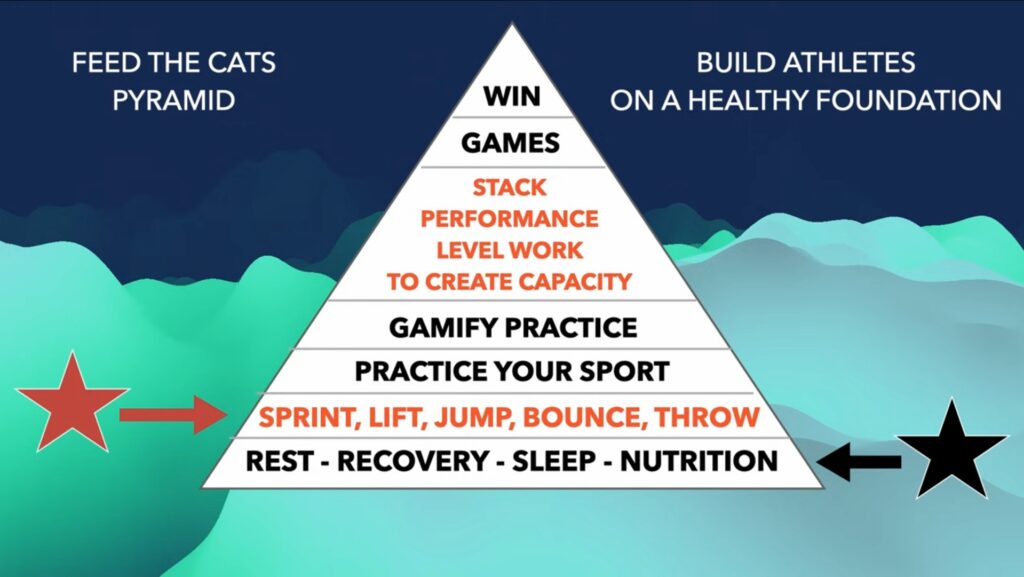
Injury prevention is performance optimization in disguise. When you are in the performance zone, you´re typically not getting hurt. Coaches must leave the undisciplined pursuit of more, and move closer to the disciplined pursuit of less.
The whole world adopted periodization as kind of like just holy scripture because the Soviets would have four years to develop an Olympic team. So, they buried them for a year or two with really hard work and creating huge capacity to work harder. Then, they would back off a little bit as the Olympics got there because, obviously, fresh healthy athletes are much better performing than athletes that are banged up. The problem comes when a team has a 12-week track season or a 12-week football season, and they bury their team for the first half of the season because of periodization. Coaches bury their kids in the fall and then back off some in the spring. Coach Tony Holler believes that you should never break kids with high volume because they will break and they´ll get hurt. He says never drift from a state of performance. When people ask him: "Do you ever taper?", he answers his team´s tapered every week. They want to perform in November, 8 weeks away from their track season. They never want to drift from a state of performance. By doing that, they stay really healthy too.
If you want to learn more about sprint based football, I recommend reading the article "Make Speed a Priority in Your Sport".

"If you are working on something that you really care about, you don´t have to be pushed. The vision pulls you."
Steve Jobs
"Extreme results never come from centrist thinking. Revolutions are never top-down, always bottom-up."
Tony Holler
"Speed (health) is the priority, but not the majority."
Tony Villani
"Sprint as fast as possible, as often as possible, staying as fresh as possible."
"Rest, recovery, sleep."
"Tired is the enemy, not the goal."
"Do less, achieve more."
"Never let today ruin tomorrow. Never burn the steak."
"You don´t plant beans and grow corn."
"Speed grows like a tree."
"Speed is the tide that lifts all boats."
"Speed is the best barometer of health.""An athlete faster than ever is healthier than ever, and vice versa."
Tony Holler
Bibliographic references:
- Coach Tony Holler [@coachtonyholler]. (2026). “But 🏈 is never a straight-line sprint!” “🏈 is almost all acceleration!” [Carousel]. Instagram. https://www.instagram.com/p/DU81ychkfOI/
- Coach Tony Holler [@coachtonyholler]. (2026). “You don’t lose because you aren’t fast enough. You lose because you can’t repeat it.” [Carousel]. Instagram. https://www.instagram.com/p/DVKTjtxDtsv/
- Holler T. [Coach Tony Holler]. (2026). The Sprint-Based Football Revolution Started Here [Video]. Recovered from https://youtu.be/tnmyA-EMjU4?si=p1gu3wzm_APQZdII
Discover more from Atleta Explosivo
Did you enjoy this content? Subscribe and receive the lastest posts about physical preparation and training in your email.