Weight training

Weight training, Physical preparation

HOW TO STRENGTHEN THE START OF THE PULL WITH HALTING DEADLIFTS

In the last post we talked about the rack pull. The rack pull and the halting deadlift are two very important assistance exercises for the full deadlift for more advanced lifters who are pulling heavy weights already. The advantage of using these two instead of just the deadlift is that at very very heavy weights the full deadlift becomes extremely difficult to recover from if you use enough volume to really ramp up the stress. So what we do is we break it into two parts. We do the the first half of it, really about the first 2/3 of it off the floor. We call that the halting deadlift. And then there´s the rack pull, which is the top 2/3 of it from below the knee. We’re going to talk about the halting deadlift today.

Weight training, Physical preparation

EVERYTHING YOU NEED TO KNOW ABOUT THE RACK PULL: WHY, WHEN, AND HOW

There are two primary assistance exercises for the deadlift. When we say assistance exercises in in this context, we’re talking about pieces of the full deadlift that have been pulled out of the deadlift and exercised separately. The first is the rack pull which is the top 2/3 of the pull, and the second is the halting deadlift which is the bottom 2/3 of the pull. We’ll deal with the halting deadlift in another post. Today we’re going to talk about the rack pull.

Weight training, Physical preparation

WHEN CAN YOU START DOING HALTING DEADLIFTS AND RACK PULLS IN YOUR STRENGTH TRAINING?

The Starting Strength method is famous for its utilization of just the basic barbell exercises: the squat, the press, the bench press, the deadlift and the power clean. But circumstances usually later in a person’s training history sometimes dictate that the deadlift becomes replaced with two other exercises that essentially cover that range of motion, but allow the use of heavier weights. Those two exercises are the rack pull, from below the knee, and the halting deadlift, which is pulled from the floor to just above the knee. So that combining these two movements results in an overlap of about 6 inches in the middle of the pull.

Weight training, Health, Injuries and rehabilitation, Physical preparation

HOW SHOULD YOU WARM UP FOR PULL UPS OR CHIN UPS?

Pull ups and chin ups are a strength exercise performed with one’s own body weight that should be included in any athlete’s strength training, regardless of whether they train for competitive purposes or to improve and maintain physical fitness. This fabulous self-loading exercise helps us strengthen our back, improve our body posture and develop general strength levels, especially in the upper body.

Weight training, Physical preparation

OVERHEAD PRESS vs BENCH, ¿WHICH ONE IS THE BEST?

Both the overhead press and the bench press are excellent lifts that should be part of our session to increase our basic strength levels, especially in the upper body. Ideally, they should be introduced in different sessions, as is done in the Starting Strength training methodology, so that overload does not occur and we can give our best in each of these exercises without accumulating fatigue. Because a large part of the muscles that intervene dynamically are the same in both movements with the Olympic bar. Therefore, when working with high weights, the performance of the overhead press would affect the bench press if we do it afterwards, or vice versa, due to the muscular fatigue that is generated, which means that doing both at a high intensity in the same session is too much work volume.

Weight training, Physical preparation

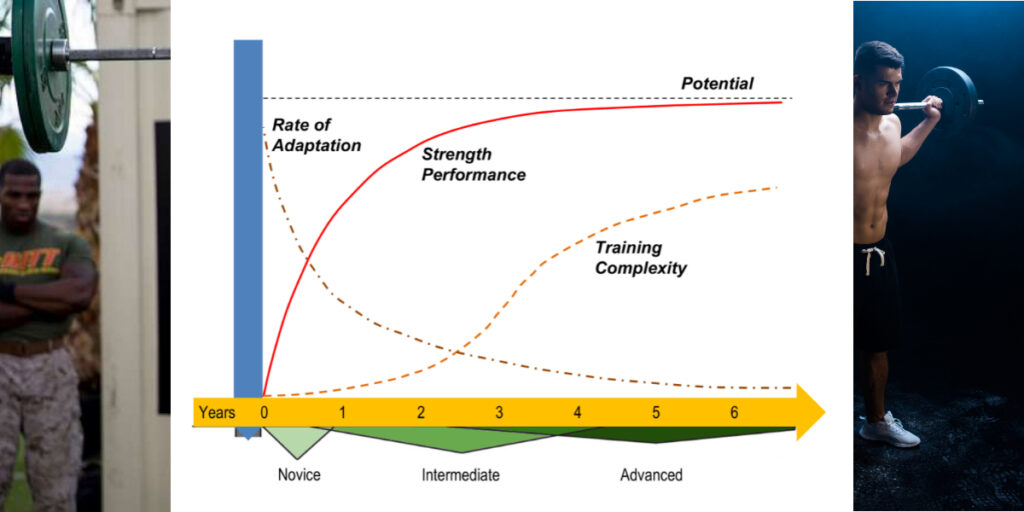
THE RELATIONSHIP BETWEEN IMPROVEMENT IN STRENGTH PERFORMANCE AND THE COMPLEXITY OF TRAINING OVER TIME

Strength training consists of following a program that increases an individual’s ability to produce muscular effort against resistance for the purpose of displacing it. This resistance is almost always external, like when we lift an Olympic bar, but it can also be internal resistance, like when we lift our body when performing a pull-up.

Weight training, Physical preparation

WHEN TO DO MULTI-JOINT EXERCISES AND SINGLE-JOINT EXERCISES?

One way we can classify strengthening exercises is into multi-joint and single-joint.

An exercise is considered multi-joint when several joints move during its execution, so that all muscle groups belonging to a kinetic chain are strengthened. In this way we can say that the entire body is strengthening at the same time since it intervenes as a single unit performing a natural movement. These exercises are characterized by their efficiency, since they save a lot of time by working the entire body at the same time. But they are also efficient because they can work on three qualities in a unique movement, and also in a functional way:

Scroll to Top