Exercise physiology

Track and field, Exercise physiology, Physical preparation

HOW SPEED TRAINING CAN IMPACT DISTANCE RUNNERS

According to coach Tony Holler, your body adapts to the specific stresses applied. For example:
If you properly train speed, your body will adapt to run faster.
If you properly train speed endurance, your body will adapt to run faster longer.
If you train long and slow, your body will adapt to run longer and slow.
Your body will only adapt to unaccustomed stimuli.
To improve your speed, you must train faster than your current maximum speed.
To run your race distance faster, you must train at paces faster than your current personal record (PR) in that event.
If you only train at paces at or slower than what you´ve already accomplished in your event, your body will not adapt to run faster.
Physical preparation, Exercise physiology

THE RELATIONSHIP BETWEEN LACTATE CONCENTRATION AND EXERCISE INTENSITY

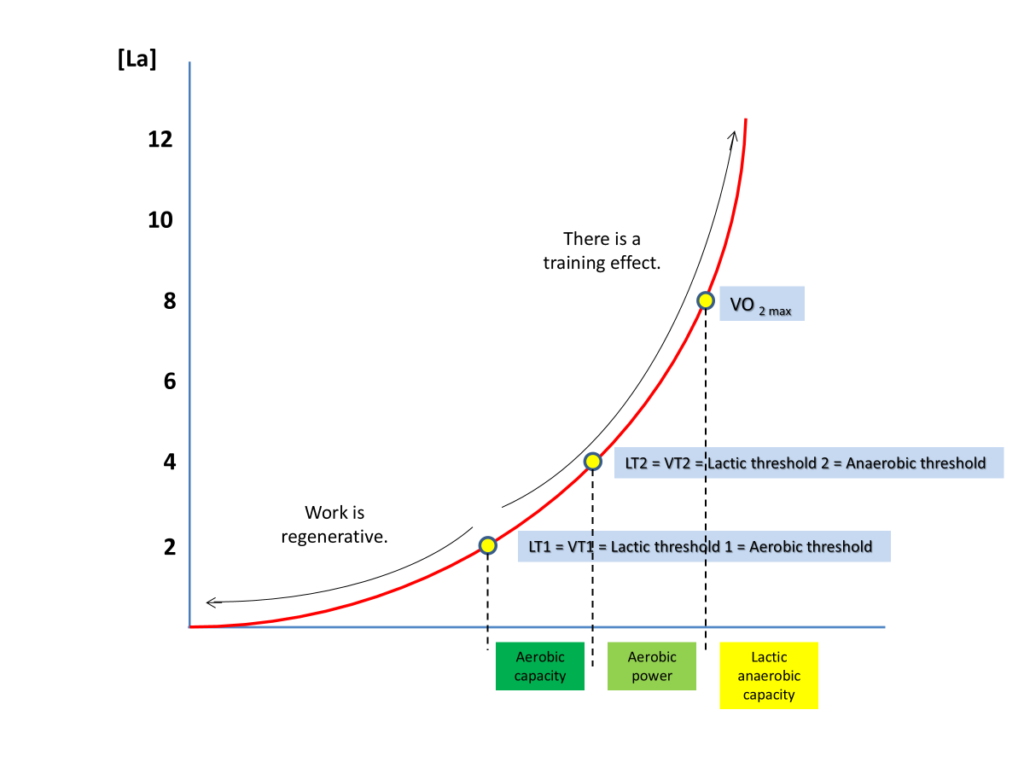
As we perform physical activity continuously over time (running, swimming, cycling, rowing, etc.), the blood lactate concentration will increase proportionally to the intensity of the effort made. But why is all this important?
Blood lactate levels correlate with blood hydrogen ion (H+) levels. Both are the result of the dissociation of lactic acid into lactate and hydrogen ion, therefore the same proportion of both elements exists. Lactic acid is a compound that is formed as a result of anaerobic glycolysis, that is, obtaining energy without the presence of oxygen.

Physical preparation, Exercise physiology

THE POWER OF POST-ACTIVATION POTENTIATION

Post-activation potentiation (PAP) is a phenomenon whereby an increase in muscle performance occurs after having performed a conditioning activity that elicits a maximum voluntary contraction, a tetanic contraction, or a series of nerve impulses. The physiological mechanisms that originate this phenomenon remain unknown at present. However, two possible hypotheses are considered:

Track and field, Exercise physiology

THE INSANE WAYS TRACK AND FIELD TRANSFORMS YOUR BODY

No other sport tests the extremes of human performance like track and field. The physical demands of each event are so confused and singular that athletes must push their body and training to the very limits of what is possible.

In the same arena you´ll see the pinnacle of human strength and power by a 320 lb behemoth while a wiry runner half his size test the limits of aerobic capacity. Just by looking at track and field athletes you can see how their event shapes their bodies. Obviously lifting heavy weights builds muscle and running hundreds of miles sheds body fat. But the really fascinating adaptations are less apparent. In the pursuit of faster-higher-farther the body transforms in some incredible ways.

Exercise physiology

PHYSIOLOGY OF SKELETAL MUSCLE (PART 4): TYPES OF MUSCLE CONTRACTION

Depending on the relationship that an individual establishes with external resistances, muscle activation can lead to three different contractions:

CONCENTRIC: With shortening of muscle fibers. Overcoming external resistance. The external force acts in the opposite direction to the movement.

ECCENTRIC: With lengthening of muscle fibers. Assignment to external resistance. The external force acts in the same direction as movement.

ISOMETRIC: The magnitude of muscle tension is equal to the force caused by external resistance, so the length of the muscle does not vary and there is no mechanical work. However, there are internal variations with respect to the state of rest: the only thing that remains the same is the angle at which the muscle tension is occurring, but the action of the muscle is to shorten fibers and stretch the connective tissue (tendon).

Exercise physiology

PHYSIOLOGY OF SKELETAL MUSCLE (PART 3): TYPES OF MUSCLE FIBERS

Skeletal muscle is a tissue capable of making a wide range of functional demands, from performing highly precise movements for which little force is required, to maximum contractions, to maintaining the body’s posture. This versatility is due, in part, to the existence of several types of muscle cells or fibers, which have different functional, metabolic and molecular characteristics.

Exercise physiology

PHYSIOLOGY OF SKELETAL MUSCLE (PART 2): MUSCLE CONTRACTION

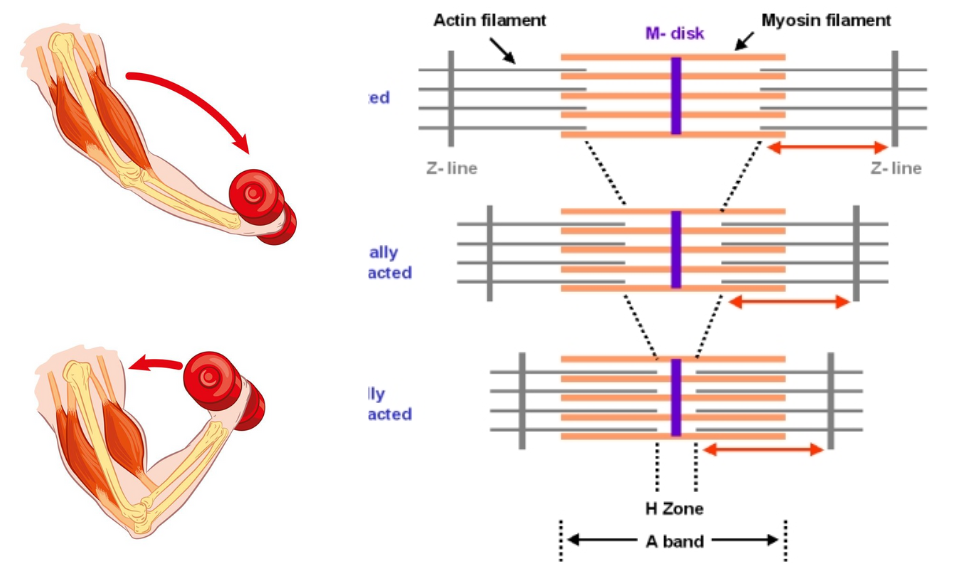
At rest, the thin and thick filaments of a sarcomere slightly overlap. During contraction, the thin and thick filaments slide past each other bringing the Z lines closer to the center of the sarcomere.

Contraction is stimulated when the muscle fiber innervating α motor neuron releases the neurotransmitter acetylcholine as a consequence of an action potential (electrical signal originating in the neuron). Thus, the action potential is transmitted along the muscle fiber, causing the following effects:

Exercise physiology

PHYSIOLOGY OF SKELETAL MUSCLE (PART 1): THE STRUCTURE OF SKELETAL MUSCLE

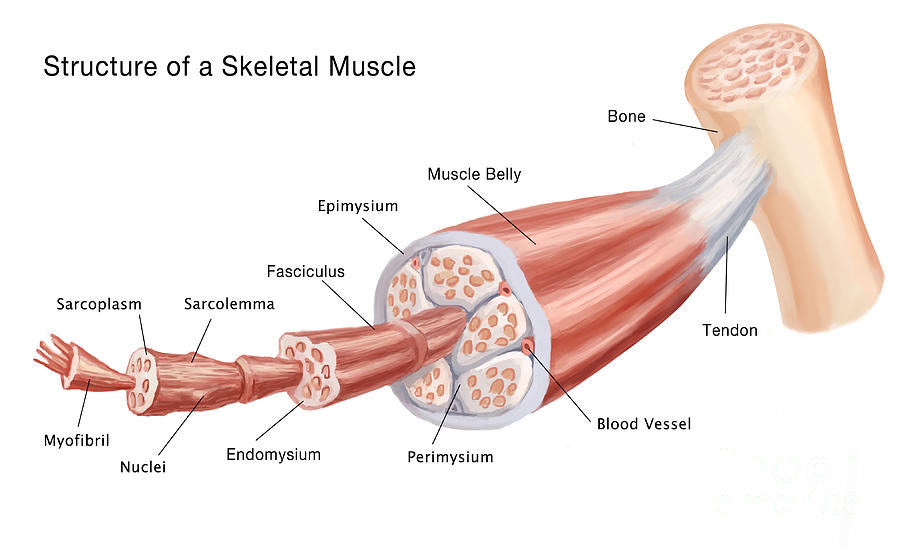
The human body contains approximately 650 muscles and the different sets of muscles are enveloped by a membrane of connective tissue called the fascia (e.g., thoracolumbar fascia).

The functional and structural unit of muscle tissue is the muscle fiber, differentiated muscle cell or myocyte. Each muscle fiber is surrounded by a fine network of reticular fibers (endomysium). In turn, the muscle fibers are grouped in bundles, among which we find connective tissue structures (perimysium) with collagen and elastic fibers, vessels and nerves. The entire muscle is in turn covered by a connective tissue sheath (epimysium), which continues with the connective tissue that surrounds the fiber bundles and tendons.

Track and field, Exercise physiology, Situational sports, Sports training

THE DIFFERENT PHASES OF THE 100 METER DASH RACE

The 100 meter dash race is the most popular event in track and field and to be successful in it, apart from having a very refined sprint technique and high levels of explosiveness, it is necessary to understand how the evolution of the race is throughout its course. All of this is conditioned because it is a trial whose predominant metabolic system is mainly alactic anaerobic.

Scroll to Top