Author name: Hugo Noya Enríquez

Exercise physiology

PHYSIOLOGY OF SKELETAL MUSCLE (PART 1): THE STRUCTURE OF SKELETAL MUSCLE

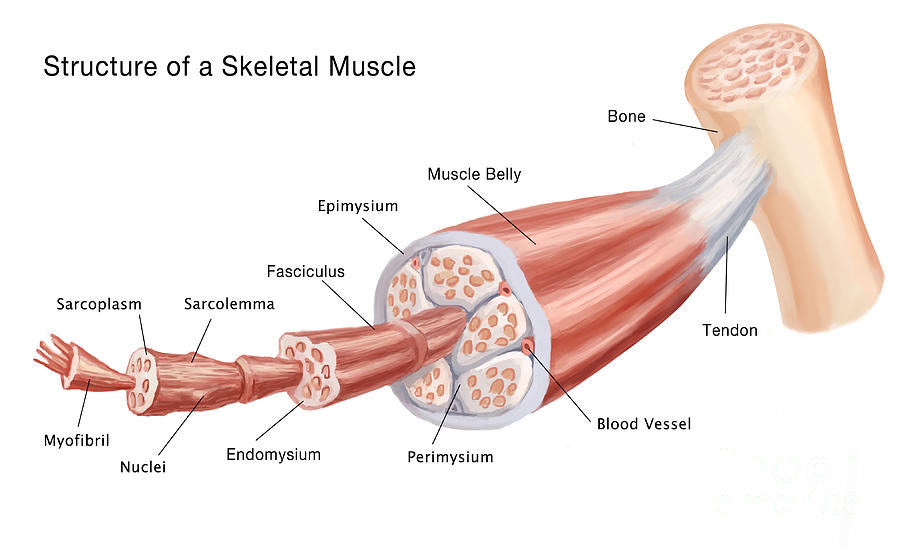
The human body contains approximately 650 muscles and the different sets of muscles are enveloped by a membrane of connective tissue called the fascia (e.g., thoracolumbar fascia).

The functional and structural unit of muscle tissue is the muscle fiber, differentiated muscle cell or myocyte. Each muscle fiber is surrounded by a fine network of reticular fibers (endomysium). In turn, the muscle fibers are grouped in bundles, among which we find connective tissue structures (perimysium) with collagen and elastic fibers, vessels and nerves. The entire muscle is in turn covered by a connective tissue sheath (epimysium), which continues with the connective tissue that surrounds the fiber bundles and tendons.
Weight training, Physical preparation

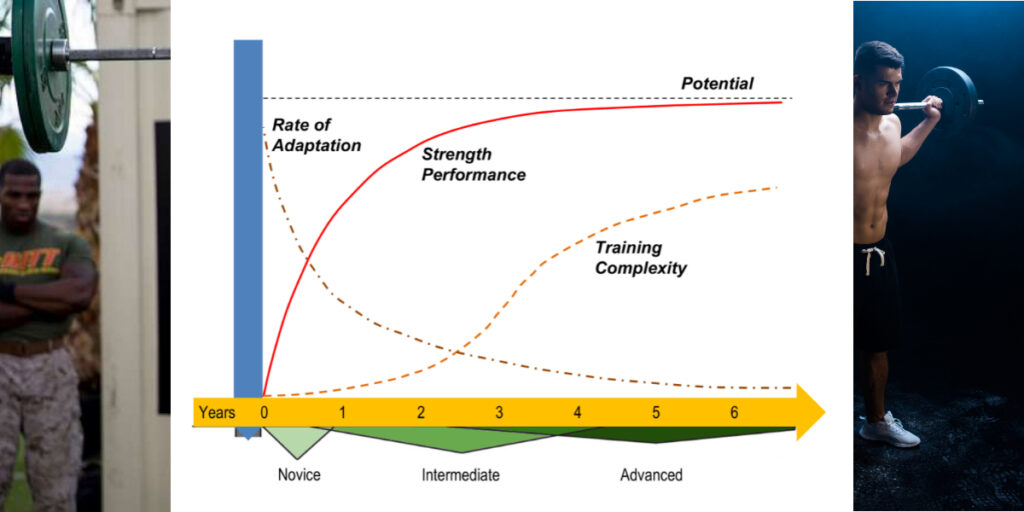
THE RELATIONSHIP BETWEEN IMPROVEMENT IN STRENGTH PERFORMANCE AND THE COMPLEXITY OF TRAINING OVER TIME

Strength training consists of following a program that increases an individual’s ability to produce muscular effort against resistance for the purpose of displacing it. This resistance is almost always external, like when we lift an Olympic bar, but it can also be internal resistance, like when we lift our body when performing a pull-up.

Track and field, Biomechanics, Kinesiology

TWO WAYS TO RUN SPEED DETERMINED BY YOUR MORPHOLOGY

In sprinting form makes function. What does this mean? It means that the sprint technique is highly dependent on the differences in muscular balance between agonist and antagonist muscles.

Kelly Baggett distinguishes in his book “No-Bull Speed ​​Development Manual” two types of runners based on the predominance of one muscle group or another, with its consequent implications in the biomechanics of sprinting.

Physical preparation, Martial arts

STRONG AND FLEXIBLE AT THE SAME TIME: IS IT REALLY POSSIBLE?

Surely you have heard phrases like this from the mouths of many sports coaches: “If you start lifting weights you will get stronger, but you will sacrifice your flexibility and joint mobility.” And vice versa: “If your goal is to gain a lot of flexibility you have to avoid lifting weights so that it doesn’t limit you.” These approaches that have always existed are not entirely wrong, but they are not 100% correct either. And it depends on how we do things.

Weight training, Physical preparation

WHEN TO DO MULTI-JOINT EXERCISES AND SINGLE-JOINT EXERCISES?

One way we can classify strengthening exercises is into multi-joint and single-joint.

An exercise is considered multi-joint when several joints move during its execution, so that all muscle groups belonging to a kinetic chain are strengthened. In this way we can say that the entire body is strengthening at the same time since it intervenes as a single unit performing a natural movement. These exercises are characterized by their efficiency, since they save a lot of time by working the entire body at the same time. But they are also efficient because they can work on three qualities in a unique movement, and also in a functional way:

Kinesiology, Health

THE IMPORTANCE OF THE POSTERIOR MUSCLE CHAIN

When performing a movement, the muscles of our body act in the form of kinetic chains. But what is a kinetic chain? We understand the kinetic chain as each part of the body (including muscles, joints and nerves), which is related together to produce a certain movement of the bones. There are several ways to classify kinetic chains and one of them is:

Track and field, Physical preparation, Situational sports

THE TWO TYPES OF SPRINTERS DEFINED BY KELLY BAGGETT

According to Kelly Baggett in his book “No-Bull Speed ​​Development Manual”, if we look at the way athletes sprint, especially at the amateur level, we can broadly differentiate two types of sprinters: athletes who are faster than strong and athletes who are stronger than fast. Below we are going to explain the differences of this classification:

Track and field, Exercise physiology, Situational sports, Sports training

THE DIFFERENT PHASES OF THE 100 METER DASH RACE

The 100 meter dash race is the most popular event in track and field and to be successful in it, apart from having a very refined sprint technique and high levels of explosiveness, it is necessary to understand how the evolution of the race is throughout its course. All of this is conditioned because it is a trial whose predominant metabolic system is mainly alactic anaerobic.

Scroll to Top