Track and field

Track and field, Biomechanics, Kinesiology

WHY IS STRIDE LENGTH SUCH A BIG DEAL IN SPRINTING?

Stride length significantly impacts sprinting speed. However, there is a right way and a wrong way to increase your stride length. The world’s fastest athletes distinguish themselves by having longer strides compared to their slower counterparts. But it’s not because they actively try to lengthen each stride. It all comes down to force production. In this post, you’ll gain insights into how top-tier sprinters achieve their impressive stride length. You’ll also learn what not to do – avoid extending your stride by casting your foot outward or over-striding. Additionally, we’ll cover essential measurements that enable you to determine your optimal stride length based on specific measurements of your leg length.

Track and field, Biomechanics, Kinesiology

TOP 3 SPRINTING TECHNIQUE DRILLS: THE SIMPLEST WAY TO RUN FASTER

Unlock the secret to sprinting faster with a no-frills approach in this quick guide. Ditch the overwhelm of endless tips and discover how to implement the most effective sprinting drills into your routine effortlessly. Whether you’re a seasoned sprinter or a coach looking to enhance your athletes’ speed, this post simplifies speed improvement, focusing on what truly works. Dive in to transform your sprinting technique with simplicity and precision. Ready, set, sprint smarter!

Track and field, Psychology

THE BIGGEST MISTAKE AMATEUR SPRINTERS MAKE

If you want to maximize your sprinting technique you have to be fluid. In this post you’ll learn how to be aggressive while staying relaxed, how to maintain proper sprinting form during maximal efforts and why tension in the face and body can rob you of speed.
Olympic coach Harnden provides actionable tips to help sprinters stay relaxed and ensure that they maximizing force production without sacrificing technique. Tension in the face and chin position cascade throughout the body and have a huge impact on sprinting form. Great races and PR’s share 1 thing in common: they feel easy. It may seem counterintuitive but “trying hard” can actually slow you down.

Track and field, Biomechanics

DO YOU HAVE THE RIGHT LEG LENGTH TO SPRINT FAST?

Do you have the right leg to height ratio to be a fast sprinter? It´s simple. Longer legs are unfair advantage because they cover more ground with each stride. But there´s just one problem: long legs don´t make you faster.
Scientists studied elite sprinters and found absolutely zero connection between leg length or leg to height ratio and speed. Now, maybe what you´re thinking: “Didn´t Usain Bolt prove longer legs are the advantage?” Well, here´s the thing: longer legs can cover more ground per stride. But you pay a triple penalty for that extra length:

Track and field, Physical preparation, Situational sports

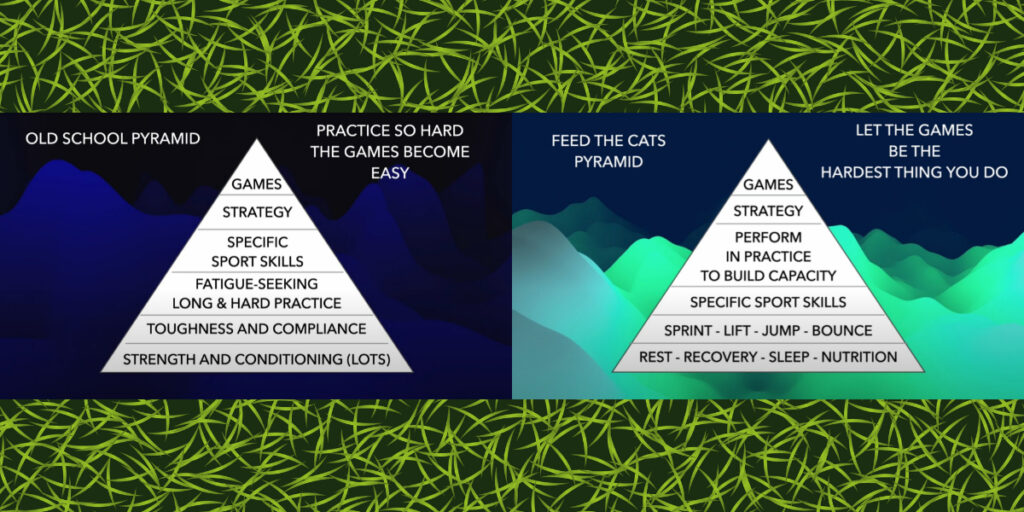
OLD SCHOOL PYRAMID vs “FEED THE CATS” PYRAMID

Just as there is Maslow’s pyramid and the food pyramid, coach Tony Holler has developed his own pyramid aimed at performance in situational sports. Tony Holler is a track and field coach and a football and basketball physical trainer. He works at Plainfield North High School. He is also a member of the Illinois Track & Field Hall of Fame and co-director of the Track Football Consortium with Chris Korfist. But above all, Tony Holler is known for being the author of the “Feed the Cats” training methodology.

Track and field, Biomechanics

SPRINT FASTER WITH THIS PROVEN TECHNIQUE

If you want to run faster, mastering the start is non-negotiable. In this post, we uncover the crucial techniques of pushing with the front leg and pulling with the back leg to achieve triple extension, a quick first step and optimal separation right from the get-go. This foundational strategy is key to unleashing explosive power and efficiency during your sprint’s initial phase. It also applies to everything from 2 point starts all the way down to block starts.

Track and field, Physical preparation, Situational sports, Sports training

MAKE SPEED A PRIORITY IN YOUR SPORT

Tony Holler is a track and field coach and a football and basketball physical trainer. He works at Plainfield North High School. He is also a member of the Illinois Track & Field Hall of Fame and co-director of the Track Football Consortium with Chris Korfist. Tony Holler is the author of the “Feed the Cats” training method. In this post, you’ll learn how to make speed the priority number one in your program.

Track and field, Basketball, Exercise physiology, Kinesiology

CAN SPRINTING HELP YOU DUNK?

Dunking a basketball is one of the most captivating things you can do as an athlete, especially if you’re under 6 feet tall. Anyone who’s ever played basketball has likely fantasized at least once about what it would be like to dunk during a game. The only problem is less than 1% of people in the world can probably dunk. In this post we’re gonna dive into the science to understand if sprinting can help you dunk.

Track and field, Exercise physiology, Kinesiology

HOW MUCH FAST TWITCH FIBERS DO ELITE SPRINTERS HAVE?

We can look at muscle fibers as being on a spectrum with slow twitch on one side and fast twitch on the other side.
Type 1, which are slow twitch, uses oxygen to create energy. The upside is they can work for a longer period of time before fatiguing. The downside is they contract the slowest. When a muscle contracts, these are the first fibers to be recruited. Then, as intensity increases, the fast twitch fibers are then recruited as well.
Type 2A, which are fast twitch, uses both stored energy and new energy created with oxygen just like type 1. The difference is, since they use stored energy, they can contract faster than type 1. They can work for a short period of time before fatiguing.
Type 2X, which are the fastest muscle fibers in humans, uses stored energy only. This allows it to contract the fastest, but it also means it fatigues the fastest. The thing is these fibers are rarely present in the average human. In a study with sprinters they found only 1 out of 1.000 muscle fibers they examined were pure type 2X.

Scroll to Top