
What do you do when injuries and structural changes make it so that holding the bar in the squat is limiting? In this post I´ll show a couple options that Rusty and Carmen, both coaches at the Wichita Falls Athletic Club, use so that their clients can still train the squat. Coaches Rusty and Carmen are always dealing, especially in the morning, with a bunch of retirees and they come with different types of issues that both have to overcome to get people to squat.
Coach Rusty, for instance, has a client who within the last three years he was able to get in a low bar position. He has had some bony changes in his neck and his shoulders that now prevent him to, and they were kind of coming on pretty quick and Rusty couldn’t figure out what was going on. One of the Starting Strength coaches who’s a doctor looked at him and figured out what the problem was, concluding that getting into a low power position just isn’t in the cards anymore. So coach Rusty had to figure out ways to get around that.
What coach Rusty does with this client is the following variation using some equipment to get him to be able to squat properly. They’re aluminum handles and what they allow him to do is to get his hands forward of the bar because he can’t get them behind the bar. He’s still able to maintain a low bar position. As long as he holds his hands in this position and kind of push into the bar or push into the handles a little bit, the bar won’t roll. If you do have something similar to these, the big thing is when ever the bar is on your back and your hands are into them, you can’t lift up or you can’t pull down because they’re going to rotate the bar on your back. Coach Rusty´s client has been working with this piece of equipment for about two years. So, he knows how to maintain that position. You still have to squeeze your shoulder blades together. Make sure you get your knees out. Everything is the same aside from your hands are now positioned further forward of the bar. That’s how this equipment works.
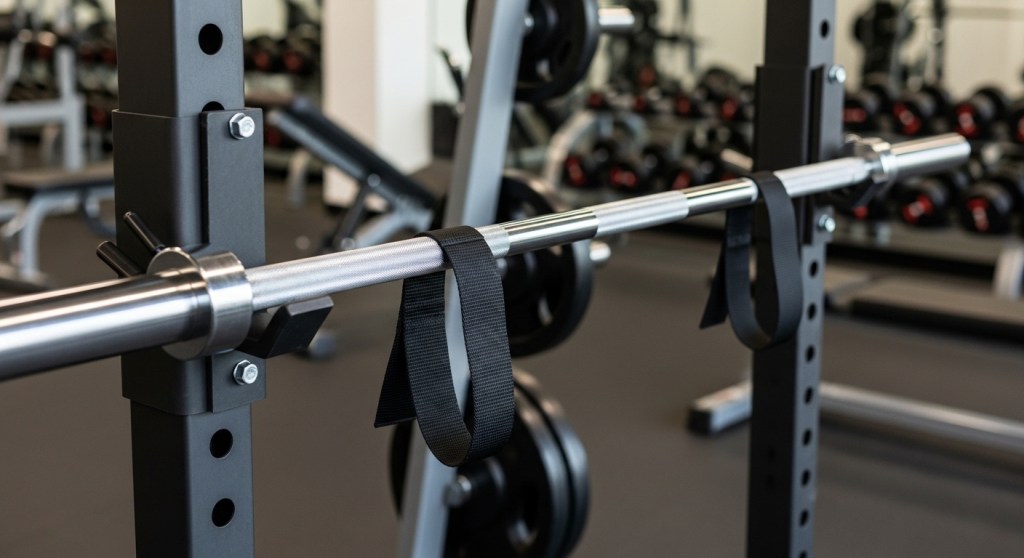
Coach Carmen Phillips works with one of her clients so that she uses straps when squatting and she holds the bar a little bit higher on her back. Carmen has a lot of clients that are her age and older. They have issues with bar position and the squats, the presses, and the deadlift. She wants to try and get everybody to lift like the model shown in the blue book, but because of certain issues that people have with their shoulders, their hips or their knees, she can’t. So, she modifies the lift.
One of the coach Carmen Phillip´s clients has to use straps when she squats. She has arthritis in her shoulders and she has an injury to the other shoulder. She’s even had both of her hips replaced and she’s still squatting. She’s doing great but, of course, Carmen wish that she could do it as the model shows in the blue book, but that’s all right. She can still do it because she uses straps.
What Carmen does with her client is the next. She puts her hands on the straps up close to the bar because that way she has better control. She comes up under the bar and she has to do a high bar squat because she cannot get her shoulders pulled back. She cannot get the bar any lower because of her shoulders. She stands tall and takes a couple steps back. Straps are tight. She looks down and she does a set of 2 reps. Knees out. She drives up with her hips. She can’t quite get to depth, but that’s because she’s had both hips replaced. So, she has her grip nice and close. That way, she has more control of the bar. She uses a 22lb bar because she has to start lighter. She starts at like 35 lbs. This is one option. There are others but this is what works for her.
The whole point of this post is whether rather you’re training yourself or you are a coach training other people, you can still get them to do these movements. We want people to lift like the model in the blue book. That is the goal whenever we are putting bars in people’s hands and on their backs. However, if you’re older and you’re banged up or you are training people, you’re going to come across situations where you cannot get them to put a low bar on their back and have them squat to depth.
For instance, coach Rusty´s client has arthritis in his hips. For a while there, Rusty was having him squat high, but now he can squat to depth. And this is the important thing: he has always been active his whole life. He’s a recovering runner and Rusty got him lifting heavy weights. These are very important things because of these things, he doesn’t have pain even though he has arthritis that limits his hip mobility. Coach Rusty still can get him to squat to depth. Rusty has to load the bar very carefully and has to do programming a very specific way, but he can get him to squat to depth. Carmen’s client can’t squat to depth, but the thing is she is still squatting.
You can still get people and yourself to do these movements even if you have to alter them because of certain injuries or physical limitations. The whole point is we want to get bars on people’s back and in their hands to get them stronger so they can live a better life. Being strong is really important and sometimes we have to use equipment and unconventional methods to get people to do these movements. This isn’t permission to start using equipment if you don’t have to. If you have to alter these lifts so you can go ahead and start squatting, deadlifting. pressing and all the other lifts, that´s all right. I hope this helps.
* If you don´t know how to do the squat by the Starting Strength methodology, click here. You’ll find the information in the section for this lift in that article.
Bibliographic references:
- Rippetoe M. (2011). Starting Strength: Basic Barbell Training, 3rd Edition. The Aasgaard Company.
- Starting Strength. (2026). Squatting with Limited Shoulder ROM [Video file]. YouTube. https://youtu.be/KpWvOT3qX8I?si=yEfN3_I22T2PKYib
 ATLETA EXPLOSIVO
Leave a comment