
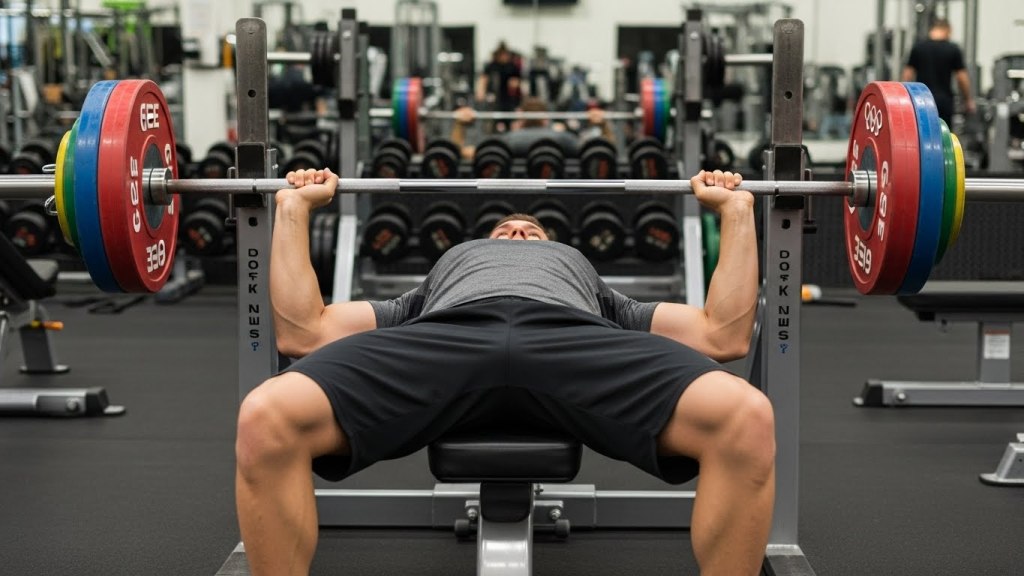
In the last post we talked about the close grip bench. We explained why you would do a close grip bench, how to do close grip bench… Now, we´re going to talk about the way is teached the regular bench press, that is to say, the standard bench press from the blue book that Starting Strength coaches teach. I’m going to talk about elbow position, forearm position, and shoulder position, and why we want those positions the way we have.
We teach a vertical forearm position in the bottom of the bench press. The reason why we want a vertical forearm is because we want to get rid of any unnecessary moment arms for general strength training purposes. If our hand is outside in the bottom of the bench press, then we are creating a moment arm from our hand to your elbow. Vice versa, a close grip bench also creates a moment arm that’s not necessary.
For general strength training purposes, we want a vertical forearm touch point. In a properly executed bench press, we’re going to have a nice solid arch, not the crazy powerlifting arch where you just get the bar up as high as possible. A lot of flexible people can do that with their low back and you’re moving the bar an inch. We want a stable surface, a properly set up bench press with a nice tight arch.
But we also want to touch the bar a little bit lower on the sternum. If we touch the bar high, if we just bring the bar straight down from the lockout position straight down to the shoulder, that actually creates an impingement. And we don’t want impingement to occur because impingements hurt people. It actually will smash the head of the humerus into the acromioclavicular joint and it has potential to smash the rotator cuff between all that. We don’t want that. If we actually come down and touch right below the nipple and actually have a slight angle on our humerus (75º), we could actually avoid any kind of impingement, and that’s ultimately what we want.
In the incorrect way of benching press with an empty bar, maybe you’ve got a nice arch, your feet are pushed back and you have a nice stable platform, but if you come straight down, your elbow is in line with your shoulder. This is where impingement can happen. We don’t want any impingement.
So, what we want to do is to set a nice stable platform. We want to touch a little bit lower, and we want a slight angle on your humerus. This allows us to push back over the lockout point safely.
We want to touch and we want to move into a straight line back into the lockout position. This is a simple concept to achieve a safe bench press and not jack your shoulders up. Jacked up shoulders will stick with you for life. Coach Rusty has clients that have very hard jobs and he has to manage shoulders whether they do different variations of bench press or different frequency of bench press. But if you protect your shoulders early on, you can train hard for a very long time and continue to push that bench press and get real strong.
* If you don´t know how to do the bench press by the Starting Strength methodology, click here. You’ll find the information in the section for this lift in that article.
Bibliographic references:
- Starting Strength. (2025). Forearm Position in The Bench [Video file]. YouTube. https://youtu.be/5RlmquvsV3M?si=-TBcOhlTRlOQmi0E
- Rippetoe M. (2011). Starting Strength: Basic Barbell Training, 3rd Edition. The Aasgaard Company.
 ATLETA EXPLOSIVO
Leave a comment