
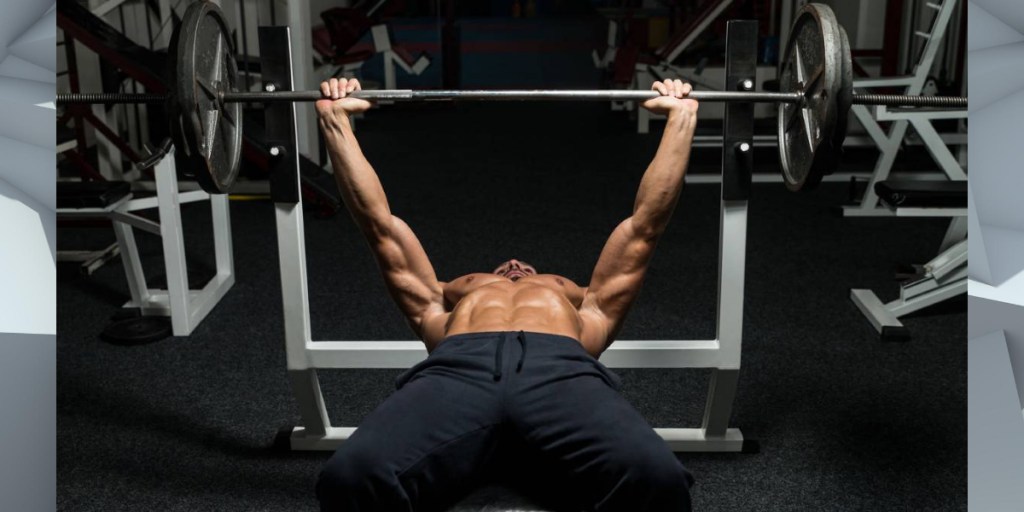
The width of your grip on the bench press is a relatively important variable in the training effect you obtain from the exercise. A wide grip on a bench press is typically what is used in powerlifting meets because the wider grip in the bench press reduces the range of motion that the bar has to travel. It is thought that a shorter range of motion would enable you to bench more weight. And if you get used to doing it with a wide grip, that’s probably true. Most bench press records are set with a wide grip. In fact, the inside score mark on a bar is the widest permittable grip for the bench press. In other words, your index fingers have to be making contact with some part of that inside ring, and that’s the widest permittable grip.
A lot of guys train with a close or closer at least grip. The closer the grip, the less dependent the movement is on the pec muscles (your pectoralis muscles on your rib cage), and the more dependent the movement becomes on the triceps. So, a true close grip bench press is essentially a triceps exercise, although all of the rest of the deltoids and the pecs remain involved at some level in the movement pattern.
It’s probably fair to say that if you have spent a lot of time working on your tricep strength, you might be better off using a narrower grip on the bench press. But that’s the basic difference between the two. For our purposes in Starting Strength training, we have a tendency to put your grip somewhere between those two extremes so that we get a balanced training effect for all the muscle mass involved in the bench press.
The next is something to keep in mind. When you bench, you don’t just lay down and grab the bar. Your grip is important in terms of the effect of the exercise. So, you’re going to have to learn to be precise about your grip placement before you take the bar out of the rack. And then, whatever you’re going to do, you need to take precautions and extra care to make sure that your bench press grip is set exactly where you want it to be set for the effect that you’re trying to obtain.
Depending on the injury status of your shoulders, that will have an effect on the grip width, too. If you’ve got a banged up shoulder, you will probably benefit from experimenting with a different grip width to mitigate the effect of that pain on your shoulders. A lot of people will use a narrower grip if they’ve got a banged up shoulder and it bothers them less than if they persist with the wide grip.
The same mechanical analysis applies to the bench press as applies to everything else: The greater the distance from the central balance point along the bar, more leverage the bar exerts against your hands. So a wider grip, although it does produce a shorter range of motion, produces a lot more moment force on the shoulder itself. And this could be a factor if you’ve got a hurt shoulder. So, Mark Rippetoe advices you to experiment with grip width, for example with 135 lb, and see which grip width bothers you the least.
* If you don´t know how to do the bench press by the Starting Strength methodology, click here. You’ll find the information in the section for this lift in that article.
Bibliographic references:
- Starting Strength. (2025). Bench Press Grip Width [Video file]. YouTube. https://youtu.be/8yYK911TeFQ?si=KJSeapIu0TAnJ_Av
 ATLETA EXPLOSIVO
Leave a comment