

What are the key differences between the A-Skip and the B-Skip? Former Olympian and world record holder Wille Banks has all the answers. Whether you’re a sprinter or a jumper, these drills are essential for developing proper ground contact and technique. Most coaches focus on the leg action, but the real key to sprinting faster is applying the maximum amount of force down to the ground. The fastest sprinters on the planet produce 5 times more vertical force into the ground compared to slower ones. By learning how to perform A-Skips and B-Skips correctly, you’ll be able to develop your vertical force and ultimately improve your speed.
In this article you’ll learn:
- What A-Skips and B-Skips are.
- How to properly perform each with detailed technical breakdowns.
- The difference between the A and B-Skips in terms of technique and what each drill helps to develop.
- Some common errors in these warm up drills.
- The fundamentals of each drill that should provide you with enough information to determine if either or both of these drills should be added to your warm up routine.
Both of these drills focus on ground contact which is essential for proper technique. Most coaches focus on the leg action which doesn’t help you sprint faster. It’s the force you apply to the ground. Remember, sprinting faster is about applying the maximum amount of force down to the ground. The more force you can apply to ground the faster you will go.
You’re going to see a lot of coaches they always talk about the A-Skip and the B-Skip.
In the A-Skip you’re bringing the foot down. You’re just driving it straight down. So it’s a thigh drive into a position of strength. Which a position of strength is always when your ankle, your hips, your shoulders and your ears are in line. That’s your position of strength. In yoga it’s called the mountain pose because you just boom. It’s nothing’s gonna move it.
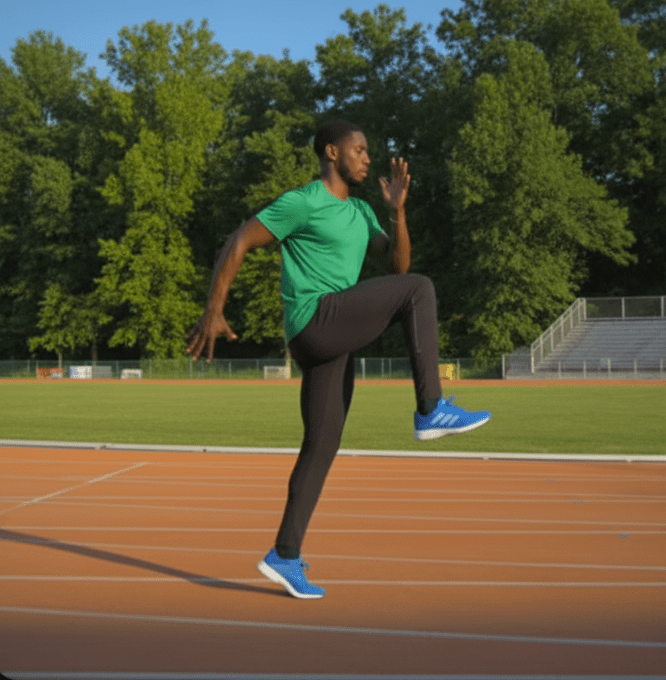
When you’re doing the B-Skips, you want to have the foot out in front of you, and then drive it down. You keep the toe up, and then you move your body over your foot. So it’s like the ankle goes almost behind when it hits the ground. Keep your toe up and pull it back. That’s the movement and that’s what the B-Skip is all about. It is moving forward, pushing forward, not just pulling your leg up and then letting it fall down.
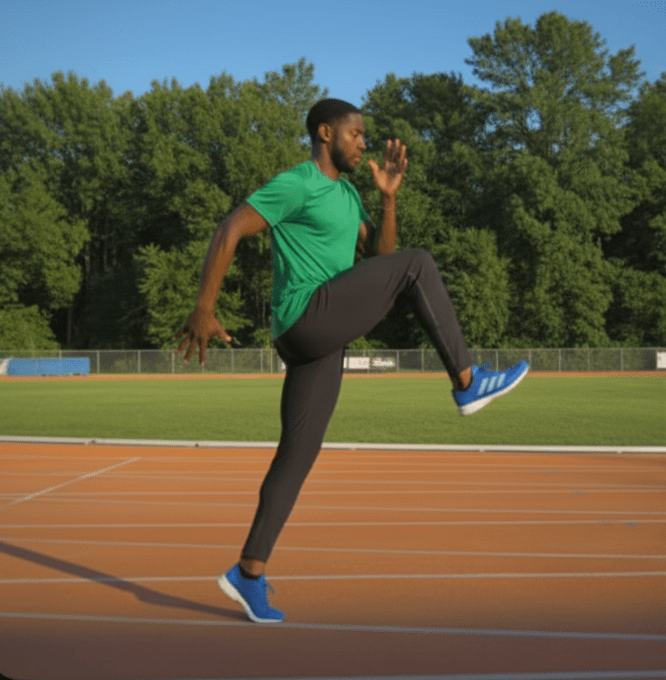
A lot of coaches teach the A-Skip. Coach Wille Banks teaches them a little bit different. In the types of A-Skips he does, you push down to the ground. Your foot should land under slightly beneath your hips, and slide your ankle slightly back. So it’s a pushing down and back. Most coaches teach just high knee. That’s not getting you anywhere. Physics tells you that if you’re not pushing against something, you’re not moving. It’s just an action of your leg. And it is not the action of the leg. It’s the pressure or force that you apply to the ground.
Complementary to the A-Skip is the B-Skip, where your foot is straight out in front of you, and then, as you pull back, it lands down underneath your hips. You want to make sure it’s underneath your hips, not out in front. Out in front is a stopping action. When you go down, you push back and it takes you forward. That’s what a B-Skip should look like: out, down and back; versus the A-Skip which is down back.
A lot of people think that the B-Skips are all about getting front side mechanics. The problem with that is you are throwing yourself out of position. Coach Wille Banks has never seen a sprinter who throws their foot straight out and then pulls it back. Basically you want to get your foot down underneath you and push.
Bibliographic references:
- Outperform. (2022). A Skip vs B Skip: The Key Differences You Need to Know [Video file]. YouTube. https://youtu.be/POTBidqOxug?si=YCk8Uy2j_9t9ZZMD
 ATLETA EXPLOSIVO
Leave a comment