
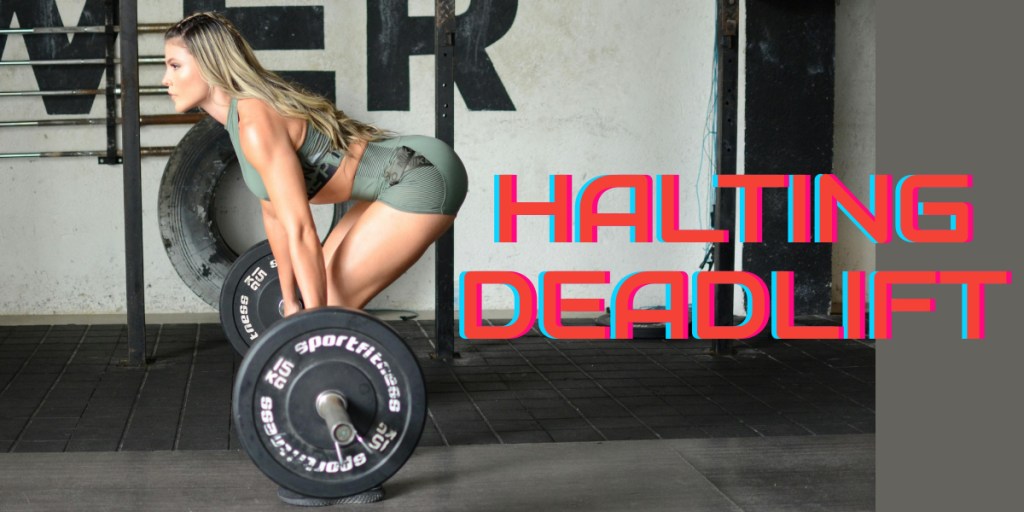
In the last post we talked about the rack pull. The rack pull and the halting deadlift are two very important assistance exercises for the full deadlift for more advanced lifters who are pulling heavy weights already. The advantage of using these two instead of just the deadlift is that at very very heavy weights the full deadlift becomes extremely difficult to recover from if you use enough volume to really ramp up the stress. So what we do is we break it into two parts. We do the the first half of it, really about the first 2/3 of it off the floor. We call that the halting deadlift. And then there´s the rack pull, which is the top 2/3 of it from below the knee. We’re going to talk about the halting deadlift today.
The halting deadlift is once again done just like the first part of a full conventional deadlift with respect to the grip and the stance. At heavy weights, if we’re going to do sets of five on this lift, it’s okay to use straps on the haltings because we if we’re going to program this in sets of five we don’t want grip problems to limit the amount of weight that you’re going to handle for a set of five. So grip is a limiting factor in these lifts and we can’t allow that to happen so we use straps on haltings.
Stance width and toe angle is the same as in the deadlift. Then what you’re going to do is you’re going to take your grip on the bar, going to set the low back as it´s also done in the rack pull. Ultimate emphasis must be must be paid attention to here. Low back must be set in full locked extension. That’s the whole purpose of both of these pulls: is to strengthen that aspect of the pull. If you can’t keep your back flat on a halting deadlift off the floor, then you’re going to have trouble with your third attempt deadlift on the platform.
So what we’re trying to do is strengthen your low back with these two exercises and you have to pay very close attention to your back position. If you cannot get your low back into full extension, you’re going to have to figure that out because that’s not optional. One of the problems we’ve seen in the past is coaches abdicating their responsibility for teaching the lifter how to get the low back set in extension by moving into the rack pull prematurely. In a rack pull position it’s easier to set your low back because there’s not as much tension on the pelvis from the hamstrings. But the rack pull that’s not what it’s for. It’s not to avoid learning how to set the low back into extension, which is what we’re going to practice on with the halting deadlif today.
What happens first is you get your grip. You take a big breath. Then you set your back and then you push the floor just like any other pull. It starts off the floor with a little bit of knee extension and then, as the bar comes up, you’re going to try to maintain your horizontal back angle, something you don’t do in a full deadlift. But we’re going to add that as an aspect of this exercise because, once again, we are trying to strengthen the low back. And by maintaining a long moment arm from hip to load we place more stress on the low back. And that’s how that’s going to work. Finally, you pause at a position just above the knee. That little pause is why we call it a halting deadlift.
Something you must notice about your back position is that you are staying out over the bar keeping your shoulders out over the bar during this movement, maintaining a bunch of stress on your erectors. You can clearly see this in a lifter doing halting deadlifts. What people do in a regular deadlift is, as they stand up, their back becomes more vertical. That’s normal in a regular deadlift. One of the reasons that happens is because you’re dumping the moment load on your hips by shortening the distance between the bar and the pelvis by becoming more vertical. This is a normal part of a full deadlift. But we’re modifying that position in both, the rack pull and the haltings, in order that this becomes a more efficient assistance exercise at heavy weights for your low back. If the back is at a more horizontal angle, your low back has more work to do to keep your back flat. So we’re intentionally using this effect in both the rack pull and the halting deadlift.
These lifts can be done pretty heavy and when they get when you get up to where you’re doing four plates, you’re probably going to need to start strapping your work sets. But in either of these exercises do not let your grip strength be the limiting factor for the weight on the bar. This is not a grip exercise, it´s a pulling exercise. If you pull up to your last warm-ups without straps, your strength and your grip will be plenty good for a heavy deadlift. Don’t worry about that. Go ahead and strap whenever it’s important because if you cost yourself weight on the bar because of your grip, you’re missing the whole point of these two exercises.
Bibliographic references:
- Starting Strength. (2025). Halting Deadlifts: Targeting the Start of the Pull [Video file]. YouTube. https://youtu.be/S-t-60BvOmk?si=omQYMM_cEkVPlruT
- Rippetoe M. (2011). Starting Strength: Basic Barbell Training, 3rd Edition. The Aasgaard Company.
 ATLETA EXPLOSIVO
Leave a comment