
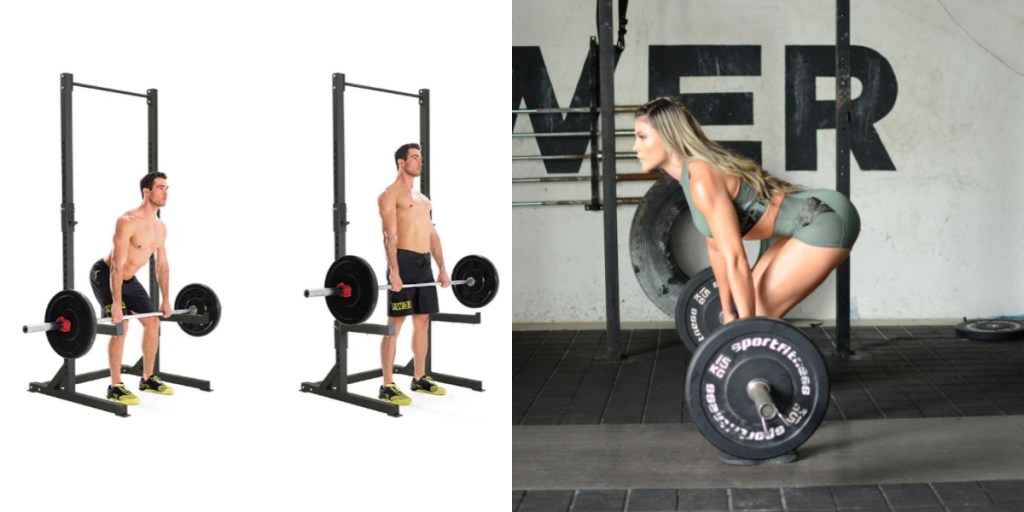
The Starting Strength method is famous for its utilization of just the basic barbell exercises: the squat, the press, the bench press, the deadlift and the power clean. But circumstances usually later in a person’s training history sometimes dictate that the deadlift becomes replaced with two other exercises that essentially cover that range of motion, but allow the use of heavier weights. Those two exercises are the rack pull, from below the knee, and the halting deadlift, which is pulled from the floor to just above the knee. So that combining these two movements results in an overlap of about 6 inches in the middle of the pull.
We always use the deadlift at first. We always start novice lifters with the deadlift. We don’t ever introduce the rack pull or halting deadlifts to people who are just beginning to train because it’s unnecessary. The deadlift is a harder exercise because of the longer range of motion. But for more advanced lifters it sometimes becomes necessary to substitute the deadlift for the combination of the rack pull and the halting deadlifts because the deadlift at heavy weights (at weights over 600 lb) for sets of five becomes very hard to recover from. It becomes a more of a recovery challenge than it does a training tool. Experience has taught us that using the rack pull and the halting deadlift together produce the same training effect as does the deadlift at lighter weights. You can pull heavy rack pulls once every two weeks and heavy halting deadlifts once every two weeks. We alternate the two on a weekly basis: one week is heavy halting deadlifts week, and the next week is heavy rack pulls week. We’ll do both of these exercises for sets of five. The form on the two exercises is sufficiently different that it goes back and patches together all of the kinetic chain that the deadlift utilizes in the full movement from the floor.
The rack pull starts with the bar below the knees, below the actual tibial plateau. You start with your back in a fairly horizontal position and then you pull that weight up to lock out staying out over the bar as long as you can. You can pull very very heavy weights with this movement pattern.
The halting deadlift in contrast starts with a bar on the floor in the same position loaded as a deadlift would be. Then you pull the halting deadlift off the floor with your back in that same position you try to stay out over the bar. As the bar clears the top of the patella (the top of the knees) you stop for a second. Hold it for a second, not an extended period of time. You stop, pause it and then set it back down.
So the combination of these two makes for very strong deadlift at the meet. When Mark Rippetoe was competing in powerlifting, the only time he ever did actual deadlifts was in a competition. The preparation provided by the rack pulls and the halting deadlifts was quite adequate for him to continue PR in his deadlift the whole time he was competing.
A deadlift pulled off the floor utilizes a back angle that increasingly becomes vertical from the minute it leaves the ground. Neither the rack pull or the halting deadlift are done this way because holding the back angle more horizontal during the rack pull and the halting deadlift produce quite a bit more load on the erector muscle. So what these two exercises, that are a little bit different than the deadlift, do is produce a stronger back than the deadlift would by itself. You can find the proper form for these lifts is in the book: Starting Strength: Basic Barbell Training, 3rd Edition.
To summarize:
- If you’re a novice lifter, you needs to just deadlift.
- If you’re an intermediate or advanced lifter and you’re running up against your ability to recover from your deadlift workouts, then the rack pull and the halting deadlift are a better way to train the pull off the floor.
Bibliographic references:
- Starting Strength. (2025). How to Get Stronger Using Rack Pulls and Halting Deadlifts [Video file]. YouTube. https://youtu.be/ar6mgjqGZTM?si=9A_As9ZAQeQcTEii
- Rippetoe M. (2011). Starting Strength: Basic Barbell Training, 3rd Edition. The Aasgaard Company.
 ATLETA EXPLOSIVO
Leave a comment