
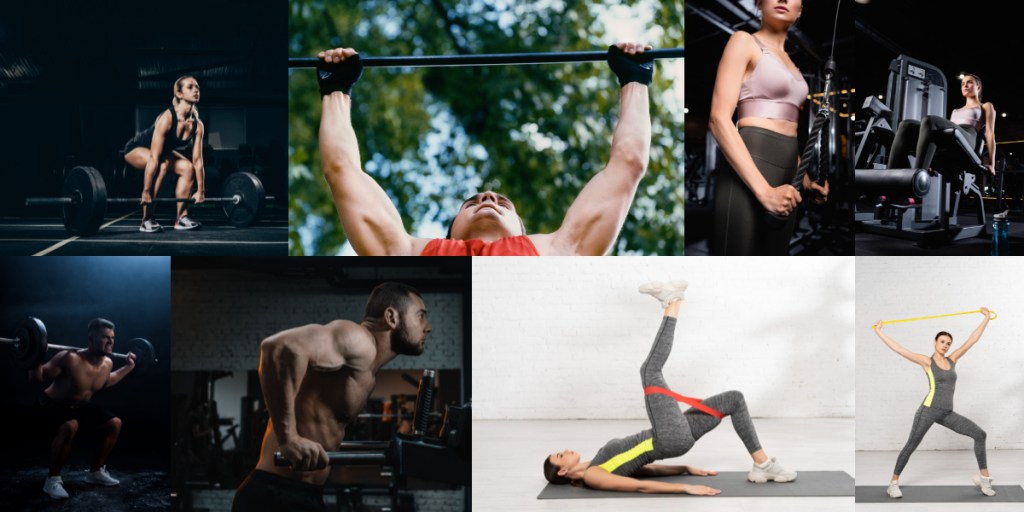
One way we can classify strengthening exercises is into multi-joint and single-joint.
An exercise is considered multi-joint when several joints move during its execution, so that all muscle groups belonging to a kinetic chain are strengthened. In this way we can say that the entire body is strengthening at the same time since it intervenes as a single unit performing a natural movement. These exercises are characterized by their efficiency, since they save a lot of time by working the entire body at the same time. But they are also efficient because they can work on three qualities in a unique movement, and also in a functional way:
- Muscular strength, both in the concentric and eccentric phases.
- Flexibility during the eccentric phase.
- The stability of the spine, by demanding the activation of the core.
All this makes these exercises a 3 x 1.
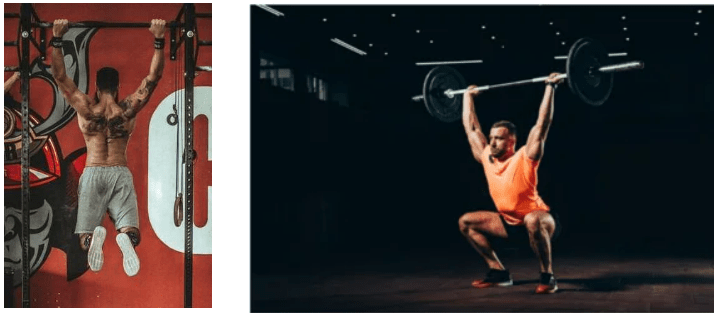
The group of multi-joint exercises includes basic lifts with the Olympic bar (squat, deadlift, overhead press, bench press and barbell row), weightlifting lifts and derived partial movements (snatch, clean, jerk, clean and jerk…) and some from the field of gymnastics and calisthenics (pull-ups, push-ups, dips, muscle-ups…)
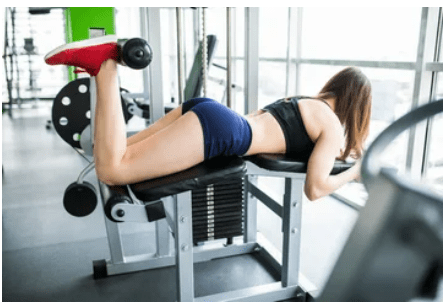
On the other hand, an exercise is single-joint when only a joint moves and a unique muscle group actively participates. They allow us to focus the workload on a single body segment, so if we want to strengthen all areas of the body through this type of exercises, it will obviously take more time. Doing a femoral curl or an ankle flexion-extension with your foot resting on the edge of a step are two examples of single-joint exercises. And due to its single-joint nature, the repertoire of this type of exercises is much greater than that of multi-joint exercises.
But the question is not about which group of exercises is better, multi-joint or single-joint. Rather, the key is to combine exercises of both types since both are necessary in the physical preparation of a person whose purpose is to optimize performance in their sport. It’s about knowing when to do each one during the planning of the sports season and for what purpose to use it.
And that is why below we are going to analyze in more depth what each category of strengthening exercises gives us.
Regarding multi-joint exercises:
- They are the best for increasing our maximum strength levels, particularly those made with the Olympic bar, due to the greater number of muscle groups capable of activating and the greater weight load they allow us to mobilize.
- They are executed mainly during the general physical preparation stage of a sports macrocycle to condition the body and improve basic strength levels. They can also be made out of season for these same purposes.
- This conditioning of the body and strength gains are essential to be able to perform strengthening exercises specific to a sport skill during specific physical preparation, since it starts with good levels of basic strength and prevents the appearance of injuries during its execution.
- They are ideal for maintaining physical condition if you do not have competition goals.
The main drawback with most of this type of exercises is that, except for powerlifting and weightlifting, the levels of strength that we have developed with them do not have a direct transfer during the execution of a typical skill of the sport we practice. Some transfer is only seen in novice or very young athletes. In more experienced athletes this no longer occurs. Therefore, when it comes to sports performance, limiting ourselves only to them is a mistake. They are necessary, but not sufficient.

Single-joint exercises are used during the following circumstances:
- The best known is to focus the phenomenon of hypertrophy locally in a single muscle or muscle group, as long as specific programming is used for this (typically moderate loads with incomplete recovery to create metabolic stress through the accumulation of lactid acid). This is of interest to people who practice bodybuilding, but not to those individuals who have sports performance purposes as it is counterproductive.
- As rehabilitation to strengthen with light weights the muscles around a joint whose mobility is limited as a result of an injury. It is about concentrating on this region of the body that is injured so that it recovers its function.
- To correct the weak link or links in a kinetic chain. That is, strengthening a muscle group that is weak and that prevents us from efficiently and correctly performing a multi-joint exercise, which also limits us from mobilizing more weight in the case of lifting with the Olympic bar.
- In those people who still do not have enough technical skill to correctly execute multi-joint exercises, it is possible through single-joint exercises to be able to do physical conditioning and acquire some strength gains, as long as enough exercises are selected to cover all muscle groups and segments of the body, working both agonists and antagonists to prevent muscle imbalances.
- And what makes single-joint exercises more interesting is that they can be used as specific exercises that reproduce a part of a technical skill of a sport. Therefore, they are mainly included in the specific physical preparation stage of a macrocycle. These exercises have the great advantage of perfecting the technique of a specific movement that is part of a certain sport while strengthening the muscle groups involved and in a way specific to that movement. This is possible since these exercises are performed correctly:
- They reproduce the same movement pattern and in the joint range in which it is carried out.
- They demand the same type of neuromuscular activation that occurs for their execution.
- They reproduce the same type of muscle contraction that occurs when doing that skill during competition.
This approach to single-joint exercises means that they have a place in the strength sessions of those athletes who seek to improve their performance because they allow them to optimize technique and strength at the same time. In this case it is a 2 x 1. And by working strength in a specific way for a sport skill, in this way its transfer is achieved when performing the same movement during the competition.
It should be noted that among the exercises specific to a sport skill, there are some that are multi-joint, but the vast majority are fundamentally single-joint.
The Soviets were the pioneers when it came to using these exercises in physical preparation and Michael Yessis was the one who popularized them.

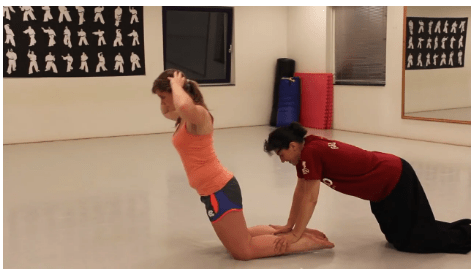
For a few years now and due to the influence of the fitness world with the emergence of functional training, there has been a tendency to reduce strength training by doing only multi-joint exercises and almost completely rejecting single-joint exercises. This is due to the false belief* of thinking that single-joint exercises only serve to achieve hypertrophy goals, which makes sense if you are a bodybuilder, and that they also reproduce artificial movements that reduce our motor skills. Obviously all of this is true and this focus on these types of exercises is a justification why no athlete should use them.
*I have to confess that I also thought like this before. Although I already knew the exercises specific to sports skills, I never classified them as single-joint since when reproducing functional movements I considered that they should all be multi-joint.
But simplifying everything in this way is still a mistake, since it makes us ignore other functions that single-joint exercises have and that are useful for sports. The main and most valuable one is to biomechanically improve each of the parts that make up the sequence of a particular skill and strengthen the muscles according to the way in which it is activated in that movement.
Therefore, as a summary and broadly speaking, as athletes we perform multi-joint exercises during general physical preparation to condition our body and improve our maximum strength gains, and then in the specific physical preparation stage we do specific sports skill exercises, which are mostly single-joint exercises, to specifically strengthen the technique of the movements of our sport and thus achieve its transfer in competition. This is the picture that we must keep in mind to select the type of exercises when planning our strength training in sports.
Bibliographic references:
 ATLETA EXPLOSIVO
Leave a comment