
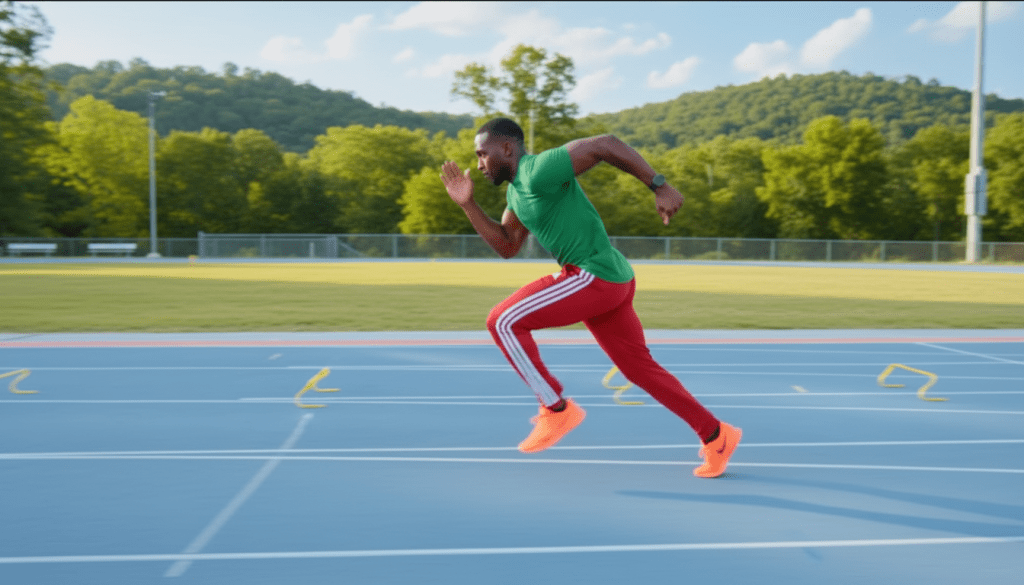
Are you looking to boost your sprinting speed and efficiency? In this post, you´ll discover the importance of proper arm action during sprinting and how it can impact your performance. You’ll learn about the optimal position for your arms based on your individual strength level, as well as why extending your arms past your body during the swing phase can actually slow you down. Proper arm strike and movement can help reduce ground contact time and improve your overall speed. By mastering these techniques, you can take your sprinting to the next level and leave your competition in the dust. All this information comes from the teachings of coach Ken Harnden. Lastly, there´s a section in which Olympian Warren Fraser explains how developing patience leads to developing better technique.
ARM ACTION
We’re talking about arm strike and arm action. Generally there’s a number of different thoughts on this. Coach Ken Harden´s personal feeling is that when the athlete is strong enough to create a short lever by keeping the arm 90º, then obviously a short lever is faster than a long lever. There are younger athletes, a lot of times female athletes, that cannot provide enough power in order to keep this arm strike, and then, they’re going to allow the arm to extend in the back to create the movement that they need in order to get off the ground. Generally, as soon as the athlete’s strong enough, we’re trying to create this short lever. The short lever in the arms aids in the foot contact on the ground being shorter and, therefore, the air time being shorter. People talk about the two being separate, but the reality is if your left foot’s on the ground, your right foot has to be in the air and vice versa. So ground contact creates air time.
ISSUES WITH FULL ARM EXTENSION
We’re talking about the arm strike and allowing the hand to drift back into a straight position in order to aid on the foot extending off the ground. The problem you have with this is that now this hand has to go from a straight long lever all the way through here to a short lever. While it’s doing that, the left leg is going to be in the air that whole time. If the left leg’s in the air the whole time, your right leg is sitting on the ground. The longer it sits on the ground, the slower you run.
Keep the arm 90º in the front and 90º in the back
WARREN FRASER´S INSIGHT ABOUT PATIENCE AND DEVELOPING TECHNIQUE
First of all, I think that patience is the hardest thing and the most difficult thing for sprinters just because it’s a short race. The shortest races are the 100 meters and the 60 meter dash indoors. So it’s the margin for error. You have basically no margin for error. As you make an error, you probably lose the race. So, but with patience comes consistency and repetition. The more you do something, the more comfortable you feel, the more it becomes like second nature. And you go through practices every day, just focusing on the same things and it gets repetitive, but that’s what the body needs to: be able to do actions without having to think about them.
Bibliographic references:
- Outperform. (2020). Maximize Your Sprinting Speed: The Importance of Proper Arm Action [Video file]. YouTube. https://youtu.be/4Bbfuyvk-cg?si=34pd-mvITu4Vye5n
 ATLETA EXPLOSIVO
Leave a comment