
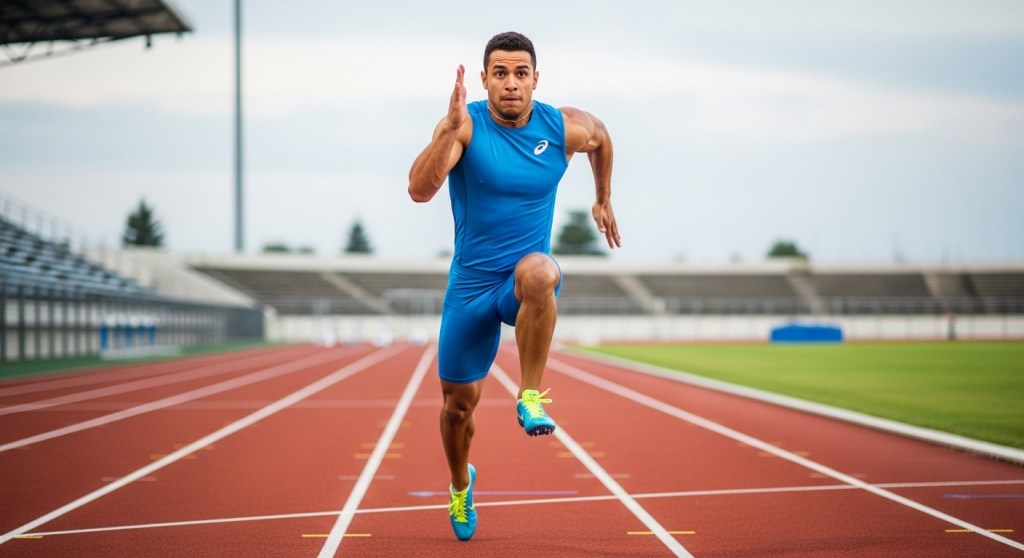
Learn how to sprint faster with proper ground contact and force application. One of the biggest misconceptions out there is how the foot strikes the ground (it’s not on the toe and not on the heel). This post covers where the foot strikes the ground and why that is important for force application and speed development. In order to take advantage of the “stretch reflex” and really utilize the muscles of the lower leg, it’s important to ingrain into the nervous system how to properly land with each stride. This post teaches the fundamentals of correct ground contact throughout the entire sprint. Athlete Insight sections cover force production and how striking down and back is different than “stomping” your way down the track.
We’re going to talk about how the foot contacts the ground in a whole sprint race. In the beginning of the race, the body post up at 45º with the ground, whether you’re sprinting or if you’re a football athlete having a 3-point start to run your 40 yards or a baseball athlete having a standing start 20 or 60 yards. Regardless great acceleration mechanics, great acceleration posture is to have a total body lean on the ground about 45º.
As you’re pushing down and back, your forefoot will contact the ground as the body is steep with the ground. But as the body starts rising until the body gets completely upright, at that moment you’re going to have a flat-footed contact with the ground. How does that work? If you watch world-class sprinters and play their movement frame-by-frame, not in the acceleration and the start, but in the max velocity phase once their body is 90º completely upright with the ground (this is top-end mechanics or max velocity mechanics), their heel will barely miss the ground. They will land flat-footed putting their lower legs (the Aquilless tendon and their calves: soleus muscles and gastrocnemius muscles) on a pre-stretch and immediately get a stretch reflex.
The foot will roll from flat-footed up to the forefoot to be able to take advantage of the elasticity of the lower leg muscles landing on a stretch position and immediately getting the stretch reflex, having more power coming off of the ground that will allow them to spend less time on the ground. Thus would be able to attain a better mechanics leaving the ground because if in the max velocity phase your sprinter or hurdler lands on the toes or on the forefoot because of the forces of gravity, their heel will sink down anyway and they’re going to end up landing flat on the ground and having the stretch reflex. That’s something that will have to happen.
The problem is the time that they will spend from the moment of landing on the forefoot until the heel sinks down and come up. They spend so much time on the ground that their ground contact will be too long. A great feature of the fastest sprinters on the planet is to spend less time on the ground having a shorter ground contact.
So you must learn to have the great dorsal flexion in the max velocity phase. Heel barely misses the ground landing flat. Now you’re landing, what the calves are on a pre-stretch. You get the stretch reflex developing a powerful and very quick impulse off of the ground, and a very short ground contact time. That will allow a sprinter to deliver more power in a shorter time, which is a very high feature of the fastest people on the planet.
JEREMY DONSON´S INSIGHT ABOUT APPLYING FORCE TO THE GROUND
When running track and field, we always talk about applying force down to the ground. And so someone may think like: “Oh!, why don’t I just stomp all the way down to the track?” Applying force in track and field is learning:
- How to apply that force.
- How long to apply that force.
- How to use it with the body.
So we can stomp our way down the track, but then we end up collapsing. We end up losing our posture.
Applying force down to the ground is about timing and is about strength. Learning when to put your limb down to the ground and when to pick it up. That’s when you develop through the multiple drills that you do 11 months out of the year.
How I learned how to apply force? I guess you don’t think about it. You go through the drills and you let the drills develop that reaction. When you do it right, just like in the race, it just becomes easy. For me, I’m an elastic runner, meaning I’m not as powerful, but I can apply a force. I’m very springy, I guess. And so for me, I just feel like I’m bouncing well, fluidly all the way down the track. That’s when I know I’m doing it well.
JANAY DELOACH´S INSIGHT ABOUT APPLYING FORCE TO THE GROUND
It’s easiest when you think it’s like a hammer. If you were to get a hammer in your hand, you pull it back and slam down. That’s the same type of force that you have to have with your leg. When your knee comes up to end that 90º, you need to be slamming. And not necessarily like stomping, but applying force so that when you hit the ground, your foot is flat and you have the right position, then you’re able to put that force and move it in a horizontal velocity.
Regarding applying force, when it kind of really clicked for me, was I didn’t know how to control it. I got to a point where I was kind of in the backyard and having all the stuff in the wrong position, and when I actually corrected it and fixed it, I almost didn’t know what to do with myself. It was almost like a slingshot and it kind of felt like: “Wow! What did I just do right there?”. And that was kind of my moment where I said: “I see what you mean by applying force in the right direction”. It makes it easier. You don’t have to work so hard. You just start moving and then you’re fast and you get better results. Just like that.
Bibliographic references:
- Outperform. (2019). Sprinting Technique | Faster Starts – Ground Contact & Force Application [Video file]. YouTube. https://youtu.be/dN9sChyubSc?si=OMns8GbMUW_0zmph
 ATLETA EXPLOSIVO
Leave a comment