
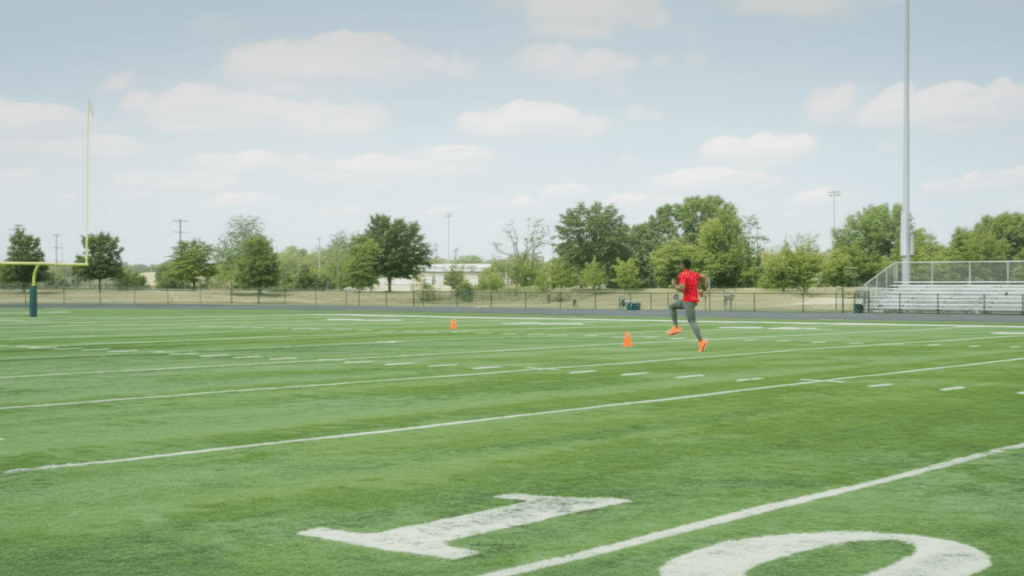
Contrary to popular belief, all out sprinting will not increase speed. Recent studies have shown that sprinting all out will actually cause the nervous system to “record” and reinforce an athletes current max velocity – not help to increase it. If you want to develop and improve your top speed other techniques must be utilized. I´m going to share with you one of the best ways, which is supported by Olympic coach Karim Abdel Wahab, to increase sprinting speed and maximize top speed development.
After we spend the first part of our training plan, probably the first six weeks or so, ingraining the technical model, teaching our athletes the correct posture, mechanics, and rhythm, we continue to do that the whole year. We continue to do that their whole career. But there will be a point where we start introducing pure speed development. Something like for top speed or maximum velocity. It will be 30 meter flies or ins & outs.
Ins & outs are very important because if you have your athlete run 30 meters, or 40 meters or 50 meters, sprinting all out all the time, it’s been proven that that will not help them develop their speed. That will help them remember their speed. This is a research-based information. You’re basically making them record their speed and repeat the same speed every single time. This is not the goal of what we’re doing. Actually, that type of training is important, but this is not what we’re talking about right now. We’re talking about developing speed.
So ins & outs (sprint-float-sprint) have:
- A section when they sprint.
- A section when they float (trying to maintain turnover without pushing too hard; less power but hold their turnover).
- A section of sprinting.
Maybe 30 meters-30 meters-30 meters or 20-20-20. It’s been proven that that method of training actually develops speed. It develops speed by forcing the nervous system:
- To coordinate the firing between the flexor muscles (the muscles that will get your knee up) and the extensor muscles (the muscles that will put your leg down or extend the knee and extend the hips down).
- As well as coordinating the movement between the limbs (between the right leg and the left leg).
Once that becomes more fluent due to ins & outs sprinting, the speed of contraction will increase. Thus, speed will increase and velocity will increase.
So what we usually do is:
- Doing a phase, maybe three to six weeks, of that type of training (ins & outs).
- Then we’ll go back to normal sprinting to record and help the nervous system lock in the new levels of speed.
- Then we go back to ins & outs sprinting for three to six weeks to develop speed.
- And we go back to regular sprinting to record and lock down the new levels of speed.
Bibliographic references:
- Outperform. (2018). Sprinting – Top Speed Development (Max Velocity Drill) [Video file]. YouTube. https://youtu.be/a8PQfK90eL0?si=dVuID-z3krumIQUq
 ATLETA EXPLOSIVO
Leave a comment