
We’re going to explain about how to warm up during the Starting Strength novice linear progression (NLP). We have to know the difference between work sets and warm-up sets. Work sets are done for the stress that we’re going to apply for today’s workouts. An example might be 200 lb for 3 sets of 5. That would be the goal today when we come into the gym. But we’re not going to walk into the gym and just load 200 pounds on the bar. We’re gonna go through a logical warm-up that gets us ready for the workout that we’re gonna do.
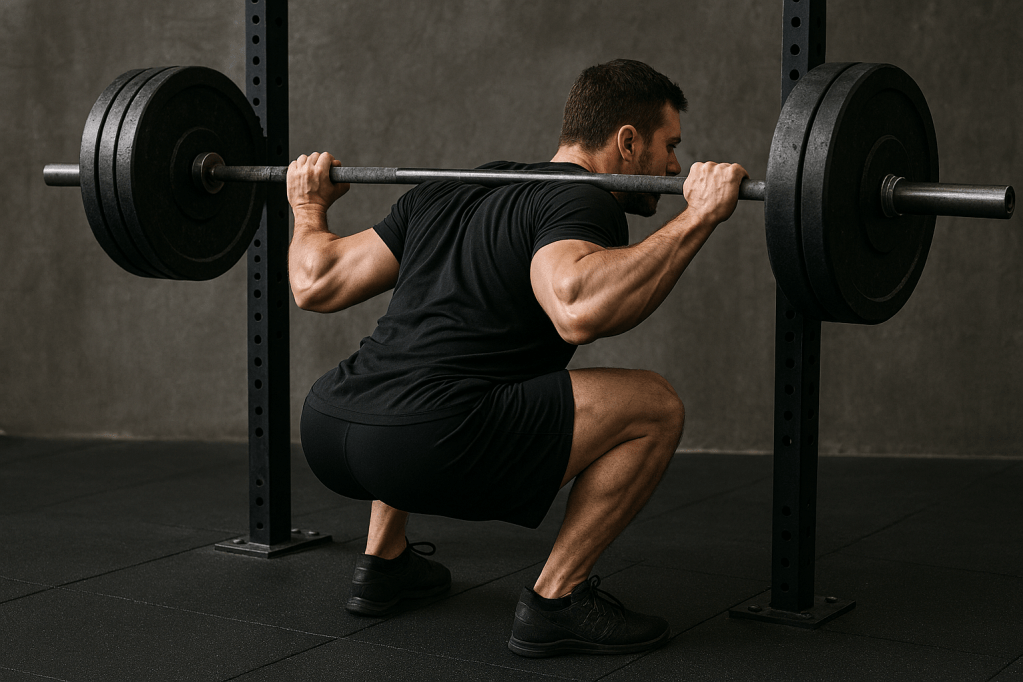
In the case of the squat we’ll start with the empty bar, and we’ll do 2 sets of 5 regardless of what our work weights going to be. From there we’ll take 45% of our work weight and do it for 5 reps. Then 65% for 3 reps, and 85% for 2 reps. At this point your body’s warm and you’re ready to perform your work sets. However you may need a little rest. The first few warm-up sets are done as quickly as you can as you add weights on and off the bar. After you’ve done 85% usually 2 or 3 minutes rest depending on your level of experience. From there you´re ready to go into your first work set.
Warmup protocol
- Empty bar → 5 reps x 2
- 45% → 5 reps
- 65% → 3 reps
- 85% → 2 reps
- Rest → 2-5 minutes
As you get more experienced, your warmup might change. For example, if you’re a 500-pound squatter, you may just go up by plates. You may find that you don’t like to jump larger than 50 pounds. Some of that will be dependent. There’s no need to stress over the percentages of your warmup. You don’t need to microload a warm-up set. It’s just a warm-up. This is a guideline to facilitate you getting ready for your work sets.
You may find from time to time that the percentages don’t work perfectly. Maybe you’re a new lifter and you’re squatting under a hundred pounds. The best way to do that is still to start with an empty bar. If you’re gonna squat with light weight maybe you need to start with the lighter bar and then just make incremental jumps up to your work week. The key is to get your body warm without applying too much stress so that you’re unable to do your work sets.
So that’s how it warm up the squat. The other lifts there’s some slight variations and modifications we can make. For example, a new lifter on the press may not be lifting more than 50 or 60 pounds. A standard Olympic barbell is 45 pounds, so you may need a lighter bar to do your first two sets of 5 in order to facilitate getting ready for 60 pounds. On the deadlift sometimes we don’t follow the percentages exactly. For man that’s gonna deadlift over 200 pounds, weights under 135 aren’t necessary. He could just put a 45 pound plate on each side and start with his warm up.
If you´ve been doing weight training for a little bit, then you know how your body responds to warm-ups. Generally, if you´re doing heavy sets, you need a little bit more warm-ups. If you´re doing more volume work or if you´re on your NLP, you don´t need to warm up as much.
Time is valuable. Warm-ups shouldn’t take the same amount of time it takes you to do your work sets. You should be able to bang through them real fast. If you have clients, you don’t need your clients to warm up for 30-40 minutes. It shouldn’t take that long.
You don’t need to take forever for your warm-ups. If time is an issue for you, you’re going to want to get through warm-ups as quick as possible, so you can get through your work sets and get into your next lift. And then, while you’re in your work sets, you can start warming up on your upper body.
If you’re doing the lifts by yourself and you know that you need a little extra work on technique, or if someone’s coaching you or you’re coaching, that would be a good time to take more time on the warm-ups to start hammering out technique issues before you get to your first work set. You don´t have to do your warm-ups in 5 to 6 minutes. You can do them in 5 or 6 minutes, but they shouldn’t take 20 minutes. But if you’re working on things like knee slide, driving your hips out of the hole, bending over…, the warm-ups are a time to hammer out all that stuff before you get into the work set. The work sets need to be as perfect as possible so you can train most efficiently.
So, I hope this helps put things in perspective on what warm-ups should look like whenever you’re pressed for time or, if it’s not even pressed for time, you’re just want to be more efficient in your workouts.
Bibliographic references:
- Starting Strength. (2019). How to Warmup for Barbell Training with Grant Broggi [Video file]. YouTube. https://youtu.be/s5hpE9wYka4?si=PNawmfGFZONM6vv5
- Starting Strength. (2025). How to Manage Your Time and Warm-Ups in the Gym [Video file]. YouTube. https://youtu.be/j9CV-O42IMY?si=TTrBO1MPw0w9Ik9a
 ATLETA EXPLOSIVO
Leave a comment