
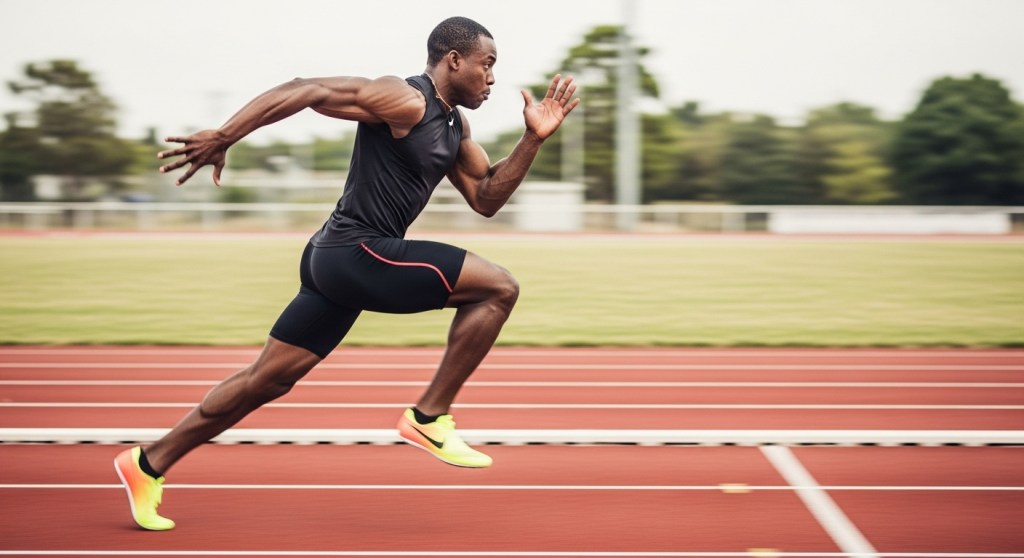
Stride length significantly impacts sprinting speed. However, there is a right way and a wrong way to increase your stride length. The world’s fastest athletes distinguish themselves by having longer strides compared to their slower counterparts. But it’s not because they actively try to lengthen each stride. It all comes down to force production. In this post, you’ll gain insights into how top-tier sprinters achieve their impressive stride length. You’ll also learn what not to do – avoid extending your stride by casting your foot outward or over-striding. Additionally, we’ll cover essential measurements that enable you to determine your optimal stride length based on specific measurements of your leg length.
Stride length is basically the distance between the toe off (the moment the athlete´s toe leaves the ground) and the ground contact in the next step. So it’s basically the amount of ground the athlete will cover what their body is in the air in a sprinting stride.
The stride length is a big deal because it is the outcome of proficient and ideal force application. Regarding world-class sprinters in sprinting, the faster they are, the less steps they take in the 100 meters, meaning they have bigger steps. But they don’t have those bigger steps by overstriding, casting their foot out in front of their body, having their foot lands way ahead of the center of mass to create a braking force, and slow them down. This is not stride length. The limiting factor for an efficient stride length is how much force can you apply to the ground and how much impulse you can apply to the ground before the body leaves the ground. At that moment, your body will cover a lot of ground and have a very good stride length that will help you sprint faster without overstriding and casting your foot out, having the foot lands in front of the center of mass, and creating braking force to slow you down.
There are some 50 years old finished studies that show how big you try your athlete’s stride length should be during the upright sprinting phase, when the body becomes perpendicular to the ground. All of that is generic but you can use it as a guideline.
- For a woman her stride length should be about 2.35 multiplied by her leg length.
- For a guy the ideal stride length should be about 2.43 multiplied by their leg length.
In physical therapy leg length is defined from the hip bone to the ground. This is not what coach Karim Abdel Wahab means. What he´s referring to is from the leg length measured from the greater trochanter, which is basically the top of the hip joint, all the way to the ground where the athlete’s standing flat-footed with no shoes, barefooted. Where the heel touches the ground up to the top of the hip joint. You take that measurement, multiply it by 2.43 for a man or for a guy to know their ideal stride length, and multiply it by 2.35 to know for a woman or for a girl their ideal stride length in sprinting.
When your athletes are sprinting and you film them and watch them, they cannot hit those values (that stride length based on their leg length) by overstriding, that will make them sprint slower. The whole goal of the training process is to get to that ideal model stride length based on the athlete leg length by applying the correct force and without overstriding. This is how they sprint faster.
Overstriding causes the foot to land ahead of the center of mass creating braking force. It causes you to slow down. So at that moment, the foot lands in front of the body, and body cannot leave the ground until the whole body gets over the knee. So when the knee and the foot are ahead of the body, you have to pull the ground first and push. At that moment, you spend so much time on the ground. There’s not enough time for your knee to come up high enough to be able to push the ground, and your shins and your hamstrings are exposed to injuries because all the shock of ground contact due to overstriding will go in the foot and the shins. It can cause foot issues and shin issues. Landing in front of the center of mass and pulling the ground can cause a lot of hamstring injuries.
Bibliographic references:
- Outperform. (2023). Why Is Stride Length Such A Big Deal In Sprinting? [Video file]. YouTube. https://youtu.be/0aSmMH98CFU?si=j-A6yxFg4LWdmaMJ
 ATLETA EXPLOSIVO
Leave a comment