
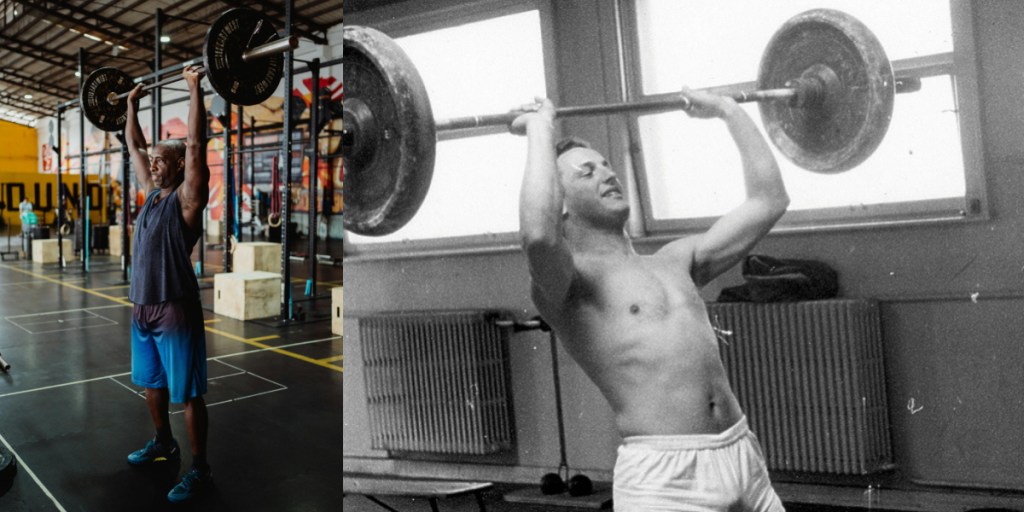
In this post, I´m going to discuss how to use the hips and torso in a press without the bounce – sometimes called “Press 1.0” – for lifters who are unable to incorporate the dynamic start. This explanation comes from the Starting Strength Coach Andrew Lewis.
The correct use of the press incorporates a layback, the hip in motion, and a bounce that comes from the tightness of the abs and the knee muscles. It’s not from the knees bending. It’s from the quads being so tight that the knees are kept straight as you bounce your hips in. It also gets your face out of the way and allows you to press in a vertical bar path.
There’s this temptation by coaches and by lifters on their own lifting where if this coordinated effort is not really going real well, the lifter is getting frustrated or the coach is getting frustrated to discard the method entirely and to do a strict press, but this is not necessary. A lot of times this will happen because the lifter is a little weaker. They might have balance problems. They might not be able to control the bar path real well. And so trying to do this kind of aggressive hip bounce and then bouncing the bar up can lead to some problems. So instead of discarding the lift, try this.
As a coach, what you´re going to do with your trainee is you´re just going to tell him to layback, reach his hips in a little bit, and then pause and press. Finally, bring the bar down. It’s really important to make sure that he’s standing up tall at the bottom and tall at the top, so the hips can’t stay forward. So lay back, hips in, and then press straight up, get under the bar, and bring it down. You´re moving him because the temptation with the lifter will be to not lay back enough. It’ll be to not shove the hips in enough. And when you´re pushing on his back there, you´re not pushing on his lumbar. You´re pushing just above his butt. Because if you push on his lumbar and he extends his back, that is not good. We want his abs real tight. So you´re pushing just above his butt, not quite at his lumbar so that his abs stay tight, his knees stay tight and he’s not overextending his spine.
So, if you’ve been having issues with teaching the dynamic version of the press because the original version is kind of not going well, you’re getting frustrated, the lifter is getting frustrated, or you notice that there are problems because of the balance and because of weakness, you can try this more static version. In the static version of the press they’re reaching in, they’re laying back, they’re kind of pausing a little bit, but they’re staying tight. And then they’re still getting the benefit of the vertical bar path and the tightness of the abs and the knees, but it’s just a little bit slower. So, it’s a little bit easier to learn and it’s easier to control the bar path. And very quickly, you can transition this into the normal or dynamic press because the movements are so similar. At some point, as a coach or even as a lifter, you’re going to notice that the bar path has gotten a lot smoother. It’s staying vertical. There’s better motor control of the bar. And when this happens, you can immediately just add the bounce.
* If you don´t know how to do the dynamic press by the Starting Strength methodology, click here. You’ll find the information in the section for this lift in that article.
Typically, if this is a learning problem, you can do this on the first day. So, you’ll teach the static version and then after a set or two, you can immediately get into the dynamic version and have them pressing correctly day one. If it is a motor control, a balance or a strength problem, it might take a little bit before they are strong enough to actually be able to do this lift correctly without basically falling over or without losing the bar forward or backward.
So, if you’ve been having some trepidation about doing the dynamic press for certain clients or for yourself, and you’ve just been discarding it entirely and going to a strict press, try doing this instead. This is going to transition better. This is going to get them using more muscle mass more effectively and get them stronger. So try that out.
Bibliographic references:
- Starting Strength. (2025). Don´t Give Up on the Press [Video file]. YouTube. https://youtu.be/NrncaFxEbiU?si=yqiphc3l8OYUFBjM
 ATLETA EXPLOSIVO
Leave a comment