

The right shoes are an essential tool for developing strength as they improve your relationship with the floor and allow you to train more effectively. Common features of a good shoe for strength training include a stiff, non-compressible sole, slight heel, adequate toe box, and metatarsal strap.
Starting Strength coaches always recommend weight lifting shoes for barbell training. Barbell training is a full body exercise. It depends on you standing in balance with a heavy bar either on your back, or on your shoulders, or in your hands. And balance is kind of a critical component because if you are not in balance, you cannot produce optimum amounts of force to the floor to move the bar. Squishy shoes are not conducive to maintaining balance because any slight perturbation of the position of the bar in your hands, or on your back or shoulders, is going to have to be dampened by your feet against the floor. You can’t do that if you’re wearing squishy running shoes. Squishy running shoes do not belong in barbell strength training.
There are lots and lots of lifting shoes that are on the market right now and all of them have a couple of features in common. Most important is the uncompressible hard sole. It is solid all the way from the heel to the toe. It does not compress. It does not deform under a load. Running shoes are designed to deform under a load because that apparently to runners is very important as they go through their stride pattern to absorb some of the impact in the squishy sole of the shoe that does not apply to power training under a barbell.
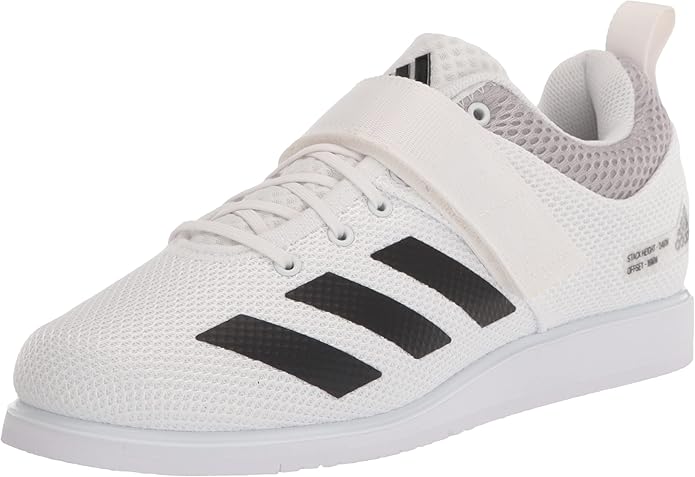
We want no movement in the sole. Notice that the sole has got a little bit of a heel on it. Not a big giant heel. The heel is about 5/8 of an inch taller than the sole under the ball of the foot. It produces a little bit of lift from the back that allows you to get a little bit more quad into the knee extension that you’re going to perform as you either pull the bar off the floor, or as you come back up out of the bottom of the squat. If the heel is too tall, it alters your position too thoroughly. It pushes the knees too far forward, throws your balance off the middle of the foot and onto the toe. A little bit of heel is what you want. Not a giant blocky heel like Olympic weightlifters use to help them get in a better position for the front squat that they catch the clean in the position of at the bottom of the clean. This is not an Olympic lifting shoe. This is a strength training shoe, but it is non-compressible in the sole.
When we´re wearing lifting shoes, there’s more knee extension out of the bottom of the pull. Knee extension is what gets the bar moving in the very bottom. Your knee´s pushing out. You pushing the floor away is what gets the bar moving. Because the angle of the ankle joint is higher, we get more knee extension. We get more shin angle into it. On top of shin going forward and pushing out to the to the arms in a properly executed deadlift setup, we get more knee extension. Coach Rusty says he would happily sacrifice less than 1 inch to have more knee extension to help him out of the bottom of the of the deadlift. That is a benefit from having a heel on our lifting shoes. This is the big thing that nobody talks about whenever we talk about wearing lifting shoes: You get more knee extension, and that is very important whenever we’re pushing off the floor.
Most of the lifting shoes have the metatarsal strap. What the metatarsal strap was designed to do in Olympic weightlifting shoes was to hold the foot back into the heel of the shoe because when you do a split snatch or a stomp of any kind, if your heel is not securely mashed into the back of the shoe, your foot’s going to slide forward in the shoe during that stomp, during that dynamic movement. We want the shoe to stay in place for the whole lift, and that’s what the metatarsal strap is for. It’s not to gather your metatarsal bones up, which it does and that’s good also, but it’s primarily to hold the position of the foot in the shoe.
All-leather version of the lifting shoes are not obtainable. But the closest you can get to these is going to be the best thing to buy. They’re going to be a couple of hundred dollar. They’re not cheap because they last a very long time if you buy good ones. Just don’t buy flimsy ones with any fabric in the top of the vamp. They’re trying to save money instead of make a good shoe when they do that.
The function of this shoe is to improve your relationship with the floor during the execution of either a pull, a press or a squat. They’re not important on the bench press. But all the rest of the movements, and especially the power clean, should be done with this kind of a shoe on your foot. Lots of different companies make them: Adidas, Do-Win, Nike… But when you go to buy the shoe, look at it and don’t buy a bunch of fabric and cheap junk. You could probably have a pair of these made if you´ve got the money to have a custom shoe maker design a shoe like this.
Just keep in mind the basic tenant. The sole must be solid. There cannot be a compressible material involved in the construction of the sole. The heel needs to be present but not very big. And the toe box needs to be wide enough so that you are not going to smash your toes when you do your cleans. There needs to be enough room for your foot in the shoe. The metatarsal strap needs to be substantial and tied onto the sole of the shoe to more securely hold your foot back in the back of the shoe while you’re moving around under the barbell. Shoes are not considered optional equipment. You need a pair of lifting shoes, so find out which one you want to buy and get it on order now. It’s very important.
There’s lots of reasons to wear lifting shoes:
- A more secure foot.
- A solid surface to push off because the sole won’t squish.
- Knee extension. It is very important that we have more knee extension out of the bottom. That will assist us getting the weight off the floor.
Below you can see an example of good lifting shoes that I personally use.
Bibliographic references:
- Starting Strength. (2025). Lifting Shoes are NOT Optional [Video file]. YouTube. https://youtu.be/7uAik5tK-Yc?si=_b3H8tbkZ9ywEzDG
- Starting Strength. (2025). The Reason for Lifetrs REDUX [Video file]. YouTube. https://youtu.be/_IBGLXskwg4?si=BKIgWz8vQ-5wxlME
- Rippetoe M. (2011). Starting Strength: Basic Barbell Training, 3rd Edition. The Aasgaard Company.
 ATLETA EXPLOSIVO
Leave a comment