
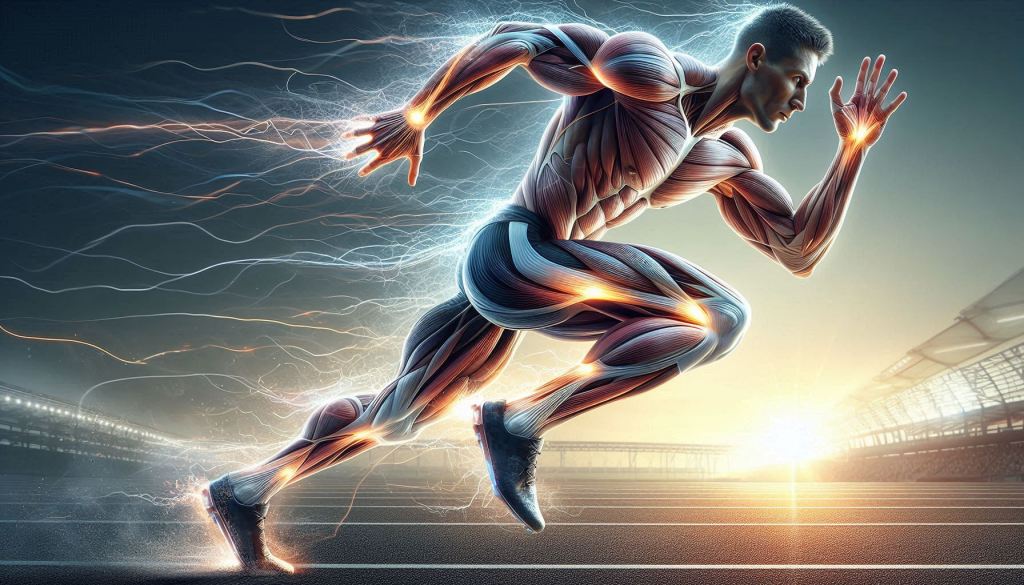
We can look at muscle fibers as being on a spectrum with slow twitch on one side and fast twitch on the other side.
- Type 1, which are slow twitch, use oxygen to create energy. The upside is they can work for a longer period of time before fatiguing. The downside is they contract the slowest. When a muscle contracts, these are the first fibers to be recruited. Then, as intensity increases, the fast twitch fibers are then recruited as well.
- Type 2A, which are fast twitch, use both stored energy and new energy created with oxygen just like type 1. The difference is, since they use stored energy, they can contract faster than type 1. They can work for a short period of time before fatiguing.
- Type 2X, which are the fastest muscle fibers in humans, use stored energy only. This allows it to contract the fastest, but it also means it fatigues the fastest. The thing is these fibers are rarely present in the average human. In a study with sprinters they found only 1 out of 1.000 muscle fibers they examined were pure type 2X.
- And finally, in between each of these types, are hybrids. These are muscle fibers that have characteristics of two or more muscle fiber types. Although type 2X is rare, the hybrid between type 2A and type 2X can be quite common.
Now, let’s talk about some of the questions that we might have, starting with probably the most common one:
“Can we change our muscle fiber type?”
For some reason, there’s a lot of confusion around this. When we actually have research that goes all the way back to the 1970s which proves that muscle fiber types can be changed: slow can become fast and fast can become slow. According to Dr. Andy Galpin, who literally examines the fibers of professional athletes, the hybrids are the ones which are the most likely to change based on your training, and the less training you have, the more hybrids you have.
“How do we know which one we are dominant in?”
The average person without years of specific training is a mix of type 1 and type 2A with no significantly dominant type. And even though there’s several tests that claim they can determine which type you are, the only way to truly find out is by having a sports scientist stick a needle into your muscle and examine them individually.
“Which one should you focus on for a building muscle?”
Although fast twitch are known to be larger than slow twitch, there is research that claims that the growth potential between fast and slow twitch is similar arguing that it doesn’t matter whether you train heavy or not. If you train to failure all of your muscle fiber types will be recruited. The general consensus is that you should train both in order to stimulate the body in different rep ranges and intensities. However, endurance athletes, which primarily use slow twitch, look very different from the strength and power athletes focusing on fast twitch.
“Which muscles are fast twitch and which are slow twitch?”
Although other muscles are a mix, some are dominant in one type of fiber depending on their function. The calves and posture muscles like the spinal erectors, are going to be predominantly slow twitch since they have to work all day at a low intensity. Muscles used for powerful movements like running or throwing are going to be predominantly fast twitch, such as the hamstring which is used heavily in sprinting. At least this is what it’s currently believed since most of the muscle fiber research is currently done on the quadriceps.
“What research is there on the muscle fiber types of elite athletes?”
They did one study on the world champion sprinter. They examined the muscle fibers of his quad and, remember, type 2X are the fastest muscle fibers that humans can have. A normal human being has about 0% of these. Even among elite athletes only a few of them have shown to have muscles with 1% of these type 2X fibers. In this study they found Colin Jackson was 24% type 2X fibers. What’s even crazier is that this study was done years after he set two world records. So he wasn’t even in his prime anymore. They also ran tests and found that his type 2X were twice faster than his type 2A, which is the fast twitch fiber that normal humans aspire to have and 14 times faster than type 1 slow twitch fibers. This guy is a walking superhuman.
And most importantly, let’s talk about:
“How we can apply this to our training?”
If you want to develop more fast switch muscle fibers, then you do low reps max speed or max strength with long rest periods. If you want to develop more slow twitch muscle fibers, then you just do the opposite of everything just mentioned. If you want more specific exercises for fast twitch, almost everything in sprint training will train your fast twitch muscle fibers: heavy lifting, plyometrics and, of course, sprinting itself.
Bibliographic references:
- Palacios C. [The Sprint Project]. (2020). How Much Fast Twitch Fibers Do Elite Sprinters Have? [Video]. Recovered from https://youtu.be/XfioxVIAZ_c?si=DZ8AfutH4K2b2Tcb
- Jansson, E., Sjödin, B., & Tesch, P. (1978). Changes in muscle fibre type distribution in man after physical training. A sign of fibre type transformation?. Acta physiologica Scandinavica, 104(2), 235–237. https://doi.org/10.1111/j.1748-1716.1978.tb06272.x
- Morton, R. W., Sonne, M. W., Farias Zuniga, A., Mohammad, I. Y. Z., Jones, A., McGlory, C., Keir, P. J., Potvin, J. R., & Phillips, S. M. (2019). Muscle fibre activation is unaffected by load and repetition duration when resistance exercise is performed to task failure. The Journal of physiology, 597(17), 4601–4613. https://doi.org/10.1113/JP278056
- Trappe, S., Luden, N., Minchev, K., Raue, U., Jemiolo, B., & Trappe, T. A. (2015). Skeletal muscle signature of a champion sprint runner. Journal of applied physiology (Bethesda, Md. : 1985), 118(12), 1460–1466. https://doi.org/10.1152/japplphysiol.00037.2015
 ATLETA EXPLOSIVO
Leave a comment