
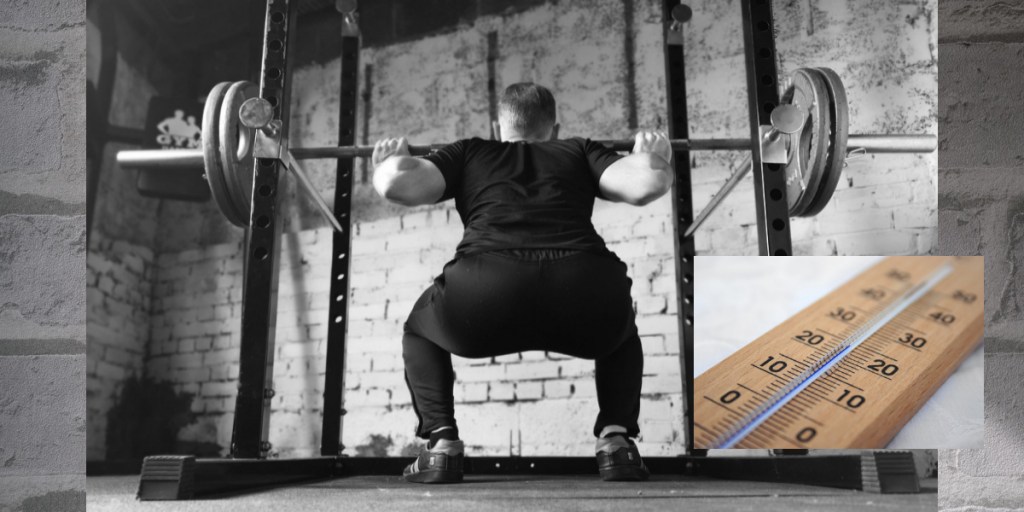
If you are going to start training in your garage at a home gym, you’re going to be pretty much at the mercy of the elements because most people’s garages are not air conditioned and heated. If you’ve got a utility room that’s adjacent to the house and you can keep a door open to keep the temperature moderated in there, that’s wonderful. But a lot of people have got a train in a shed outside. If it’s 22°F, it’s going to be cold in the gym. If you’re inTexas and it’s August, it’s going to be 112ºF outside and probably 130ºF in the gym. So what are you going to do?
It’s easier to deal with the heat than it is the cold because if you’re too hot, that means you’re sweating too much, but it also means that all your joints are warm and you’re less likely to get hurt.
If you’re warm like that you can always put in a couple of fans and make the fans circulate the air and blow on you, and more effectively evaporate your sweat and cool you off. That’s what your sweat’s for: evaporative cooling. So help that out with a couple of fans and stir the air up. And when you’re between sets, go stand in front of one of the fans and get cooled back off. If you’re training in a situation like that, you’re probably going to have to bring three or four shirts with you because when you sweat one all the way out, it’s not going to be effective at holding the bar position in the squat. So you’re going to need to take care of this and keep all of this in mind when you’re selecting the stuff to put in your gym bag to go out to the the shed in the middle of the summer.
Staying warm is a whole lot harder situation to deal with. If you’re in a situation where your shed’s got electricity, you can put a little resistance heater back there and kind of get it up to where you can stand it. If you’re in a situation where you’re having to train in an unheated building in winter, you got to wear a lot of clothes. When you wear a lot of clothes, you have to be cognizant of the effect that those clothes have on the positions of your joints during the movement. If you’ve got three pairs of sweats on, it’s going to affect your knees and hips and the squat. This has to be thought about. You’ve got to get loose enough sweats to where they don’t interfere with your getting to the bottom in the squat, or they don’t wad up under your knees and send you the wrong propriceptive message about your depth. Because they will do that. If you’ve got on enough clothes to stay warm in a cold shed outside, you’re probably going to have movement pattern problems as a result of those clothes being in the way of knees and hips flexing during the movements. If you’re in a situation like that, you really think need to think about figuring out a way to heat the building because being too cold is far worse a problem than being too hot when you’re training. If you’re cold, you’re and your connective tissues are cold, and you can’t get warm. You’re liable to yank something that would not have been injured, had the room been the right temperature.
This is mundane stuff. It’seasy enough to solve. There are heaters and there are fans. But give some thought to the environment in which you train because if you do this wrong, you can hurt yourself and at minimum you’re not going to have a good workout. This can be a problem, so fix it before it starts.
Bibliographic references:
- Starting Strength. (2025). Gym Temperature [Video file]. YouTube. https://youtu.be/OmcRFit619I?si=FDPdo1RHTFhUmBvW
 ATLETA EXPLOSIVO
Leave a comment