

According to coach Tony Holler, your body adapts to the specific stresses applied. For example:
- If you properly train speed, your body will adapt to run faster.
- If you properly train speed endurance, your body will adapt to run faster longer.
- If you train long and slow, your body will adapt to run longer and slow.
Your body will only adapt to unaccustomed stimuli.
- To improve your speed, you must train faster than your current maximum speed. Our intention is try to set a speed record in every speed workout. We love to run with the wind on windy days. Chris Korfus says it´s really important to feel a speed you´ve never felt before.
- To run your race distance faster, you must train at paces faster than your current personal record (PR) in that event.
- If you only train at paces at or slower than what you´ve already accomplished in your event, your body will not adapt to run faster.
Your body will positively adapt to stress, unless the stresses are too great.
- If the stresses are too great, you will not improve. You will regress, and/or will become injured or ill.
- Short-term stresses are seldom the cause of injury or illness.
- Cumulative stress (due to lack recovery-adaptation between workouts) is generally the cause of lack of improvement, regression of performances, and injuries and illnesses.
Speed justification: Speed creates endurance. Endurance does not create speed. For example, if your best 100m time is 15 seconds, you´ll certainly not be able to mantain that pace for a 2:00 800m. But if you can run a 12.0 100m, with proper specific endurance training, you´ll be able to mantain a 15.0 pace throughtout to achieve a 2:00.
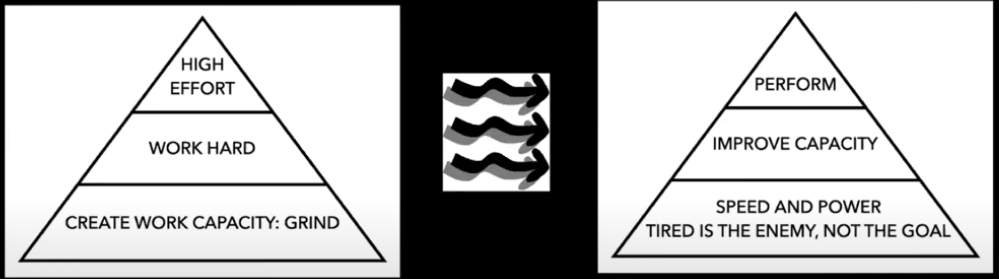
On the left we have the traditional pyramid. On the right it´s the “Feed the Cats” approach. This is why Tony Holler´s sprinters never do anything more than 5 seconds ever because they want to totally sell out towards the growth of speed and power wich takes forever. Speed grows like a tree. Speed grows slow. Because of that you gotta plant that tree early and water everyday because your adaptations become very very slow.
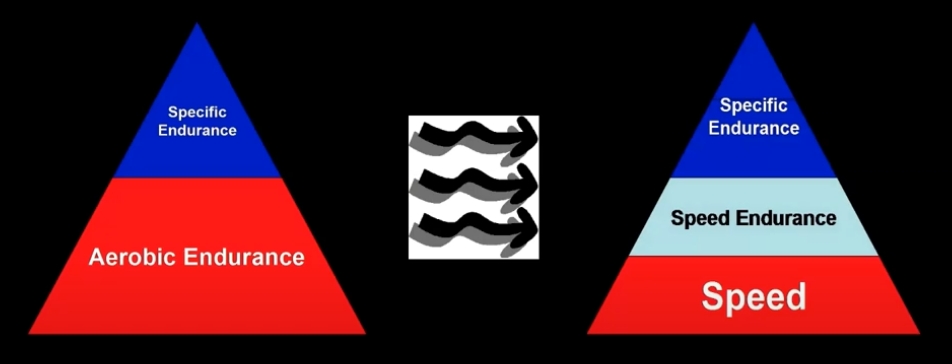
Should you develop speed or endurance first? Certainly don´t develop aerobic-endurance first, because long-slow running will cause loss of speed. You will protect speed even the early phases of base training. Some sprint coaches advocate an inverted pyramid model, developing speed first and then adding endurance training to extend the speed over increasingly greater distances. Based on the scientific principles, you can and should develop speed and endurance simultaneously.
The soccer conundrum
- 9-10 miles of running in a college soccer game.
- 85% of running is at less than 50% of max speed.
- 2% is at 75% of max speed.
- Should 85% of off-season training be at slow speeds? And only 2% at three-quarters speed?
- What wins the game? The slow play or the fast play?
What kind of traits do your best players have? Are they have the ability to run a 10 mile run really well? Or are they fast and explosive?
Things are not always what they seem. In the article “Three reasons why your hurdlers can´t three-step”, Tony Holler´s son presents the following case: “Hey coach, my hurdler fades at the end of the race.” The wrong answer would be “Increase volume (get him really tired every day so he won´t get tired in the race).” The correct answer is “Work on high speed efficiency in first two hurdles.” Everybody that fades you can trace the problem back to the first two hurdles, they probably took off too close to the hurdle, wich caused them to go up and not across the hurdle. Then, because they went up, they came down and collapsed, which means they had to lengthen their stride to the next turtle. Everything about to the first two hurdles caused the problems late in the race. This is counter-intuitive that if you think kids are not finishing well, it seems like an endurance problem. But there is no endurance component to the 110 high hurdles.
Bibliographic references:
- Holler T. [Coach Tony Holler]. (2021). Distance Training From a Sprint Coach (featuring John O’Malley) [Video]. Recovered from https://youtu.be/yG-xHwiyzzo?si=yi7Wm1ld4aP2ij99
- Holler T. [Coach Tony Holler]. (2023). The World’s Greatest Sport is Cross Country … But Some Things Need to Change [Video]. Recovered from https://youtu.be/Bp5xpcKtbkA?si=cFUihnzA_7wqMAQe
- Holler T. [Coach Tony Holler]. (2023). Injecting Speed Training into Cross Country [Video]. Recovered from https://youtu.be/dt_9xBvG-2s?si=KKZ–G90H4GM7t6T
- Holler T. [Coach Tony Holler]. (2023). How I Recommend Speed Training Athletes for Cross Country [Video]. Recovered from https://youtu.be/2Kv4SOzFGJI?si=7N1J9WRUGXgFy7ZL
 ATLETA EXPLOSIVO
Leave a comment