
Tony Holler is a track and field coach and a football and basketball physical trainer. He works at Plainfield North High School. He is also a member of the Illinois Track & Field Hall of Fame and co-director of the Track Football Consortium with Chris Korfist. Tony Holler is the author of the “Feed the Cats” training method. In this article, I’m going to show you how Tony Holler programs speed workouts with his high school athletes.
More isn´t always better. We cannot sprint for two hours. This is not like distance running where maybe more is better. This is not like weightlifting, where we trying to lift for one or two hours. This isn´t like some old school coach that wants to practice three hours. More will only ruin speed training.
Tired is the enemy, not the goal. Speed and power must be trained differently than endurance. The 10th event of the decathlon is an endurance race, the 1500 meters. When finishing, decathletes look like they´re terribly undertrained for this event. The fact is they are. The reason is if they would train for endurance, that would make this race a little easier, it would hurt their other nine events. They wouldn´t be as fast, vault as well, long jump as well, and throw as well because they would be leaner and look like a cross-country guy. These athletes train for power and speed, and then gutted out in the 1500.
Do less, achieve more. When you agree to do a short workout, Tony Holler believes your outputs will automatically increase in intensity and that´s what we´re looking for.
“Never mistake activity for achievement” (John Wooden). John Wooden believed that most sports practices were full of activity without of accomplishing much. So a coach has to constantly ask themsleves: “What do we want to accomplish? What do we want to achieve?” You need to get rid of all those other things that are just activity based. We do not want to be like a bad teacher in a bad class that signs busy work to fill in half the class every day.
Activity or achievement? The problem Tony Holler has found with athletes that he´s worked with, especially remote athletes, is that their schedule is so jam-packed. There are lots of athletes so busy that they can´t speed train that Tony Holler can guarantee these athletes will be slower at the end of the season because they´re full of activity but they´re doing nothing that resembles top speed, high speed, sprinting.
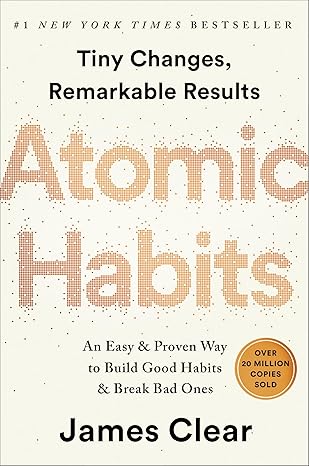
The idea by James Clear that we want to creat habits. You don´t create habits by having huge commitments. You create small habits first and let them grow into bigger commitments. It´s the reason why you call them atomic habits. The atom has a lot of power. Habits have tons of power behind them. But atomic means small like the smallest thing we could possibly have of gold would be an atom of gold.
Tony Holler tried to crerate the smallest possible speed workout that we could possibly do and still called a speed workout. Once we create habits of doing speed workout, then we can progress to more optimal workouts. Tony Holler has a whole catalog of exercises we can do, but we can´t get them done in 16 minutes. So what could we get done in 16 minutes that we could still say would have a really positive impact if we could get out and do this two or three times a week?
The 16 minutes speed workout
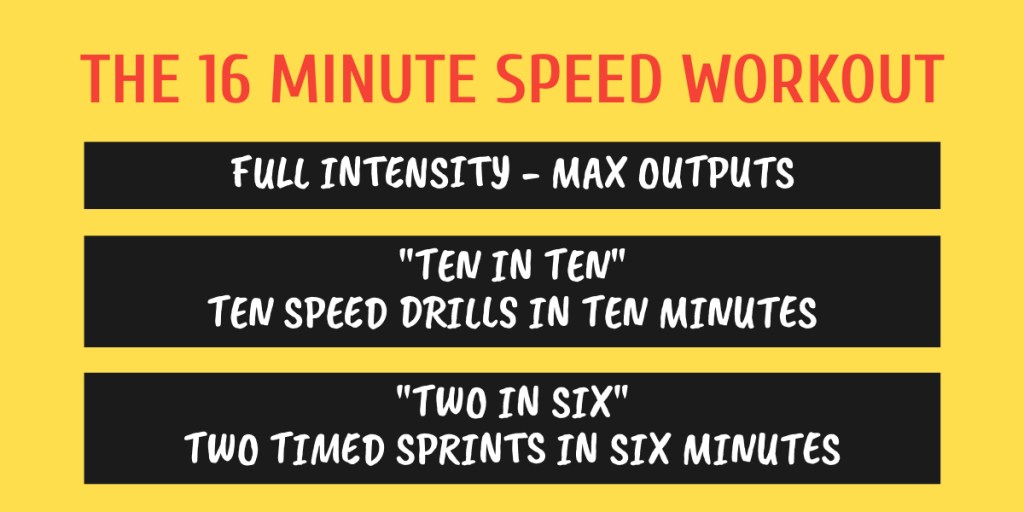
- Everything we´re going to do is full intensity and max outputs. That´s made easier by the fact that our work that we´re going to do do will be in segments of 5 seconds. You need to be fresh. You can´t do this after you lift weights or after a sports practice. You have to find times that you´re fresh in order to train speed.
- “Ten in ten”: Ten speed drills in ten minutes. That means a 5 second speed drill followed by 55 seconds of rest. That´s a 1 to 11 work to rest ratio. #1-3: Front side drills; #4-6: Plyometrics; #7-9: Prime times; #10: Acceleration.
- Fast march
- A-skip
- High knees
- Box jumps
- Bounding. We want to cover a lot of ground but not by just taking big steps. We want a table top thigh, and we want to jump up and out at about a 45 degree angle and pose in the air.
- Pogo jumps
- Short prime times
- Big prime times
- Bent knee prime times
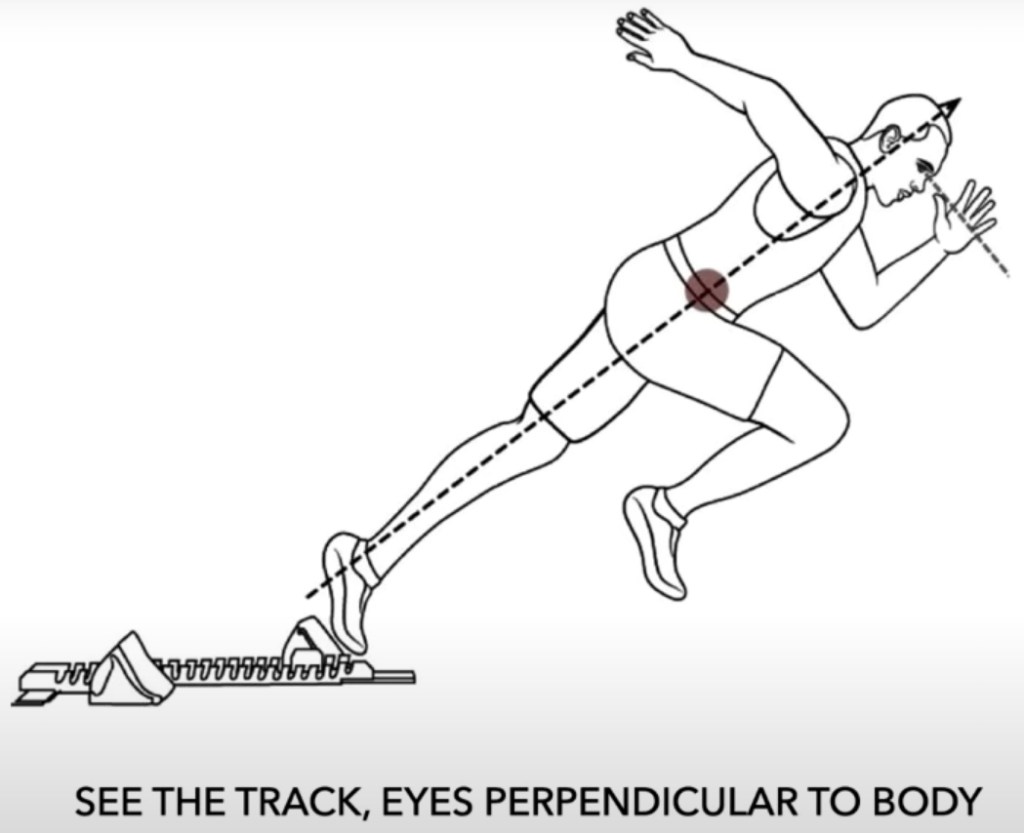
- Accelerate. We start with all of our weight on our front foot. Eyes are down. Split our hands and then rip through all the while we´re going to push the ground behind us. See the track. Eyes perpendicular to the body. When we split and rip coming out, we really want to come out and finish through the hips. When you finish through the hips, you have very good straight lines and you´re not all bent up anymore. We want to fully extend coming out. We won´t come out about 45 degrees with our eyes not up but down. We get to top speed.
- “Two in six”: Two timed sprints in six minutes. Do two 40 yard dashes. It´s 10 times better if you sprint that 40 yards and get timed. We´re going to do two of them and we´re going to separate by 5 minutes of rest. We don´t go shorter rest because we want to be as fast as possible on that second 40 yard dash. You must have timing system to measure max speed.
Front side drills
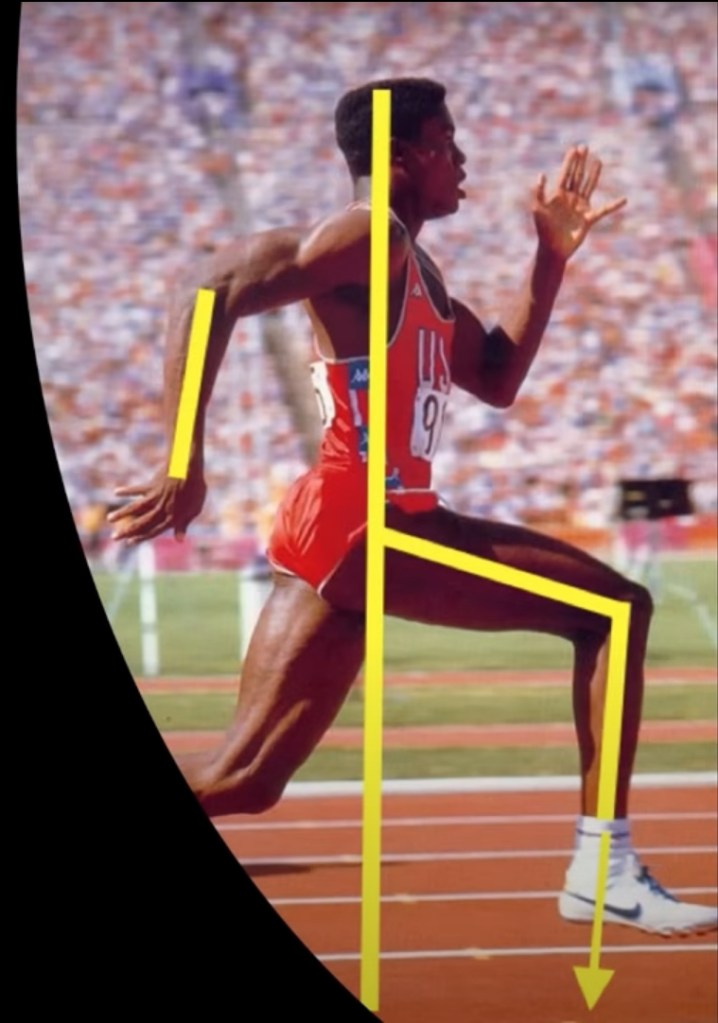
Front side means we´re bigger in the front that we are in the back (the old Carl Lewis pose). We want to be as tall as possible, and we want that back hand we want to have real loose shoulders, so that our back hand has a full range of motion and ends up about 12 inches past our hip. We want to be snappy in our movements and we want to stomp the ground.
- Get tall.
- Cross the hips.
- Foot high and in front.
Sprint
How do you train a cat? “Sprint as fast as possible, as often as possible, staying as fresh as posible.”
Tony Holler says we can sprint three times a week. He thinks the optimal thing you could do with this atomic workout is to do this three times a week.
If you don´t have a timing system, you will be stuck doing 40 yard dashes. The 10 meter fly is like a 30 meter run and there we´re going to time the athlete at maximum speed for 10 meters. Wearing spikes is the optimal when we sprint. Obviously if you are in the road, on a sidewalk or parking, you´re not going to wear spikes. But if you get to a track you will be faster in spikes. The faster you are, the better your central nervous system will remember what that´s speed feels like.
The 40 yard dash looks exactly the samem except we´re going to time the athlete for 40 yards. If you don´t have the Freelap timing system, then you´ll need to stopwatch this. The way you time a 40 yard dash is: 1) The runner gets set. 2) As soon as you see the hands move, you click start. 3) Imagine like a sheet of glass as the finish line. As soon as you see the chest hits that sheet of glass, that´s when you hit the stop. If you don´t have a stopwatch, the third option would be to just run this and pretend you´re getting timed.
Mechanics
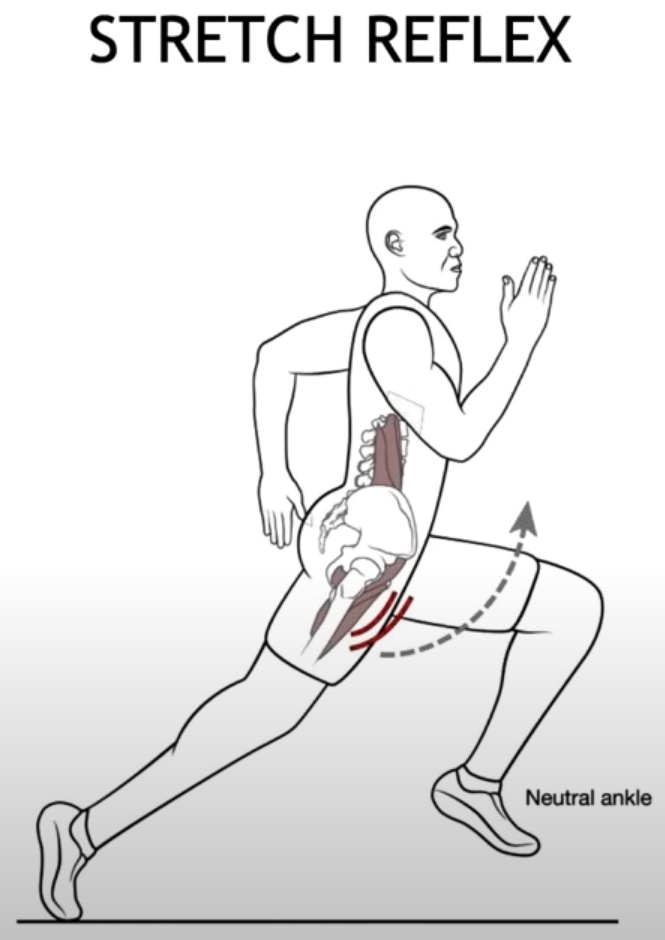
When you´re big in the front, you´re get this stretch in your hip flexor, which is like a rubber band. That stretch will result in a snap forward. The neutral ankle is called a dorsiflex foot. The toe is supposed to be up and not pointed to the ground.
Most people that play field sports like soccer, lacrosse, rugby or football, don´t get into good front side mechanics because they´re always tired. They´re just like jogging or tired running. There´s a huge difference between running and sprinting. We need to train when we´re fresh in the off-season a couple times a week, even in-season. We need to train to run fast. Most high school athletes train for their sport and they lift weights. That´s all they do and they get tired a lot. They just think that speed must be genetic: slow people are always going to be slow; fast people were born that way. They don´t realize that speed can be improved just anything else in your life, but you gotta make it a habit. So hopefully the 16 minute speed workout can get you out the door.
The 16 minute speed workout is not optimal. This is atomic. It´s the tiniest speed workout you could possibly do. The good thing about this maybe it will become a habit for you. This could improve you a great deal, especially if you never done speed workouts before.
“Never mistake activity for achievement.”
John Wooden
“Sprint as fast as possible, as often as possible, staying as fresh as possible.”
Tony Holler
“Rest, recovery, sleep.”
“Tired is the enemy, not the goal.”
“Do less, achieve more.”
“Never let today ruin tomorrow. Never burn the steak.”
“You don´t plant beans and grow corn.”
“Speed grows like a tree.”
“Speed is the tide that lifts all boats.”
“Speed is the best barometer of health.”
“In speed development, the nervous system only understands quality.”
Boo Schexnayder
“Always choose quality over quantity.
His Holiness the Dalai Lama
This rule applies to every life situation.”
Bibliographic references:
- Holler T. [Coach Tony Holler]. (2022). The Atomic Workout | 16 Minute Speed Workout [Video]. Recovered from https://youtu.be/M2eGvElkBQU?si=j-s15s58Jz2Q70zh
- Holler T. [Coach Tony Holler]. (2022). ATOMIC SPEED WORKOUT – Best and Shortest Workout to Improve Speed [Video]. Recovered from https://youtu.be/hLsmj_DUKpY?si=n7pT_W-JQQv6HD8r
 ATLETA EXPLOSIVO
Leave a comment