
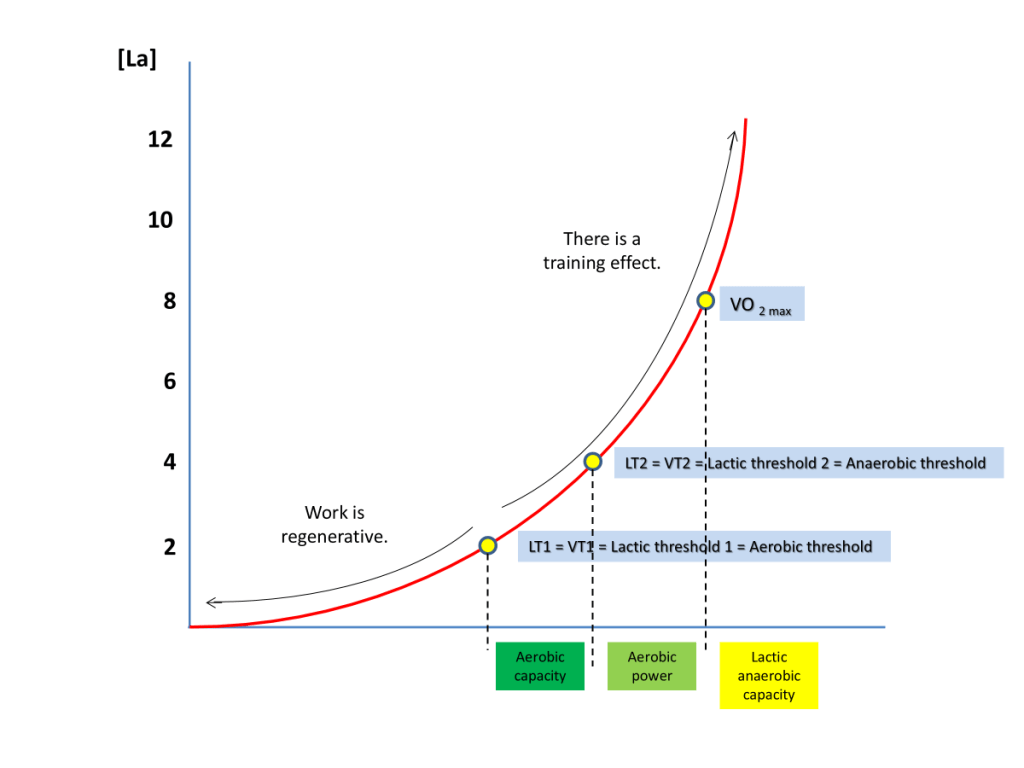
As we perform physical activity continuously over time (running, swimming, cycling, rowing, etc.), the blood lactate concentration will increase proportionally to the intensity of the effort made. But why is all this important?
Blood lactate levels correlate with blood hydrogen ion (H+) levels. Both are the result of the dissociation of lactic acid into lactate and hydrogen ion, therefore the same proportion of both elements exists. Lactic acid is a compound that is formed as a result of anaerobic glycolysis, that is, obtaining energy without the presence of oxygen.

High concentrations of hydrogen ions are responsible for producing muscle fatigue, creating a metabolic acidosis scenario that makes efficient muscle contraction difficult and, as a consequence, worsens an athlete’s physical performance. What we are really interested in is knowing the hydrogen ions concentration in the blood, as this is one of the main factors responsible for fatigue. However, there is no direct method that allows us to measure this parameter. Therefore, an alternative is to use the blood lactate concentration, since knowing this data will indirectly tell us what the hydrogen ions concentration is and the level of fatigue in an athlete.
To measure the blood lactate concentration we can use photometry or electroenzymatic analysis. Either method is perfectly valid. The difference between the two is that although the photometric method is the gold standard test, it is very expensive and takes hours to obtain the results, while in the electroenzymatic method you prick the earlobe and in 10 seconds the result is known.
Therefore, plasma lactate concentration is a very useful indicator that allows us to measure the intensity of the load in endurance training. It is worth mentioning that measuring blood lactate is of interest for use in cyclic sports because they consist of a stable, long-duration test. It is not useful for intermittent or acyclic sports because it varies as it clears up during periods of standing still.
Based on the lactate concentration and the predominance of the different metabolic pathways that are put into operation, we can establish three thresholds and define several training zones according to the intensity of the exercise.
In this way we distinguish:
- The aerobic threshold or lactate threshold 1 (LT1 or VT1), from which anaerobic metabolism starts to function, but the aerobic pathway remains predominant. Above this threshold, a training effect is already produced, while below it, the work is regenerative. Below LT1, 100% of the energy comes from the oxidative pathway, generally from fats.
- The anaerobic threshold or lactic threshold 2 (UL2 or VT2) is the threshold at which anaerobic metabolism begins to predominate over aerobic metabolism. Therefore, the body is no longer able to buffer all the hydrogen ions and they begin to accumulate. The speed of muscle contraction begins to decrease.
- Maximal oxygen consumption (VO2 max) is the maximum amount of oxygen that can be extracted from the blood to be used by the muscles during physical exercise.
The correlation of these thresholds with blood lactate levels has been observed to be as follows:
- At UL1, 2 mM lactate is reached.
- At UL2, 4 mM lactate is reached.
- At VO2 max, 8-9 mM lactate is reached.
It is worth mentioning that the highest blood lactate levels that have been detected were in 400-meter sprint runners, reaching 19-22 mM.
¿Y durante cuánto tiempo se puede mantener el ritmo en cada uno de estos umbrales?
And how long can you maintain the timing at each of these thresholds?
- The timing at UL1 can be maintained almost indefinitely.
- The timing at UL2 can be maintained for up to 45 minutes.
- The timing at VO2 max can be maintained for up to 3 minutes (6 minutes in well-trained athletes).
Lactate thresholds allow you to define training zones whose effects are different based on the type of effort being worked on.
- Zone 1: Between UL1 and UL2. The type of effort worked on is aerobic capacity.
- Zone 2: Between UL2 and VO2 max. The type of effort worked on is aerobic power.
- Zone 3: Above VO2 max. The type of effort worked on is lactic anaerobic capacity.
Bibliographic references:
- Sports Resource Group, Inc. (2020). Lactate.com. https://lactate.com/index.html
- Legaz A. (2012). Manual de Entrenamiento Deportivo. Paidotribo.
- Muñoz M. (s.f.). Lactato en el deporte: cómo influye, cómo calcularlo y cómo mejorarlo. Fit Generation. https://fitgeneration.es/lactato-en-el-deporte/
 ATLETA EXPLOSIVO
Leave a comment