
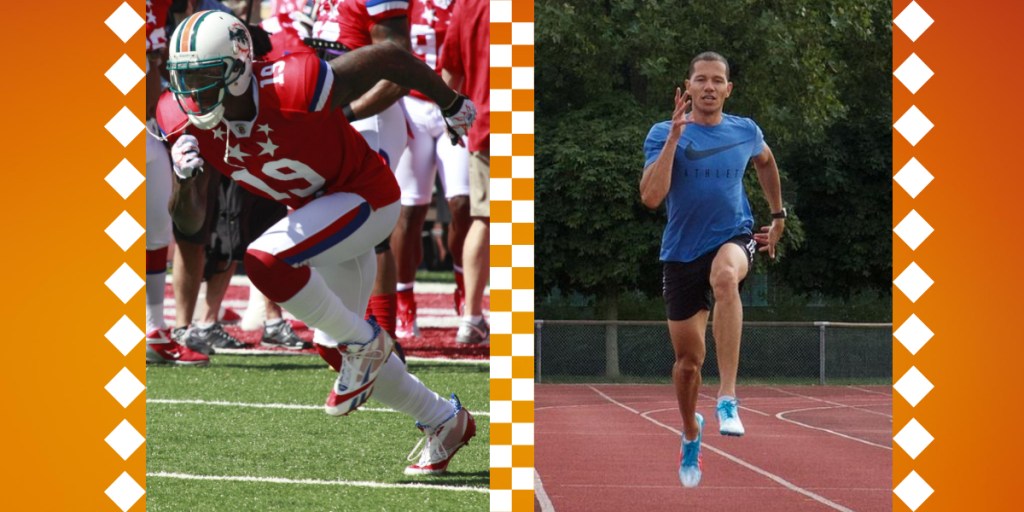
According to Kelly Baggett in his book “No-Bull Speed Development Manual”, if we look at the way athletes sprint, especially at the amateur level, we can broadly differentiate two types of sprinters: athletes who are faster than strong and athletes who are stronger than fast. Below we are going to explain the differences of this classification:
Athletes who are faster than strong:
- Their strength levels do not stand out above their speed.
- They are not able to lift more than twice their body weight in a squat. They lift 1.5 times their body weight or less at most.
- They do not stand out for making quick starts in sprint races (the first 20 meters). Instead, they manage to reach and maintain a great top speed.
- Their vertical jump on two legs from running or landing in depth (depth jump) is 20% or more higher than their standing vertical jump (countermovement jump).
- They have good coordination and move fluidly, that is, their feet do not weigh them down since they are easy to store elastic energy and express it in the form of reactive force. They are said to be natural sprinters.
- Their build tends to be thinner with long legs, thin ankles, long Achilles tendons and a shorter trunk.
- Examples of athletes who are characterized by meeting all these requirements are Jesse Owens, Carl Lewis and Usain Bolt.
Athletes who are stronger than fast:
- They tend to be much faster at the beginning than at the end of a sprint race. That is, they stand out for making fast accelerations but are not capable of developing a high top speed.
- They are able to easily lift twice their body weight when doing a squat.
- They tend to have a thicker build with large ankles, short legs, and a long torso.
- Their running vertical jump is almost the same as their standing vertical jump.
- Their strength levels stand out compared to his speed, vertical jump and movement efficiency.
- It is often said that their feet feel heavy because they have a hard time storing elastic energy and expressing it as reactive force.
- An example of an athlete who can be classified within this group is Ben Johnson.
Of course, these two types of sprinters correspond to the two extremes of a scale in which everything is not always black or white, but sometimes there are different shades of gray.
The interesting thing about this classification is that it allows us to know the strengths and weaknesses of an athlete when doing a sprint. And with this we can make a more personalized programming with the aim of improving his performance by dedicating more hours of his time to improve his weak points and enough hours to maintain his virtues.
In the case of people who are faster than strong, they will spend more time lifting weights with basic Olympic bar exercises to improve their maximum strength in which they have a deficit. And in the case of people who are stronger than fast, they will invest more hours in doing plyometric work and sets of sprints to improve their explosiveness and top speed, and running technique assimilation exercises to improve their efficiency in movement.
Both physical qualities, strength and speed, are necessary to be successful in a sprint race since power, that is, the ability to make an effort as quickly as possible, is the result of multiplying the two (strength x speed).
Bibliographic references:
- Baggett, K. (2006). The Ultimate No-Bull Speed Development Manual.
 ATLETA EXPLOSIVO
Leave a comment