
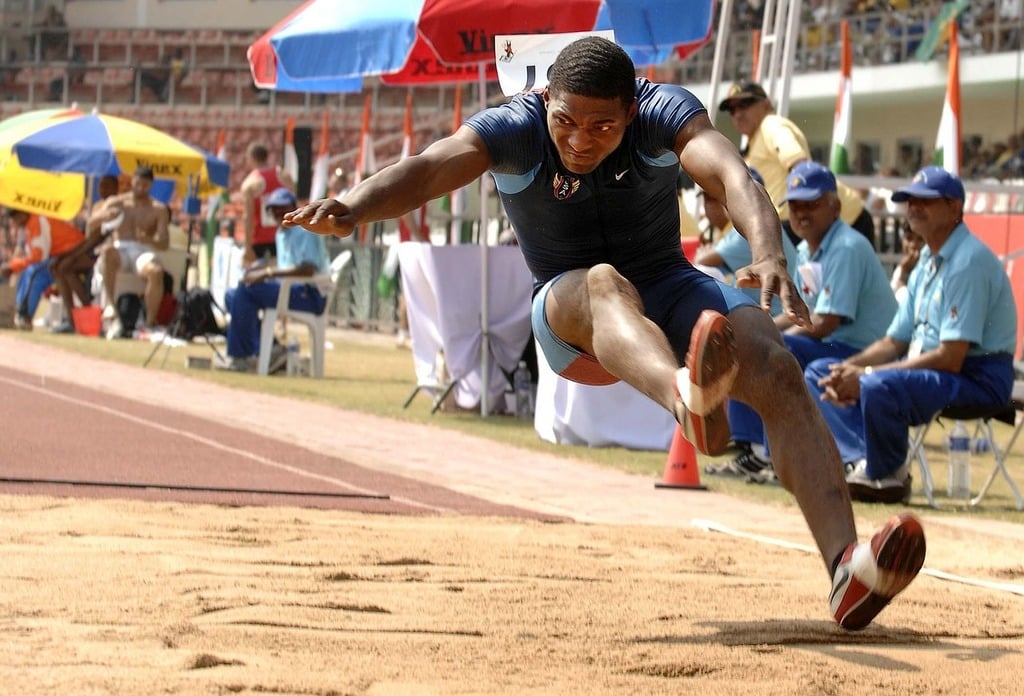
Jumping is the Glue
According to coach Justin Kinseth, jumping is the glue between those football players and those track athletes, knowing that you can have a field event on the in between that can be able to provide both. You´re getting great plyometric work in, you´re sprinting… The long jump and triple jump is such an athletes and athletic movement, and also where a football player can delve into and feel like they can be a part of that program even more.
- Max velocity is the priority number 1 but utilize to its fullest.
- All athletes must sprint, but not all athletes are sprinters.
- If you can sprint, you can jump. Speed is so important with the long and the triple jump. Those events help build into a better sprinter as well. So it´s a double-edged sword. If you´re that football coach that wants your athletes to get faster, you gotta involve the jumps with it too.
- The eighth faster sprinter on your team can be your best jumper. Imagine results once faster.
- Long and triple jump are triple threat events:
- In an acceleration phase you´re pushing out the back, you´re being aggressive down the runway.
- In the max velocity phase you´re hitting high in tension.
- The plyometric phase is the bounding, the jumping, the hit learning a penultimate step. You can turn that speed and translate it into a very far jump.
- Invest in the jumps.
Priorities in Developing the Long Jump
- Instructing a proper “penultimate step”.
- Developing a consistent approach.
- Understanding take off and flight mechanics.
- The entry.
The Penultimate Step
- It´s simply the “step before last”. It sets up proper take off position.
- The last two steps are a flat foot concept. It´s a “rocking chair principle” (heel to toe).
- Hips remain high. Jump should feel reactive, not forced.
- It allows essentially three things to occur:
- The Achilles tendon is primed for take off.
- That minimal drop in height allows “the bump” or “hitting the pot hole”.
- It provides correct front side distance for the take off leg to enable proper rotation.
The Approach
You should find each athletes fastest point of velocity. Build from there. i.e. Don´t 8 step if 7 will do. There are 3 phases to the approach:
- Acceleration phase (First 6 steps or 3 rights/lefts). It must be consistent. This is where jumpers foul on the board 90% of the time.
- Rhythm phase (Next 6-8 steps or 3-4 rights/lefts). Athlete builds into the crescendo of the jump. He feels bouncy, relaxed, and fast.
- Gathering phase (Last 4 steps or 2 rights/lefts). Athlete must be aggressive through the board while keeping postural integrity. Cue the athlete to feel “crowded at the board”. It prevents reaching. Athlete should feel reactive through the board. Try to have the board “scare you”. Do not force this phase.
Take Off and Flight Mechanics
The take off should be abrupt. Blocking of the free arm and leg should occur at 90 degrees. Jumper should project out, not up or forward. Proper front side mechanics of take off leg. Athlete should amortize force from absorption to propulsion. “Broom stick theory” or “rigidity” will allow the bump to occur.
In flight mechanics the number 1 goal is slow rotation. While short levers are fast, long levers are slow. (Ice skater and fit the hallway). We want long levers to slow rotation. Sail vs Hang vs Hitch. There is no “better technique”, only what slows rotation the best.
- Sail. Hold the drive knee position. Stay long with hands up. Then leg chute.
- Hang. Drive free leg. Then drop both knee and hands. Form a reverse “C”. Then leg chute.
- Hitch. The number depends on athlete. Arms/legs create big cycles. One way is to do punch-punch-leg chute.
Learn all three ways and teach what comes natural to athlete.
The Entry
The entry is the most neglected of the 4 priorities, yet the easiest skill to develop.
- 1st phase. Lead with knees. Then deploy the chute (chair drill).
- 2nd phase. “Fit the window” during leg chute. Knees lead, chest drops and eyes up.
- 3rd phase. “Pluck and pull”. Upon landing, extend and pluck feet into sand heels first. Quickly “pull”, “collapse”, or simply replace your butt into your feet marks. (Indiana Jones Switcheroo). Finally roll off to the side with hands up and elbows in.
Cues Justin Kinseth Uses
- Push out the back – Keep the first 6 steps consistent on runway.
- Head thru ceiling – It reminds the jumper to keep strong posture and high hips.
- Crowd the board – It prevents reaching. Allows a reactive jump, not forced.
- Big punches – It promotes aggressive knee and arm drive/blocking at take off.
- Fit the hallway – While in-flight, It keeps jumpers long and slow thru rotation, no starfish.
- Squeeze! (right before the entry) – It reminds the jumper to fit thru the window before the pluck and pull into sand.
In this video you have a complete demonstation of long jump training drills.
Priorities in Developing the Triple Jump
- Instructing proper bounding mechanics.
- Developing a consistent approach.
- The 1st phase.
- The 2nd phase.
- The 3rd phase and entry.
Proper Bounding Mechanics
Flat foot striking is the foundation of bounding. Core is locked in. Posture and hips are high. You must land with a heel-to-toe foot strike (rocking chair concept). Toeing is a defensive mechanism.
Arms: Single vs Double.
- Single
- Pros: It promotes balance, speed between phases. (Tightrope walker)
- Cons: Limited propulsion.
- Double
- Pros: More powerful. It increases distance/propulsion.
- Cons: Difficult to maintain balance.
Justin Kinseth´s opinion: Speed based jumpers – Single; Plyometric based jumpers – Double.
The Approach
You should find each athletes fastest point of velocity. Build from there. There are 3 phases to the approach:
- Acceleration phase (First 6 steps or 3 rights/lefts). It must be consistent. This is where jumpers foul on the board 90% of the time.
- Rhytm phase (Next 6-8 steps or 3-4 rights/lefts). Athlete builds into the crescendo of the jump. He feels bouncy, relaxed, and fast.
- Gathering phase (Last 4 steps or 2 rights/lefts). Athlete must be aggressive through the board while keeping postural integrity. Cue the athlete to feel “crowded at the board”. It prevents reaching. Athlete should feel reactive through the board. Try to have the board “scare you”. Do not force this phase.
The 1st Phase
Skipping the rock. It´s important to preach projecting forward. Cueing out causes too much height/crashing. Run thru the wall or be aggressive thru the board.
The pop-n-drop. The athlete pops the drive knee forward to immediately drop “lengthen”. It promotes a low center of mass to keep the rock skipping. (No scissor kicks). Take off leg then abruptly “tucks” under the butt for a big cycle. (Pick it up). Take off is now back in front and primed to push up into the 2nd phase.
The 2nd Phase
In the 2nd phase we drive the swing knee. Drive the pop-n-drop swing knee into a 90 degree bend (hit the “H” position). Reminder: Keep postural integrity and lock in core to maintain rigidity.
Go from an “H” to a “Y”. Next, extend the 90 degree bent “H” leg to promote an active landing (hit the “Y” position). It allows proper frontside distance to prevent over rotation. It emphasizes to lead with the heel and push up on ground contact.
The 3rd Phase and Entry
The 3rd phase and entry are the most neglected, yet the easiest skill to develop.
- 1st phase. Lead with knees. Then deploy the chute (chair drill).
- 2nd phase. “Fit the window” during leg chute. Knees lead, chest drops and eyes up.
- 3rd phase. “Pluck and pull”.
Upon landing, extend and pluck feet into sand heels first. Quickly “pull”, “collapse”, or simply replace your butt into your feet marks. (Indiana Jones Switcheroo). Finally roll off to the side with hands up and elbows in.
Cues Justin Kinseth Uses
- Push out the back – Keep the first 6 steps consistent on runway.
- Head thru ceiling – It reminds the jumper to keep strong posture and high hips.
- Run thru the wall – It keeps the jumper aggressive and promotes forward instead of out.
- “H” to “Y” – It promotes the jumper to lead the knee into 90 degree bend. Then extend out to prepare for impact/push into next phase.
- Lead with the heel – It prevents toeing within bounding.
- Big arms – Little arms = little phases
- Squeeze! (right before entry) – It reminds the jumper to fit thru the window before the pluck and pull into sand.
In this video you have a complete demonstation of triple jump training drills.
Bibliographic references:
- Holler T. [Coach Tony Holler]. (2022). Horizontal Jumps Development – An Introduction with Justin Kinseth [Video]. Recovered from https://youtu.be/d9Z-5PMMB4Q?si=0L1j3Sma9aL3xafC
- Holler T. [Coach Tony Holler]. (2022). How to Train for the Long Jump | The Approach and Penultimate Step [Video]. Recovered from https://youtu.be/cwdIILRknwA?si=wvjchZAsgFYdxx4A
- Holler T. [Coach Tony Holler]. (2022). How to Train for the Long Jump | Flight Mechanics and Entry [Video]. Recovered from https://youtu.be/ovnkwOkx8Pk?si=kj0FVOobbtSOUz1t
- Holler T. [Coach Tony Holler]. (2022). Long Jump Training Drills | A Complete Demonstration [Video]. Recovered from https://youtu.be/KrzPuBEnJnI?si=IJEe1s3z9439DjTY
- Holler T. [Coach Tony Holler]. (2022). Everything You Need to Know When Training for the Triple Jump [Video]. Recovered from https://youtu.be/XoYtu5RDE_k?si=uavwWlRWgsfkDmV8
- Holler T. [Coach Tony Holler]. (2022). Triple Jump Drills | A Complete Demonstration and Walkthrough [Video]. Recovered from https://youtu.be/Cb0gaJ1TDzA?si=aEeIUvSn6c0v8T3t
 ATLETA EXPLOSIVO
Leave a comment