

In this post, I want to present different situations that can occur in team sports where the ball is played and both teams share the field. I’ll also explain how you should proceed to resolve each of these situations from a defensive perspective, with the goal of preventing the pass from being played between the attackers and being better prepared to intercept it if does end up being made. All of these solutions are perfectly applicable to various sports (basketball, handball, soccer, American football, Australian football, hockey, etc.).
Before starting, it is necessary to clarify the meaning of the following acronyms:
- AWB: Attacker with the ball
- AW/OB: Attacker without the ball
- DAWB: Defender of the attacker with the ball
- DAW/OB: Defender of the attacker without the ball
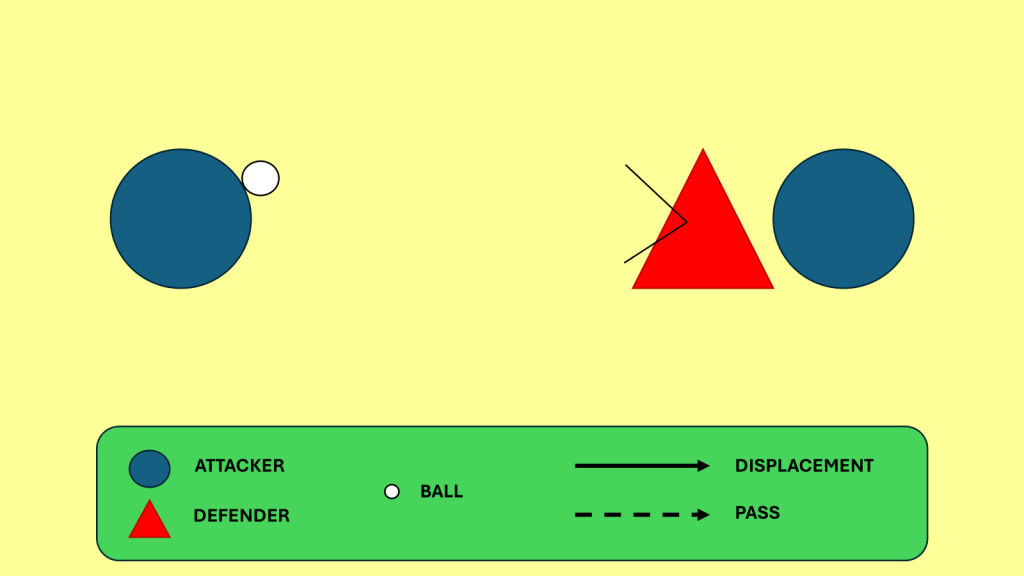
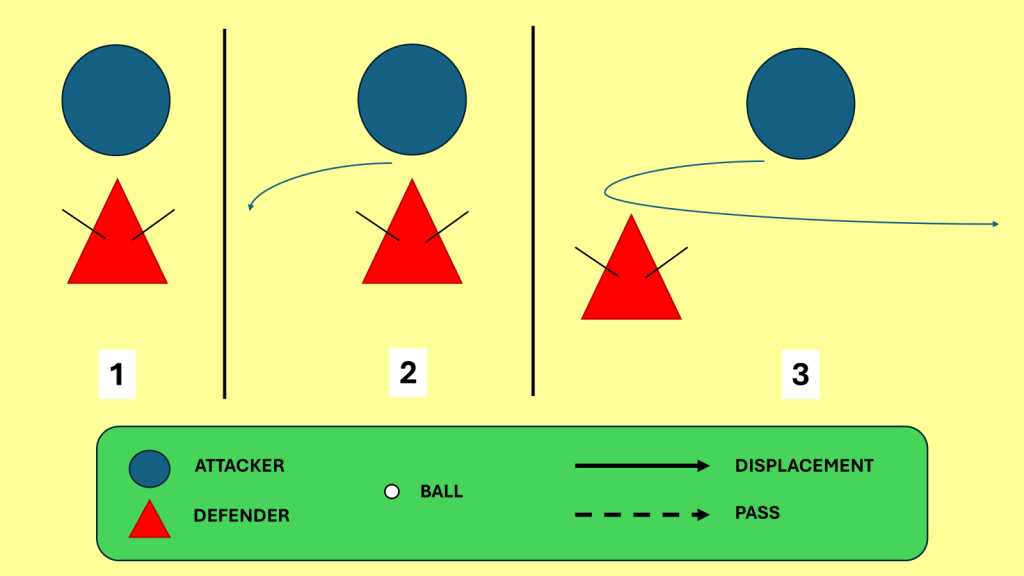
SITUATION #1: 2 ATTACKERS vs 1 DEFENDER (2×1) – Neither attacker can move from his position
This is the easiest position of all to defend, as both attackers, unable to move from their positions, act as if they were poles or lampposts. The defender must always cover the AW/OB and has the luxury of standing with his back to him, allowing him to see the AWB.
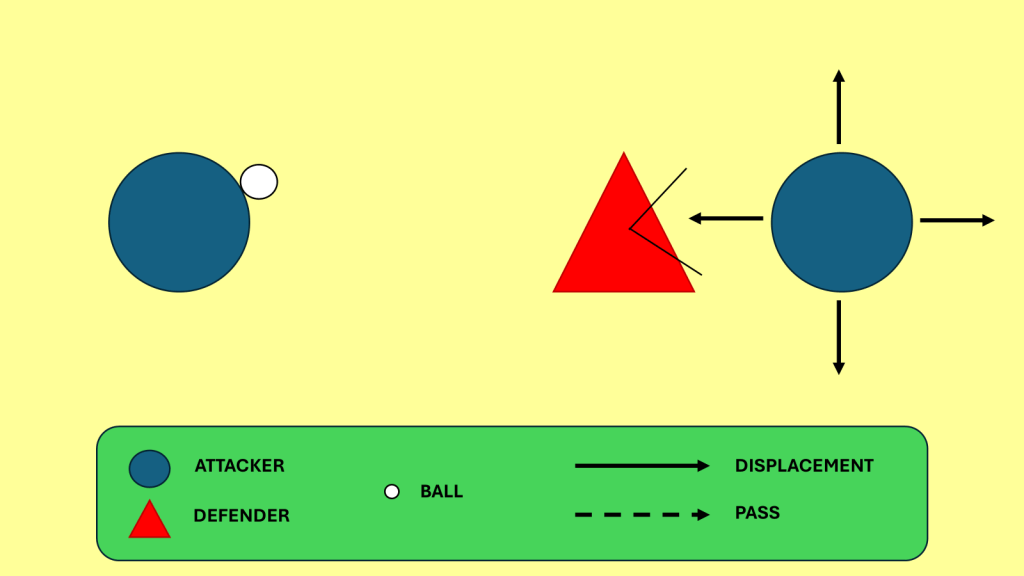
SITUATION #2: 2 ATTACKERS vs 1 DEFENDER (2×1) – Only the AW/OB can be moved from its position
In this situation, the scene becomes a little more complicated, as one of the attackers can move from their starting position. Again, the defender must cover the AW/OB, but this time, they must face them head-on. Since they can move, they must pay attention and be alert to react quickly in the same direction they are moving.
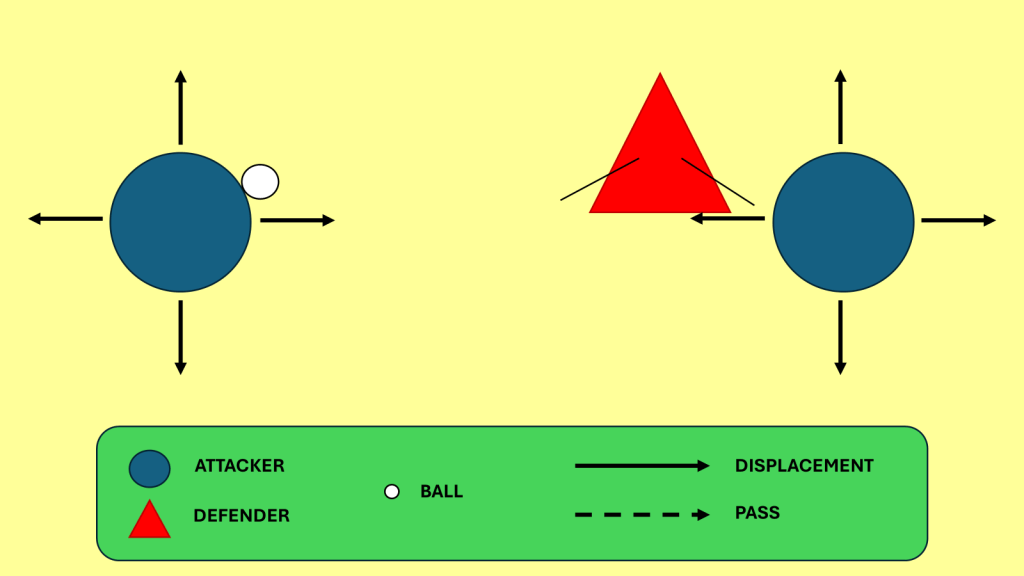
SITUATION #3: 2 ATTACKERS vs 1 DEFENDER (2×1) – Both attackers can move from their positions
Without a doubt, this is the most difficult situation of all to defend when outnumbered. Once again, the defender must be close to the AW/OB, but must position himself in a sideways position where he can constantly see both the AW/OB and the AWB and be aware at all times of the spatial position of both attackers, which will change continuously because both can move. Again, it is essential for the defender to be constantly alert and react quickly in the same direction as the AW/OB, trying to anticipate and prevent the creation of a passing line between the two attackers.
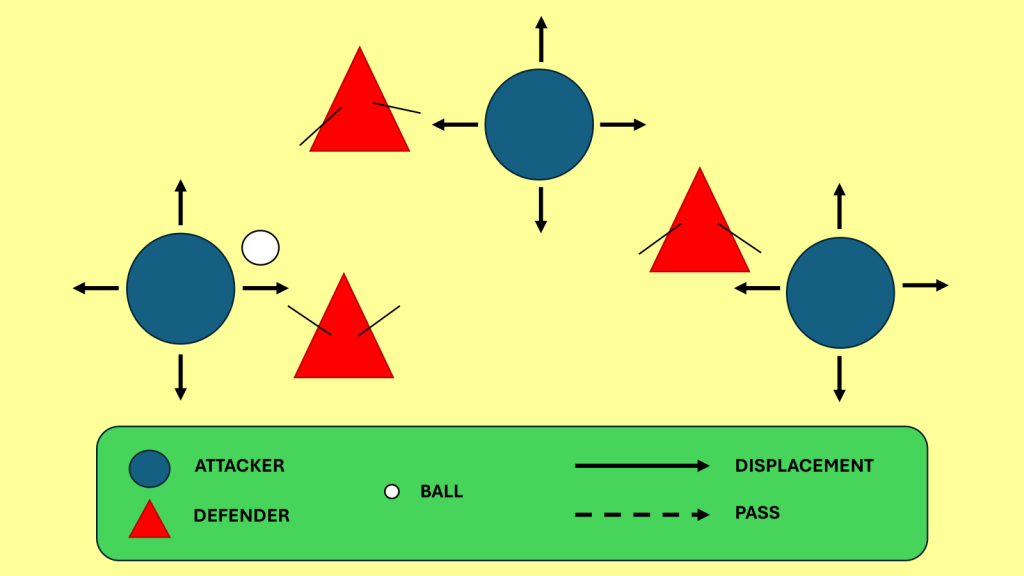
SITUATION #4: 2 ATTACKERS vs 2 DEFENDERS (2×2) – Both attackers can move from their positions
This situation is a little easier than the previous one, because although all attackers can move from their starting position, there is a numerical equality between attackers and defenders. Ideally, each defender should always cover the same attacker, positioning themselves close to him and positioning themselves to the side to maintain the spatial reference of both defenders, which will vary at all times. Once again, it is important for each defender to be constantly alert and react quickly in the same direction as their defender, trying to anticipate and prevent the creation of a passing line between the two attackers. It could happen that both defenders are forced to switch the attacker they were covering to keep them marked and not be left free. An example of this is when the AW/OB wants to block the DAWB, which is a good time to switch attackers if the block is going to be effective.

SITUATION #5: 3 ATTACKERS vs 3 DEFENDERS (3×3)/4 ATTACKERS vs 4 DEFENDERS (4×4)… – All attackers can move from their positions
The resolution is the same as above, ideally covering the same attacker. The only difference is that by positioning ourselves on the side closest to the attacker we are covering, we must know the spatial reference of a greater number of attackers, but we will always prioritize both our attacker and the AWB (if we are covering an AW/OB), and the AWB and AW/OB closest to us or those most likely to receive a pass (if we are covering the AWB).
So far, I’ve explained how to act in each of these situations from a defensive perspective. But as attackers, how can we break away from the defensive pressure and create passing opportunities?
- The AW/OB should try to get away from his defender by deceiving him by making quick changes of direction in the form of feints, and by seeking to create a direct passing line between the AWB and him.
- If the ACB is covered by a defender (as occurs in numerical equality situations), he must always protect the ball by moving it away from him, using his body to act as a barrier between the ball and his defender. Obviously, like the AW/OB, the AWB will use their movement to create a passing line with an free AW/OB, thus being able to effectively pass the ball.
I hope I’ve helped you understand how to resolve each of these typical passing dynamics situations that occur so frequently in team sports involving the ball and shared space. Now all that’s left is to practice and apply it to your real-life game.

 ATLETA EXPLOSIVO
Leave a comment