
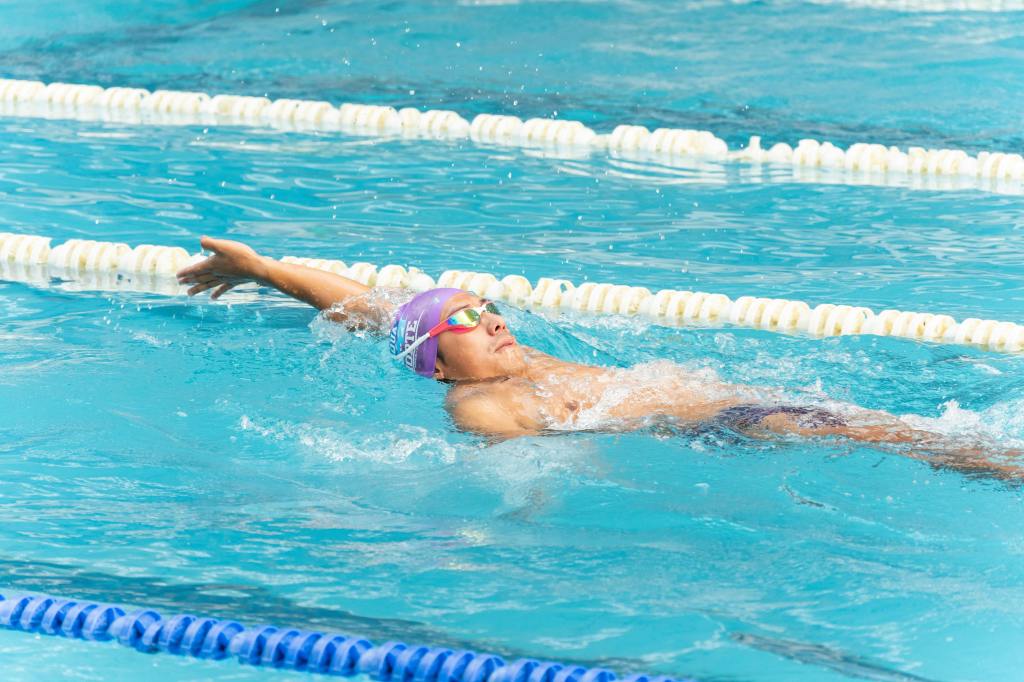
The backstroke is an alternative swimming style in which the swimmer performs rotating and alternating movements of the arms. To turn, he sinks his head, lifts both legs out of the water and takes momentum off the wall. The existing competition events of this style in swimming are the following: 50 m, 100 m, 200 m. Among them, only the last two are Olympic.
When analyzing the technique of any swimming style we must pay attention to observing four body segments: arms, legs, trunk and head. The arms are the most important segment in technical analysis. In this way, in backstroke swimming we can contemplate all of the following:
- ARMS
- Air phase or recovery. The elbow is fully extended. The end of the air phase is the entry of the hand into the water. In it, the hand is positioned with the palm facing out, so that the first thing to enter the water is the little finger. Thus the hand is now prepared to correctly perform the grip.
- Aquatic phase or traction. It is the most important phase because it is the one that allows the swimmer to propel himself. It is divided into 3 subphases:
- Grip. It is the most important subphase of all because it is where traction begins and conditions the other subphases. It is the subphase in which the most force is generated.
- Pull. It is the subphase in which the most power is generated.
- Push. It is the subphase in which the most speed is generated.
- LEGS
- Ascending phase. It is the most important phase because it is the one that allows the swimmer to propel himself.
- Descending phase.
- TRUNK. It must be in a horizontal position. It intervenes in rolling.
- HEAD. The gaze should be upward. It intervenes in breathing.
Rolling is the turning or rotating movement of the shoulders and the rest of the body in the longitudinal plane. It is important because it provides fluidity in swimming as it allows you to expand the range of motion in both the stroke and the shake.
In the backstroke style the shake is continuous. Therefore, there is only one type of coordination.
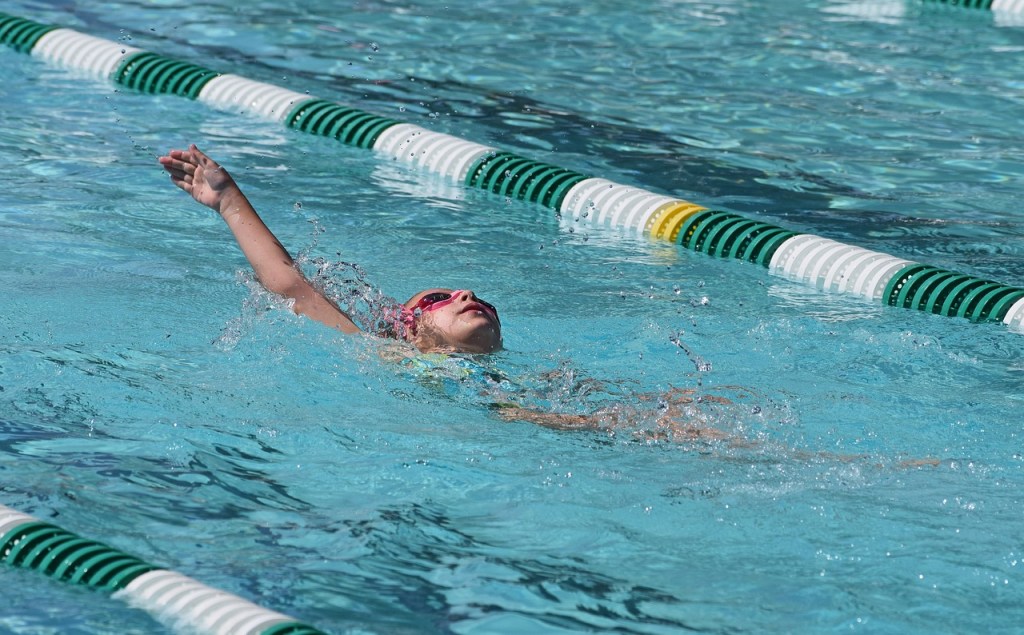


Grip is always the number 1 priority when observing a swimmer’s technical performance. The grip is the part of the stroke where we try to generate more force. All other parts of the style should be linked to help make the grip better. When performing the grip, all of the following considerations must be taken into account:
- The entry of the hand should be in line with the shoulder and not behind the head. If we try to grab water behind the head we will be pushing to the side and not towards the feet.
- Once you enter the water, the hand changes direction to direct the palm towards the feet and not down. Sometimes it happens that the swimmer feels pressure on the shoulder when he pushes down with his palm and then thinks that is better, but no. Ideally, he should not notice much tension in his grip; this will be a sign that he is orienting his hand well.
- The tips of the fingers have to point outwards (that is, away from the body).
- This grip position will put your hand in a perfect position to push water toward your feet for the majority of the pull.
- During traction, the arm should follow the extension of the trunk from a frontal view. The arm should be in line with the back.
- In this way, the traction will be more powerful and we will keep the elbow flexed more than 90º. When the swimmer sinks his hand too much during the pull, it usually happens that the elbow has to bend too much, the hand gets too close to the body and is less effective.
- Do not push down.
- Do not direct the arm under the body.
- The sensation is like throwing a ball on the ground while standing.
- We must try not to compromise the core, which must be compact.
In relation to the position of the head and body during swimming, the swimmer should keep the chest slightly sunken and the head slightly inclined, as if resting on a pillow. To do this, the back and head must adopt a rounded, curved position. This will help the hips to be just below the surface of the water and the legs can move freely making for an effective and more propulsive shake. If he put his head too far back (look up), his back will arch and his hips will possibly sink more.


The most important thing about rolling is not how much you turn but when you turn. This action must be done soon. The magnitude of the roll should allow you to grip well (a maximum rotation of approximately 20-30° is sufficient). The arm when pulling does not require greater rotation. You have to stay more on your back than on your side. You have to try to pull with your entire arm, from the shoulder to the hand.
The key is to make the roll a little early so that when the hand enters the water, the trunk is already oriented a little towards that side. If the roll is done late, the entry of the hand into the water will be difficult. The elbow is probably flexed at the entry and this occurs over the head, in addition to the hand entering with the back and not with the little finger. We can control the rotation time by lowering the armpit and thus sinking the shoulder.
In addition to achieving adequate rotation time, coordination is important when rolling. So that the roll is well coordinated, it is good to start it with the help of the end of the traction of the opposite arm. That is, with the end of the traction I have to support myself to start turning my hips to the other side and, with that, help the body to be correctly oriented when the hand prepares to enter the water.
The push is the end of the stroke and we must use it to rotate early. To do this, the hand goes down and inward. The tips of the fingers are oriented upwards, that is, towards the surface. We must rotate our shoulders to the other side to favor the entry of the other hand. You have to feel the push of your hand to finish the stroke. A common mistake is to push down with the palm of your hand. The push should occur below the hips and end to the side of the body, at hip level. You have to raise your hand so that it comes out of the water near your hip.
The cadence (timing) in backstroke swimming should be marked by the turn of the body and not by the movement of the arms. In this way, when the swimmer wants to accelerate the stroke frequency, he must increase the cadence of the body turn.
The parameters that allow us to control performance are stroke frequency and cycle length. Stroke frequency is the number of strokes per minute. To define the cycle length, we must assume that a cycle is the interval included every 2 strokes in the crawl and backstroke styles, or in each stroke in the breaststroke and butterfly styles. The cycle length is the distance traveled from the entry of the hand into the water until the hand of that same arm re-enters. It is usually measured in meters.
Bibliographic references:
- Zarzosa, F. (n.d.). Técnica de Espalda para el Alto Rendimiento [PDF file].
- International Olympic Committee (n.d.). Swimming. https://olympics.com/en/paris-2024/sports/swimming
- Marca. (n.d.). Natación. https://especiales.marca.com/juegos-olimpicos/natacion.html
 ATLETA EXPLOSIVO
Leave a comment