

Depending on the relationship that an individual establishes with external resistances, muscle activation can lead to three different contractions:
- CONCENTRIC: With shortening of muscle fibers. Overcoming external resistance. The external force acts in the opposite direction to the movement.
- ECCENTRIC: With lengthening of muscle fibers. Assignment to external resistance. The external force acts in the same direction as movement.
- ISOMETRIC: The magnitude of muscle tension is equal to the force caused by external resistance, so the length of the muscle does not vary and there is no mechanical work. However, there are internal variations with respect to the state of rest: the only thing that remains the same is the angle at which the muscle tension is occurring, but the action of the muscle is to shorten fibers and stretch the connective tissue (tendon).
In addition to the previous three, a combination of two or more types of contractions can also occur, such as plyometric contraction, which is a concentric contraction preceded by a rapid eccentric contraction.
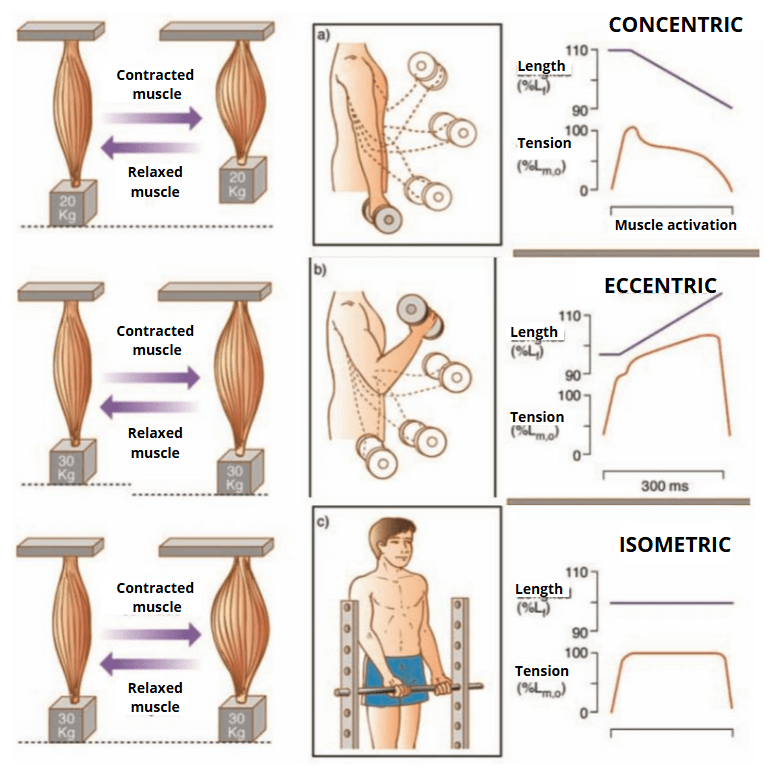
Eccentric contraction produces greater muscle tension because the elastic elements add passive tension to active contractile activity, and therefore, it is capable of exerting a useful force greater than concentric and isometric actions. The number of motor units involved in this type of contraction is less; hence the surface electrical activity in this type of contraction is clearly inferior to other methods.
Since the number of motor units involved is less, the intensity of these has to be greater to produce movement. In this way, ECCENTRIC CONTRACTIONS generate biological adaptations in muscle fibers and motor units that are superior to other types of contraction.
Directly related to the type of contraction is the ability of a muscle to generate force throughout the entire range of motion, muscle length being directly related to muscle tension (Length-tension relationship) and energy expenditure.
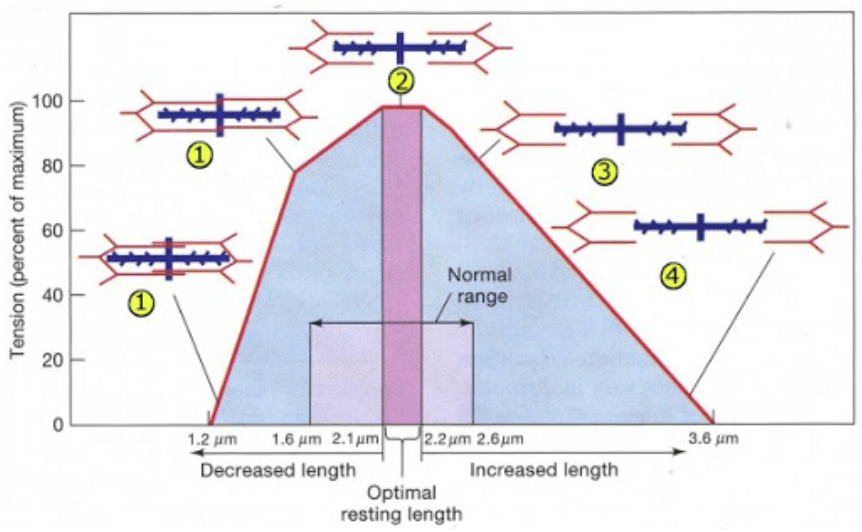
Likewise, the duration of the contraction will also determine the associated energy expenditure:
- Greater eccentric component and/or shorter duration of contraction = lower associated energy expenditure. This is precisely due to the energy stored by the passive elements, titin and nebulin, of the sarcomeres of the muscle fibers and that facilitates eccentric actions energetically speaking. It is estimated that an eccentric contraction requires about 40% more energy than a concentric contraction for the same weight used.
- Higher maximum isometric component and/or longer duration of contraction near the point of greatest mechanical disadvantage = more associated energy expenditure.
According to the will of the subject, a contraction can be isometric before a maximum load (sending the greatest number of nerve impulses and with the greatest possible intensity) or submaximal (not sending the greatest number of nerve impulses possible or with the greatest intensity). The more maximal isometric character a contraction has, the greater energy expenditure is associated with it compared to any other type of contraction for the same time under tension.

Bibliographic references:
- Marchante D. (2020). Physiology of exercise and muscle hypertrophy. Basic concepts [PDF file]. Recovered from https://universidadpowerexplosive.com/
- Chicharro, J. L., & Vaquero, A. F. (2006). Fisiología del ejercicio. Madrid. Ed. Médica Panamericana.
- González-Badillo, J.J., Ribas, J.J. (2002). Bases de la Programación del entrenamiento de fuerza. Barcelona: Ed. Inde Publicaciones.
- Herzog, W., Powers, K., Johnston, K., & Duvall, M. (2015). A new paradigm for muscle contraction. Frontiers in physiology, 6. https://doi.org/10.3389/fphys.2015.00174
- Menard, M. R., Penn, A. M., Lee, J. W., Dusik, L. A., & Hall, L. D. (1991). Relative metabolic efficiency of concentric and eccentric exercise determined by 31P magnetic resonance spectroscopy. Archives of physical medicine and rehabilitation, 72(12), 976-983. https://doi.org/10.5555/uri:pii:000399939190139A
 ATLETA EXPLOSIVO
Leave a comment