
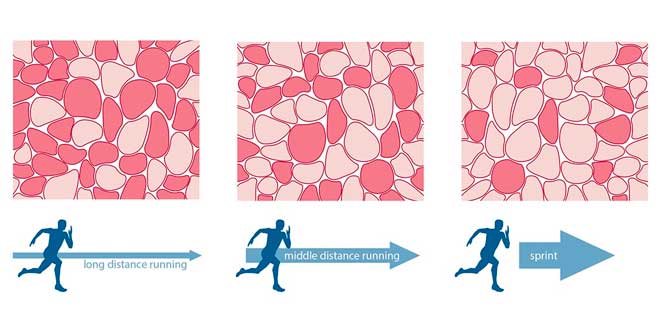
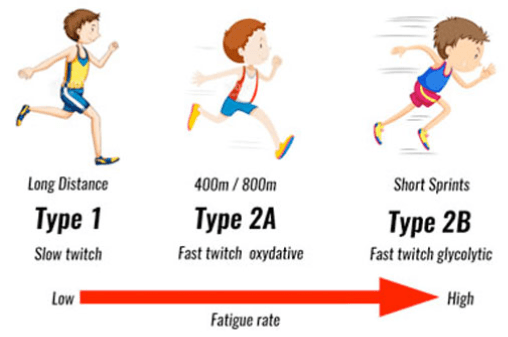
Skeletal muscle is a tissue capable of making a wide range of functional demands, from performing highly precise movements for which little force is required, to maximum contractions, to maintaining the body’s posture. This versatility is due, in part, to the existence of several types of muscle cells or fibers, which have different functional, metabolic and molecular characteristics.
Different types of fibers are found in varying proportions within each muscle. Thus, each of them is a mosaic with different proportions of the different types of fibers, which gives it special properties and a perfect adaptation to the functional task for which it is intended.
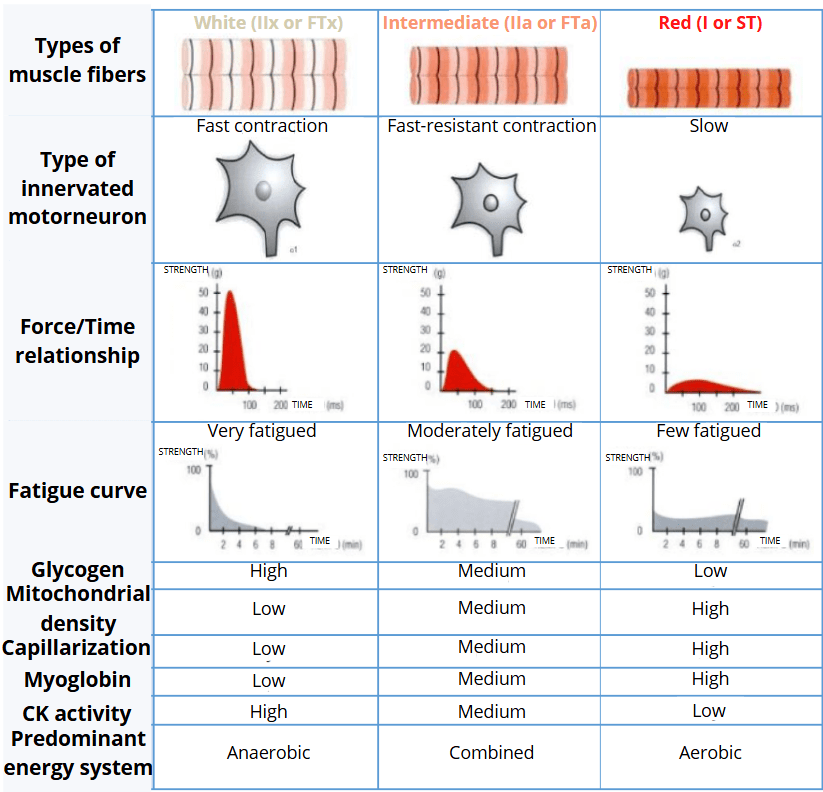
Currently, the classification of muscle fibers is carried out according to the type of myosin (MHC) present in the cell and the rate of shortening of the fiber. Three types of myosin are present in humans:
- MHC-I
- MHC-IIa
- MHC-IIx
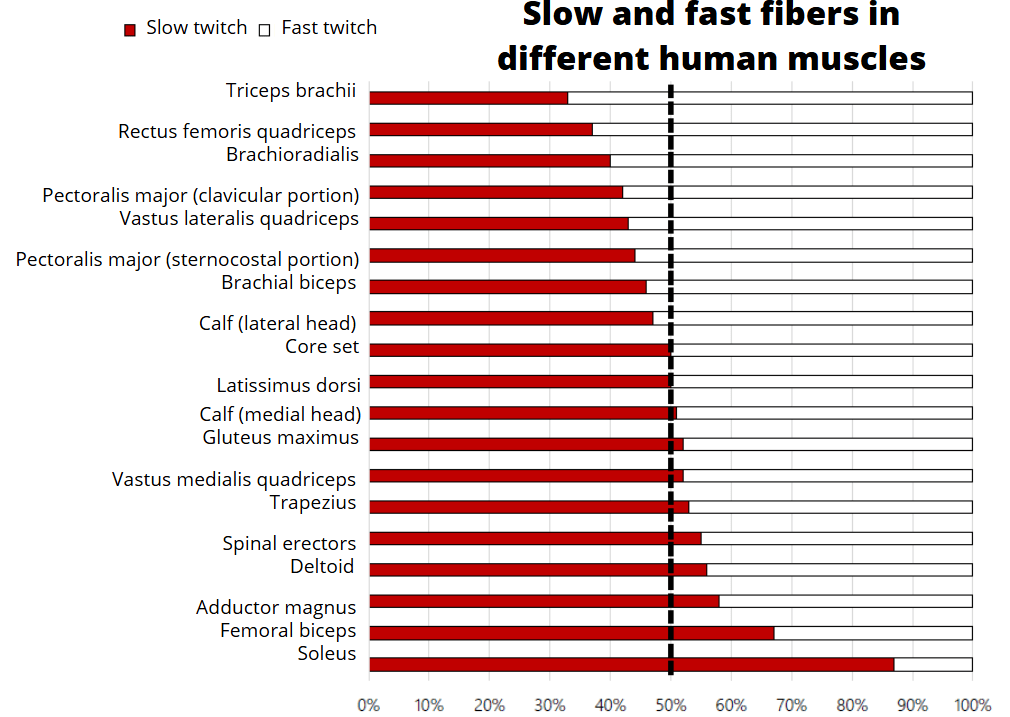
In some muscle groups, one or other types of muscle fibers are more present, which means that some are slower contracting (they have a higher proportion of type I fibers), such as the soleus, while others are faster contracting (have a high proportion of type II fibers), such as the triceps brachii.

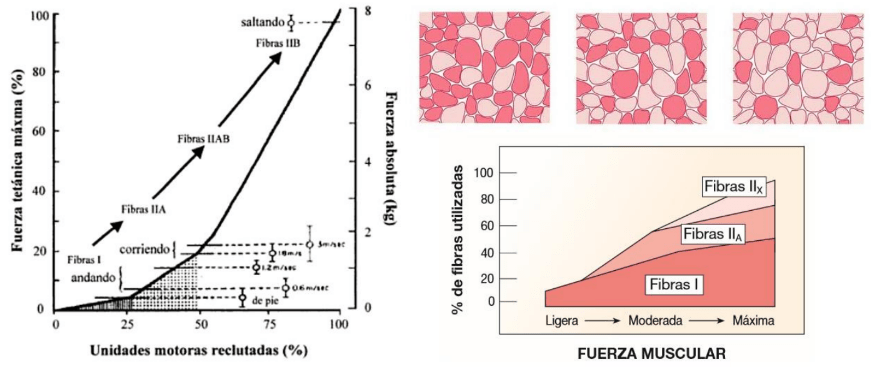
The recruitment of different types of muscle fibers occurs according to Henneman’s Principle, which states that both the intensity of the muscle contraction force and the speed of shortening are directly related to the magnitude of the neural signal sent.
In addition to the magnitude of the neural signal, the duration of the neural signal is also thought to be important. The longer the duration of the neural signal, the longer the motor units and, consequently, the recruited muscle fibers will remain active, thus producing force for a longer period of time and generating a greater energy expenditure per unit of time.
Bibliographic references:
- Marchante D. (2020). Physiology of exercise and muscle hypertrophy. Basic concepts [PDF file]. Recovered from https://universidadpowerexplosive.com/
- Chicharro, J. L., & Vaquero, A. F. (2006). Fisiología del ejercicio. Madrid. Ed. Médica Panamericana.
- Vived, À. M. (2005). Fundamentos de fisiología de la actividad física y el deporte. Madrid. Ed. Médica Panamericana.
- Johson, M.A., Polgar, J., Weightman, D., & Appleton, D. (1973). Data on the distribution of fibre types in thirty-six human muscles: an autopsy study. Journal of the neurological sciences, 18(1), 111-129. https://doi.org/10.1016/0022-510X(73)90023-3
- Henneman, E., Somjen, G., & Carpenter, D. O. (1965). Functional significance of cell size in spinal motoneurons. J neurophysiol, 28(3), 560-580. https://doi.org/10.1152/jn.1965.28.3.560
 ATLETA EXPLOSIVO
Leave a comment