
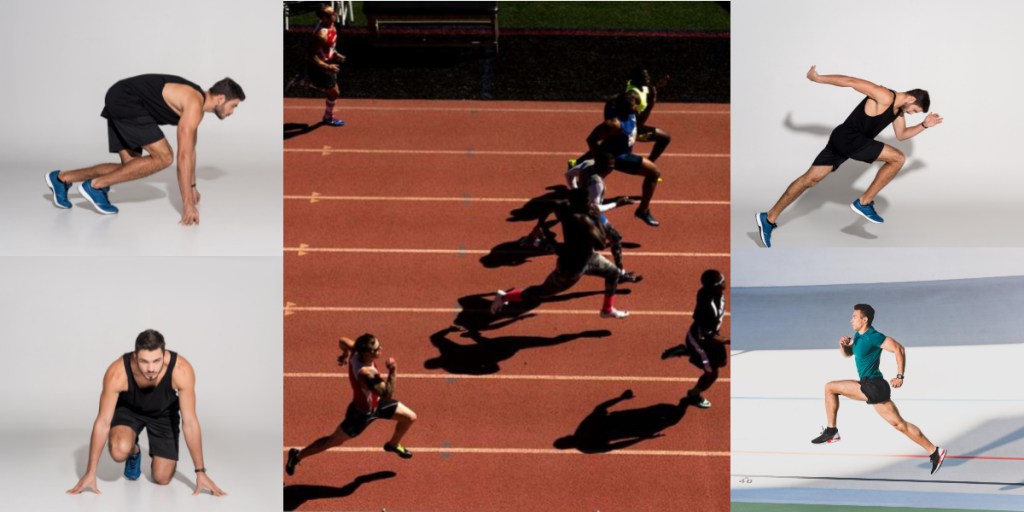
The 100 meter dash race is the most popular event in track and field and to be successful in it, apart from having a very refined sprint technique and high levels of explosiveness, it is necessary to understand how the evolution of the race is throughout its course. All of this is conditioned because it is a trial whose predominant metabolic system is mainly alactic anaerobic.
In this metabolism, ATP, a molecule necessary for muscle contraction of the white or fast fibers, is obtained immediately without going through intermediate processes since it is synthesized instantly from the phosphates that are stored in the creatine reserves of the muscle in the form of phosphocreatine. There is obviusly a limit of effectiveness in the functioning of this metabolic system and there will come a time when all these phosphate reserves contained in creatine are depleted, which happens after about 8 to 10 seconds after performing a physical activity at maximum intensity. And in the case of elite sprinters, this time allows them to run the entire distance of 100 meters or a very good part of it, taking advantage of obtaining ATP instantly.
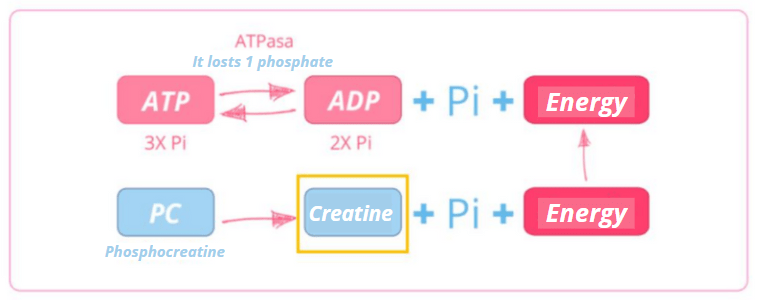
In this way, during the 100 meter dash race we can distinguish the following phases:
- Reaction speed
- Acceleration
- Top speed
- Speed endurance
The reaction speed phase is the only one that depends entirely on the nervous system and corresponds to the block start after the starting shot. It consists of the speed of transmission of nervous signals after reacting to a sound stimulus (the shot that indicates the output signal), with the aim of activating the muscles that are required for the body to move into locomotion. This nervous transmission occurs in two senses:
- First at a sensory level, the signal travels from the receptors of the hearing organ to the cerebral cortex;
- And secondly at the motor level, the signal that gives the order for the target muscles to contract travels from the cerebral cortex.
The stimulus can also be visual in the case of a player who accelerates in the context of a team sport such as football or basketball.
The reaction speed has a very high genetic component due to the fact that it depends completely on the proper functioning of the nervous system. For this reason, although it is possible to train this type of speed, its margin for improvement is very narrow.
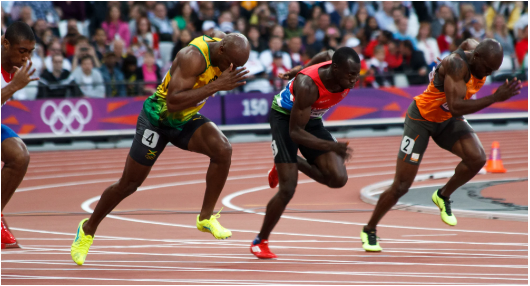
Having a good reaction speed is very important to achieve a good start and quick acceleration, but it is not the most important factor in determining success in the 100-meter dash race. In fact, the best sprinter of all time, Usain Bolt, was not always characterized by being one of the competitors with a fast reaction speed.
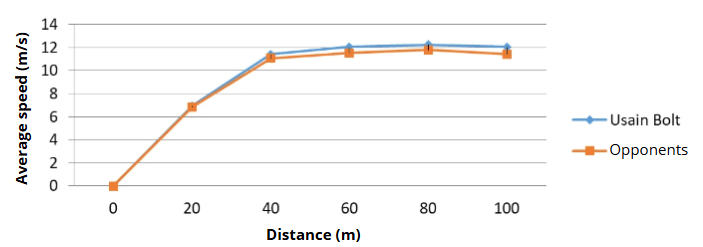
The acceleration phase is the most important of the entire 100 meter dash test and consists of increasing speed as quickly as possible, going from a static position on the blocks until reaching the maximum speed that the athlete can develop. In amateur sprinters, acceleration occurs around the first 40 meters of distance, but in the case of elite sprinters it lasts up to the first 60 meters.
In the top speed phase the sprinter reaches his maximum peak speed once he barely stops accelerating. In this phase the athlete runs almost at a constant speed in the form of a plateau that remains around 20 meters.
The speed endurance phase is characterized because inevitably in the last section of the test there is a loss of speed that occurs in the form of deceleration or negative acceleration. In the case of elite sprinters, the decrease in speed takes place after 80 meters of distance and is milder when compared to amateur sprinters, so it does not have a great impact on the development of the race. It should be noted that in the case of Usain Bolt, who like everyone else also goes through this phase of speed reduction, it is barely perceptible that one could almost say that it does not exist and he is capable of reaching the finish line practically at the top speed he has reached.
From this analysis of all the phases that characterize the evolution of the 100-meter dash race, the main conclusion can be drawn that what is important is to maximize the speed-acceleration phase as much as possible and minimize the speed resistance phase as much as possible. This is how a sprinter will be able to perform with maximum efficiency throughout the race. And that’s how it happens for elite sprinters.

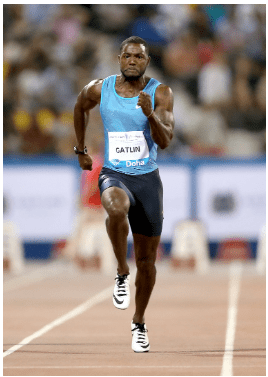
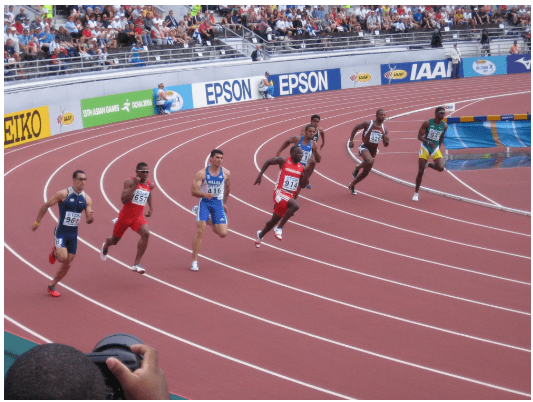
Doha Stadium Plus Qatar from Doha, Qatar, CC BY 2.0, via Wikimedia Commons

And to finish this article, I will comment on two specific situations to complement all of the above.
In the case of the 200 and 400 meter sprint trials, after passing the first 100 meters of distance, the energy metabolic system that predominates becomes the anaerobic lactic system or anaerobic glycolysis, as a consequence of having depleted all phosphates stored in creatine. In this type of metabolic pathway, two ATP molecules are synthesized and lactate and H+ are generated as byproducts, the latter molecules being responsible for altering the environment in the muscle and causing the sensation of fatigue to progressively appear. The synthesis of ATP occurs after a series of intermediate reactions, making anaerobic glycolysis a slower metabolic route, but not as slow as in the case of aerobic glycolysis.
Zen, CC BY-SA 2.5, via Wikimedia Commons
Running at high speed is not something that only happens in athletics. In many team sports, athletes also have to put this skill into action as a result of the demands of different game situations. The main difference with respect to the 100-meter dash race is that, apart from the fact that the start occurs in a standing position and the trajectory is not always linear, not all the phases described above occur. The fact that the game court distances are not long enough does not allow all phases of the sprint race to take place. Just the reaction speed and acceleration speed. Therefore, practitioners of these sports should focus on training more the ability to accelerate and not top speed because the latter will never take place in the competition. Another detail worth highlighting is that in collective and situational sports, many accelerations are carried out throughout the duration of the game, which implies that players must develop the ability to accelerate under conditions of fatigue without maximizing the loss of quality in this skill over time.

Bibliographic references:
- Baggett, K. (2006). The Ultimate No-Bull Speed Development Manual.
- Hansen, T. (2012). The Speed Encyclopedia. Reno Speed School.
 ATLETA EXPLOSIVO
Leave a comment